Mass gatherings, erosion of trust upend coronavirus control

Advertisement

Advertise with us

NEW YORK - Protests erupting across the nation over the past week — and law enforcement's response to them — are threatening to upend efforts by health officials to track and contain the spread of coronavirus just as those efforts were finally getting underway.

Read this article for free:


or

Already have an account? Log in here »

To continue reading, please subscribe:

Subscribe and receive a limited-edition Free Press branded hat or tote.

Digital Subscription

One year of digital access for only $205*

  • Enjoy unlimited reading on winnipegfreepress.com
  • Read the E-Edition, our digital replica newspaper
  • Access News Break, our award-winning app
  • Play interactive puzzles

*First annual payment billed as $205.00 + GST for one year. This annual subscription will automatically renew at $233.00 + GST every 52 weeks (10% off the regular annual price of $259.35). Offer available to new and qualified returning subscribers only. Cancel any time.

To continue reading, please subscribe:

Add Free Press access to your Brandon Sun subscription for only an additional

$1 for the first 4 weeks*

  • Enjoy unlimited reading on winnipegfreepress.com
  • Read the E-Edition, our digital replica newspaper
  • Access News Break, our award-winning app
  • Play interactive puzzles
Start now

*Your next Brandon Sun subscription payment will increase by $1.00 and you will be charged $17.95 plus GST for four weeks. After four weeks, your payment will increase to $24.95 plus GST every four weeks.

Hey there, time traveller!
This article was published 01/06/2020 (2280 days ago), so information in it may no longer be current.

NEW YORK – Protests erupting across the nation over the past week — and law enforcement’s response to them — are threatening to upend efforts by health officials to track and contain the spread of coronavirus just as those efforts were finally getting underway.

Health experts need newly infected people to remember and recount everyone they’ve interacted with over several days in order to alert others who may have been exposed, and prevent them from spreading the disease further. But that process, known as contact tracing, relies on people knowing who they’ve been in contact with — a daunting task if they’ve been to a mass gathering.

And the process relies on something that may suddenly be in especially short supply: Trust in government.
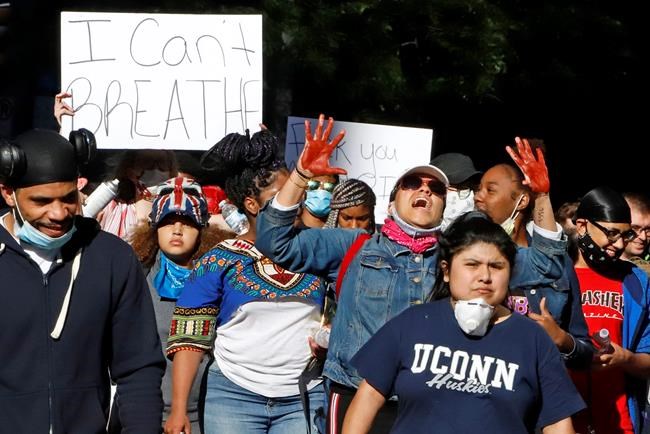
A group marches through the streets of downtown Pittsburgh Sunday, May 31, 2020 protesting the death of George Floyd, who died after being restrained by Minneapolis police officers on Memorial Day, May 25. (AP Photo/Gene J. Puskar)

“These events that are happening now are further threats to the trust we need,” said Dr. Sandro Galea, dean of the Boston University School of Public Health. “If we do not have that, I worry our capacity to control new outbreaks becomes more limited,” he said.

Government officials have been hoping to continue reopening businesses, churches and other organizations after months of stay-at-home orders and other infection-prevention measures. But health experts also hoped that any reopening would be accompanied by widespread testing, contact tracing and isolation to prevent new waves of illness from beginning.

Over the past week, protests sparked by the death of George Floyd, a black man who died after a white Minneapolis police officer pinned a knee to his neck, have involved thousands of people gathered tightly together in large crowds in more than 20 cities nationwide.

It’s unclear if the protests themselves will trigger large new outbreaks. The protests were outside, where infections don’t spread as readily as indoors. Also, many of the protesters were wearing masks, and much of the contact was likely less-hazardous “transient” moments of people moving around, passing each other, said Dr. William Schaffner, an infectious diseases expert at Vanderbilt University.

But, still, experts worry that public efforts to contain the disease in the future could be undermined.

In Los Angeles, the city’s mayor announced Saturday that COVID-19 testing centres were being closed because of safety concerns related to violent protests. Testing in Minneapolis will be affected because some of the clinics that provide the service have been damaged in the protests, according to a city government spokesperson.

Reduced testing could “be giving the virus another head start,” Schaffner said.

And contact tracing, which is only just getting going in several states, is an even bigger concern. It involves people who work for or with health departments asking intimate questions about where a person has been and who they’ve been talking to — and getting full, truthful answers in return.

“In this current environment which has enhanced or brought forth a mistrust of governmental authority, it might make them disinclined to speak with anyone in government,” Schaffner said.
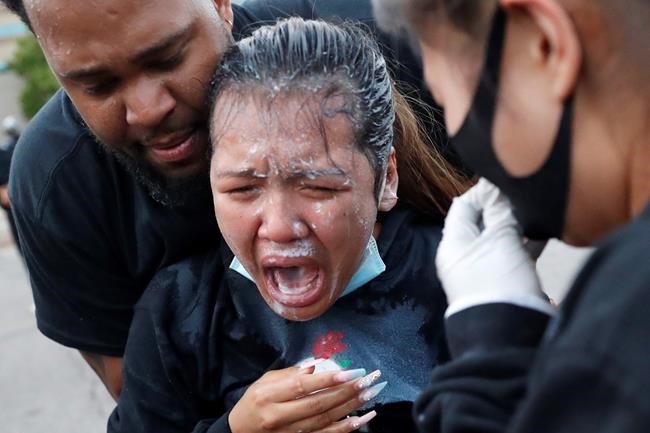
A woman is helped after being hit with pepper spray after curfew on Sunday, May 31, 2020 in Minneapolis. Protests continued following the death of George Floyd, who died after being restrained by Minneapolis police officers on Memorial Day. (AP Photo/John Minchillo)

That is especially true in black communities trying to cope with episodes of police violence and longstanding frustrations with how they have been marginalized and mistreated by people who work for government agencies. And those are the communities that have been hardest hit by the coronavirus in the U.S. and most in need of public health measures to help control it.

Protests in Salt Lake City that drew several thousand people are a setback for contact tracers already struggling to contain the spread of the coronavirus, said Tair Kiphibane, infectious disease bureau manager for the Salt Lake County Health Department.

She became concerned as she watched hundreds of protesters go by her downtown Salt Lake City office Saturday afternoon where she and her staff were working another weekend day after seeing increases in COVID-19 cases last week.

She sent contact tracers home three hours early Saturday as protests grew violent near the office. She expects further increases in cases because so many people were close to one another during the protest. Tracing the web of infected people that may have been exposed will be daunting since protesters likely won’t have names and phone numbers for many of the people they were around.

“It is going to make it so much harder,” Kiphibane said. “It could be anybody. They don’t know most of those people … It is just too many people.”

In a press conference Saturday, Minnesota Public Safety Commissioner John Harrington used the term “contact tracing” when describing an investigation into arrested protesters there. He said the goal is to “see if there are crime or white supremacy organizations that have played a role” and “to understand how do we go after them, legally,” Harrington said.

But Harrington’s use of “contact tracing” by law enforcement may complicate the job of health workers as they try to track the virus’s spread, some experts said.

“That was an abuse of the word ‘contact tracing.’ That is not what contact tracing is,” said Dr. Tom Frieden, former director of the federal Centers for Disease Control and Prevention.

“Contact tracing is a service to patients and their contacts to provide services for patients and warning for contacts. It has nothing to do with police activity. Nothing,” said Frieden, who is now president of Resolve to Save Lives, a non-profit that works to prevent epidemics.
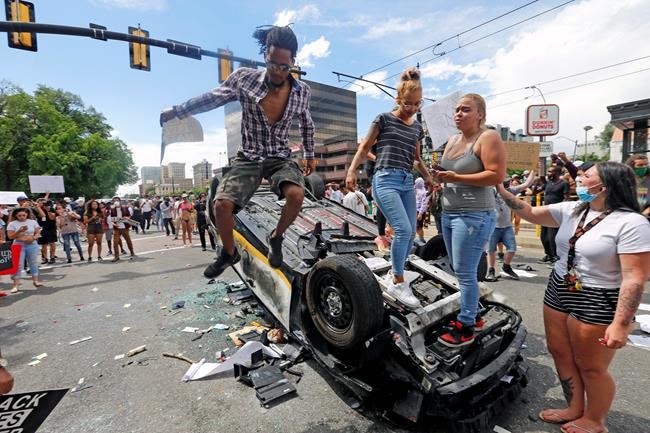
FILE - in this Saturday, May 30, 2020 file photo, protesters climb on a flipped over police vehicle, in Salt Lake City. Protests in Salt Lake City that drew several thousand people are a setback for contact tracers already struggling to contain the spread of the coronavirus, said Tair Kiphibane, infectious disease bureau manager for the Salt Lake County Health Department. (AP Photo/Rick Bowmer, File)

Galea said he hopes many people will separate in their minds the contact tracing done by public health workers from crime investigations by the police. But, he added, “I do think sometimes it’s difficult to make a distinction when you feel marginalized by, and targeted by, the entire government.”

___

Associated Press writer Brady McCombs contributed to this report in Salt Lake City.

___

The Associated Press Health and Science Department receives support from the Howard Hughes Medical Institute’s Department of Science Education. The AP is solely responsible for all content.

Report Error Submit a Tip

More Stories

Heart and soul of a neighbourhood

Melissa Martin 16 minute read Preview

Heart and soul of a neighbourhood

Melissa Martin 16 minute read Thursday, Jun. 24, 2021

Every morning on her way to work, Mel Prociuk clambers up the scaffold that hugs the spire jutting up from the east side of Augustine United Church. The metal and plywood steps clang as she rises above the trees, above the roofs of Osborne Village, and into the blue Prairie sky.

From the tip of the steeple, 46 metres above River Avenue the city splays out a blanket of leafy green, pierced by the blocky tops of nearby apartment towers. Across the river, the Golden Boy turns its back towards the church, which was already 15 years old when that statue first raised its torch atop the legislature dome.

For the two months they've been working to paint and restore the steeple, Prociuk and her Valour Decorating co-worker Lindsay Nakonechny have liked to sip their morning coffee up there, enchanted by the view, unfazed by the height. You can see the whole city from up there, Prociuk says, an incredible sight.

"It's a once-in-a-lifetime opportunity... you're never going to be that high again," Prociuk says, squatting on a plywood platform about five storeys up the church's elegant limestone face. "You can see all the green, all the beautiful buildings all around."

Read
Thursday, Jun. 24, 2021

Widow on mission to improve mental-health supports for law-enforcement officers, families

Chris Kitching 5 minute read Preview

Widow on mission to improve mental-health supports for law-enforcement officers, families

Chris Kitching 5 minute read Wednesday, Aug. 17, 2022

Stacia Franz is honouring her late husband’s life and legacy by seeking to ensure no law enforcement officer suffers in silence and no other spouse is widowed at 36.

Read
Wednesday, Aug. 17, 2022

One family passes trapping knowledge through three generations

Story and photography by Mikaela Mackenzie / Winnipeg Free Press 5 minute read Preview

One family passes trapping knowledge through three generations

Story and photography by Mikaela Mackenzie / Winnipeg Free Press 5 minute read Tuesday, Mar. 23, 2021

Snow falls softly over a muted landscape of boreal forest, rock ridges, spruce swamps and beaver ponds. This 60-square-kilometre area of land in the southwest corner of Whiteshell Provincial Park is the Imrie family trapline; they are designated to trap and manage the populations of fur-bearing animals.

Right now, three generations of Imries — Murray, 72, Devin, 36, and five-year-old Thomas — are gathered at a beaver house. Devin thumps a 1.5-metre-long ice chisel onto the surface of the pond, looking for the entrance of the lodge (the movement of the beavers swimming back and forth below weakens the surface). Thomas climbs onto the pile of sticks and brush with his grandpa, and the two dig through the snow to find the breathing hole. Hot air and a thick, musky smell means that the beavers are active here this winter.

The scene could have taken place a century earlier. Other than the snowmobiles parked nearby, the process hasn’t changed much over the years. Devin cuts a hole in the ice, chops down a long, thin tree to serve as a pole for holding the traps under the water, and then gets to work setting them. They are wire “conibear” style traps, orange with rust after many seasons of use, designed to snap around the animals’ neck or body, killing them instantly.

Murray explains the beavers have already eaten all of the poplar in the area, which is their preferred food source, and have moved onto birch and spruce. If the going gets really rough, the rodents might even resort to eating cattail tubers to make it through the winter. A twig of poplar, scratched to simulate tooth marks, is stuck into the trap as bait. “We’re going to have a beaver probably in less than two days,” crows Thomas.

Read
Tuesday, Mar. 23, 2021

Mass gatherings, erosion of trust upend coronavirus control

Mike Stobbe, The Associated Press 6 minute read Preview

Mass gatherings, erosion of trust upend coronavirus control

Mike Stobbe, The Associated Press 6 minute read Monday, Jun. 1, 2020

NEW YORK - Protests erupting across the nation over the past week — and law enforcement's response to them — are threatening to upend efforts by health officials to track and contain the spread of coronavirus just as those efforts were finally getting underway.

Health experts need newly infected people to remember and recount everyone they've interacted with over several days in order to alert others who may have been exposed, and prevent them from spreading the disease further. But that process, known as contact tracing, relies on people knowing who they’ve been in contact with — a daunting task if they’ve been to a mass gathering.

And the process relies on something that may suddenly be in especially short supply: Trust in government.

“These events that are happening now are further threats to the trust we need,” said Dr. Sandro Galea, dean of the Boston University School of Public Health. “If we do not have that, I worry our capacity to control new outbreaks becomes more limited,” he said.

Read
Monday, Jun. 1, 2020

City advised 275 people in 72 camps as of July

Joyanne Pursaga 5 minute read Preview

City advised 275 people in 72 camps as of July

Joyanne Pursaga 5 minute read 5:49 PM CDT

A tally by the City of Winnipeg shows the number of people in encampments has fallen by a few hundred since last September.

A Friday presentation to city council members shows 245 people lived in 72 encampments across the city in July, compared with about 100 encampments with 700 people in September 2025.

“There’s some good progress that’s being made … The number of people in encampments is less than half of what it was last year,” said Mayor Scott Gillingham.

The city did not provide numbers for July 2025. It has previously noted the number of encampments tends to increase in warmer months, which has happened each month since February 2026.

Read
5:49 PM CDT

Police investigate after three sent to hospital in North End blaze

Morgan Modjeski 5 minute read Preview

Police investigate after three sent to hospital in North End blaze

Morgan Modjeski 5 minute read 11:53 AM CDT

Three people were sent to hospital and a criminal investigation is underway after a historical home in the St. John’s neighbourhood was severely damaged by fire.

Fire crews were called to the blaze at 344 St. Johns Ave. at 10:16 p.m. on Thursday, the city said Friday.

Michael Block, who lives across the street, told the Free Press his wife called 911 after he and his son realized the house was ablaze.

“We heard some yelling from inside the house and then my son looked out the window and he could see fire coming out of the second-storey window,” Block said. “We went out (and) there was a gentleman who had walked out of the house, who was underneath that tree right there … and his pants were still on fire.”

Read
11:53 AM CDT