In rural U.S., fears of virus seem far away as stores reopen

Advertisement

Advertise with us

ROUNDUP, Mont. - Traffic got a little busier along Main Street, but otherwise, it was hard to tell that coronavirus restrictions were ending in the tiny Montana town of Roundup.

Read this article for free:


By clicking the button above, an account will be created and you will begin to receive some of our recommended newsletters. You may opt out of any newsletter by visiting your Email and Communication Preferences page or by clicking "unsubscribe" at the bottom of any email.

or

Already have an account? Log in here »

To continue reading, please subscribe:

Digital Subscription

One year of digital access for only $1.44 a week*

  • Enjoy unlimited reading on winnipegfreepress.com
  • Read the E-Edition, our digital replica newspaper
  • Access News Break, our award-winning app
  • Play interactive puzzles

*Billed as $5.77 plus GST every four weeks. After 52 weeks, price increases to the regular rate of $19.95 plus GST every four weeks. Offer available to new and qualified returning subscribers only. Cancel any time.

To continue reading, please subscribe:

Add Free Press access to your Brandon Sun subscription for only an additional

$1 for the first 4 weeks*

  • Enjoy unlimited reading on winnipegfreepress.com
  • Read the E-Edition, our digital replica newspaper
  • Access News Break, our award-winning app
  • Play interactive puzzles
Start now

*Your next Brandon Sun subscription payment will increase by $1.00 and you will be charged $17.95 plus GST for four weeks. After four weeks, your payment will increase to $24.95 plus GST every four weeks.

Hey there, time traveller!
This article was published 28/04/2020 (2377 days ago), so information in it may no longer be current.

ROUNDUP, Mont. – Traffic got a little busier along Main Street, but otherwise, it was hard to tell that coronavirus restrictions were ending in the tiny Montana town of Roundup.

That’s because it’s largely business as usual in the town of 1,800 people. Nonessential stores could reopen as a statewide shutdown ended this week, but most shops in Roundup — the pharmacy, the hardware store, two small grocers — were essential and never closed.

A florist and a thrift shop reopened Monday, apparently two of the only stores that had to shut down at all. Bars and restaurants remain shuttered and getting takeout is still the only option until May 4, when they can open with restrictions.

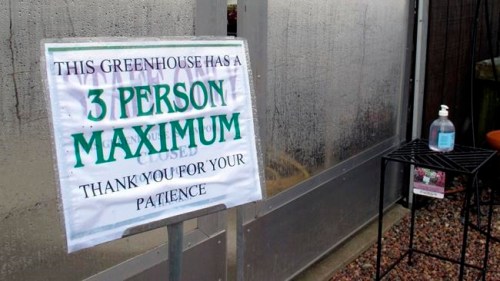
In this Monday, April 27, 2020, photo, with a bottle of hand sanitizer in the background, a sign limits the number of shoppers in the greenhouse of Evergreen Gardens of Vermont in Waterbury Center, Vt. Monday was the the first day businesses such as greenhouses and garden centers could allow a small number of customers inside as part of Vermont's gradual coronavirus pandemic reopening plan. (AP Photo/Wilson Ring)

Parts of the U.S. are starting to lift closures, and some of the quickest to do so have been rural states like Montana, Vermont and Alaska. The effects of the pandemic in small towns can seem a world away from cities grappling with overwhelmed hospitals, packed morgues and economies pushed to the brink.

The consequences of easing restrictions in rural communities won’t be fully known for some time, and health officials said they will be watching for a resurgence of infections.

But for now, there’s little doubt in places like Roundup that it was the right thing to do after weekslong stay-at-home orders.

“We don’t have the fear of the virus. It’s been more concern about our shut-ins and older people who can’t come out,” said Shannon Thompson, who works in the deli at Picchioni’s IGA supermarket and has two sons home with school still cancelled.

The coronavirus is largely a distant threat that so far has touched few people here directly. Face masks are a novelty, and greetings often still come with a handshake.

Despite some grumbling that the lockdown was too harsh, most people co-operated, county commissioner Adam Carlson said.

Thompson said she practices social distancing and “we’re all doing what we’re supposed to do.”

By contrast, in some rural parts of states where stay-at-home orders remain in place, local leaders have pledged defiance. The mayor of Grants, New Mexico, population 9,000, led a rally Monday where dozens urged nonessential businesses to reopen.

Only a fraction of people in the state have been infected by COVID-19, and it doesn’t make sense to keep small businesses closed, Mayor Martin “Modey” Hicks said. New Mexico has more than 2,800 confirmed cases of the virus and 104 deaths.

“The governor is killing the state over a little bug,” he said before heading to the city-owned golf course, where about 20 people were playing despite a warning by state police for the facility to close.

For most, the coronavirus causes mild or moderate symptoms, such as fever and cough. For some, especially older people and those with existing health problems, it can cause more severe illness, including pneumonia and death.

Tom Hagstrom mows the grass of St. Benedict's Catholic Church along Main Street in Roundup, Mont. on Monday, April 27, 2020. Most stores in the small town were considered essential businesses and stayed open despite a month-long closure order over the coronavirus that was lifted this week. (AP Photo/Matthew Brown)

In California, six rural counties with a combined 500,000 people asked Gov. Gavin Newsom on Monday if they could begin a “careful and phased reopening,” even as counties in the San Francisco Bay Area moved to extend their stay-at-home orders through May.

In small Alaska towns, some restaurants resumed dine-in service Friday, while shops, personal care services and other nonessential businesses reopened with limits. Rules still restrict how many people can be in a shop at once, and no waiting is allowed in salons.

In Vermont, people can shop at outdoor retailers, and five people can work at the same outdoor worksite. Manufacturing and indoor construction also can expand.

Mike MacLeod, who owns a garden centre just south of the resort town of Stowe, said the phone began ringing within minutes of the governor’s announcement Friday loosening the restrictions.

“People are getting into their gardens,” he said. “One of the things they can do is work on the gardens and beautify their houses.”

Being remote and sparsely populated helps towns avoid infections, said Dr. Marc Mentel, president of the Montana Medical Association.

Yet a rural ZIP code is no magic shield and carries its own disadvantage: fewer medical resources. That can make outbreaks difficult to contain, such as the infections that swept through an assisted living facility in recent weeks in another small Montana town, Shelby, leading to six deaths.

“No matter where you are, this is a dangerous virus,” Mentel said. “The risk is low, but if something takes off in rural America, it could be devastating.”

Gov. Steve Bullock credits an early lockdown with pushing down Montana’s infection rate and helping it reopen before other states.

“That’s what got us to this point, more than the rural nature of our state,” the Democratic governor said Monday.

Montana has one of the nation’s lowest per capita death rates from the virus. The rate of confirmed infections has declined since peaking at 124 cases a week in late March and early April. There were 15 new cases last week, health officials said.

Jerel Gustafson gives Caleb Brown his first haircut in over a month at Falls Barber Shop in downtown Great Falls, Mont., on Monday, April 27, 2020. Non-essential businesses like barber shops and boutiques are reopening this week after Governor Steve Bullock announced a tiered lifting of the stay-at-home order in response to the coronavirus. (Rion Sanders/The Great Falls Tribune via AP)

But not every business is throwing open its doors.

In Montana’s capital of Helena, the Lasso the Moon toy store was open, but its doors were locked. Customers had to knock to be let in, up to four at a time, as long as they were wearing masks.

Owner Amy Barrett said the door is locked to give employees time to don masks. Her wariness reflected the uncertainty of many small-business owners allowed to reopen.

“We’re still unsure quite how open to be,” Barrett said. “I don’t know how many people are going to want to come in.”

___

Hanson reported from Helena. Associated Press writers Wilson Ring in Montpelier, Vermont, and Russell Contreras in Grants, New Mexico, contributed to this report.

___

This story has been corrected to show Picchioni’s IGA supermarket was misspelled Picchinoni’s.

Report Error Submit a Tip

More Stories

Brian Bowman wins mayoral battle

Aldo Santin and Mary Agnes Welch 6 minute read Preview

Brian Bowman wins mayoral battle

Aldo Santin and Mary Agnes Welch 6 minute read Thursday, Oct. 23, 2014

In the end, it wasn’t even close.

A mayoral race that was supposed to be a head-to-head battle between privacy lawyer Brian Bowman and former NDP MP and MLA Judy Wasylycia-Leis turned into a rout on election night. Wasylycia-Leis, the experienced politician, had held what looked like an unassailable lead for months, but Bowman, the outsider who promised Winnipeggers a better, prosperous future, chipped doggedly away at it.

“I’m excited to tell you that positive change is coming to city hall,” Bowman told roaring supporters at the Inn At The Forks after making his way into the small ballroom accompanied by his wife and two young sons.

He said he hadn’t expecting such a landslide victory, but had believed that the campaign was building momentum.

Read
Thursday, Oct. 23, 2014

In rural U.S., fears of virus seem far away as stores reopen

Matthew Brown And Amy Beth Hanson, The Associated Press 7 minute read Preview

In rural U.S., fears of virus seem far away as stores reopen

Matthew Brown And Amy Beth Hanson, The Associated Press 7 minute read Tuesday, Apr. 28, 2020

ROUNDUP, Mont. - Traffic got a little busier along Main Street, but otherwise, it was hard to tell that coronavirus restrictions were ending in the tiny Montana town of Roundup.

That’s because it's largely business as usual in the town of 1,800 people. Nonessential stores could reopen as a statewide shutdown ended this week, but most shops in Roundup — the pharmacy, the hardware store, two small grocers — were essential and never closed.

A florist and a thrift shop reopened Monday, apparently two of the only stores that had to shut down at all. Bars and restaurants remain shuttered and getting takeout is still the only option until May 4, when they can open with restrictions.

Parts of the U.S. are starting to lift closures, and some of the quickest to do so have been rural states like Montana, Vermont and Alaska. The effects of the pandemic in small towns can seem a world away from cities grappling with overwhelmed hospitals, packed morgues and economies pushed to the brink.

Read
Tuesday, Apr. 28, 2020

Building healthier Canadians

Jason M. Sutherland 4 minute read 2:00 AM CDT

Ottawa is betting that billions of taxpayer dollars spent on steel, asphalt and concrete will secure Canada’s economic future and prosperity. Through the $51 billion Build Communities Strong fund, the federal government is paying for roads, bridges, water systems and transit to boost productivity and attract capital from Europe and Asia.

As the shovels hit the ground from Halifax to Vancouver, Canadians should be asking themselves: What good does it do to build a stronger country if we are not building healthier Canadians?

The fund’s $5 billion allocation for health infrastructure is welcome news, as many of our hospitals and long-term care homes across the country are showing severe signs of aging, and modern care centres are much needed. But pouring concrete for new facilities is not the same as building a healthy population.

A ribbon-cutting at a modern hospital does not guarantee you see a family doctor when you need one, keep a rural emergency department open overnight, or shorten the wait for a knee replacement keeping someone off the job or robbing a retiree of independence.

Kinew will listen to city request for new taxes — but no promises

Nicole Buffie 5 minute read Preview

Kinew will listen to city request for new taxes — but no promises

Nicole Buffie 5 minute read Friday, Nov. 1, 2024

Premier Wab Kinew remained coy about whether he would support a new municipal tax in Winnipeg as the city struggles to maintain services.

Kinew dodged questions on the matter Friday afternoon.

“We want to see services strong, we want to see roads getting fixed,” Kinew said. “Affordability is really top of mind … we got to keep life affordable for the average person out there.”

Some of the items being considered for a new tax are: alcohol, online deliveries, vehicle registration, vacant homes, commercial parking and land transfers with an exemption for first-time homebuyers.

Read
Friday, Nov. 1, 2024

Submit a news tip

1 minute read Monday, Mar. 16, 2026

Submit a news tip

Just say no (to deficits during good economic times)

Tom Brodbeck 5 minute read Preview

Just say no (to deficits during good economic times)

Tom Brodbeck 5 minute read Wednesday, Oct. 2, 2019

When a political party pledges to run small, “manageable” deficits if elected, it almost always means it will go deeper into the red if it wins government.

It’s human nature.

After all, as a government, if you get the blessing of the public to spend beyond your means, what’s a few billion more a year in overspending?

The problem is, it doesn’t usually end there. When those same politicians seek re-election, they often want permission to post even larger deficits. In some cases, they’ve abandoned the idea of balancing the books altogether, arguing perpetual deficit financing is acceptable, as long as the debt doesn’t exceed a certain percentage of the economy.

Read
Wednesday, Oct. 2, 2019