Canada’s Salvation Army testing out quicker tap-and-go option at kettle stations

Advertisement

Advertise with us

TORONTO - Canada's Salvation Army is testing out a new and faster way to allow cashless donations to its kettle stations via debit and credit card, making the process as quick and easy as dropping a toonie in the bubble.

Read this article for free:


or

Already have an account? Log in here »

To continue reading, please subscribe:

Subscribe and receive a limited-edition Free Press branded hat or tote.

Digital Subscription

One year of digital access for only $205*

  • Enjoy unlimited reading on winnipegfreepress.com
  • Read the E-Edition, our digital replica newspaper
  • Access News Break, our award-winning app
  • Play interactive puzzles

*First annual payment billed as $205.00 + GST for one year. This annual subscription will automatically renew at $233.00 + GST every 52 weeks (10% off the regular annual price of $259.35). Offer available to new and qualified returning subscribers only. Cancel any time.

To continue reading, please subscribe:

Add Free Press access to your Brandon Sun subscription for only an additional

$1 for the first 4 weeks*

  • Enjoy unlimited reading on winnipegfreepress.com
  • Read the E-Edition, our digital replica newspaper
  • Access News Break, our award-winning app
  • Play interactive puzzles
Start now

*Your next Brandon Sun subscription payment will increase by $1.00 and you will be charged $17.95 plus GST for four weeks. After four weeks, your payment will increase to $24.95 plus GST every four weeks.

Hey there, time traveller!
This article was published 15/11/2019 (2493 days ago), so information in it may no longer be current.

TORONTO – Canada’s Salvation Army is testing out a new and faster way to allow cashless donations to its kettle stations via debit and credit card, making the process as quick and easy as dropping a toonie in the bubble.

A pilot project starting Dec. 1 will allow donations at some kettle stations in the Greater Toronto Area to be made through a new tap-and-go machine that eliminates having to swipe a card or enter a cash amount or PIN.

The machine will be mounted on the side of kettle stands and have three discs to tap — one for a $5 donation, another for $10 and another for $20.
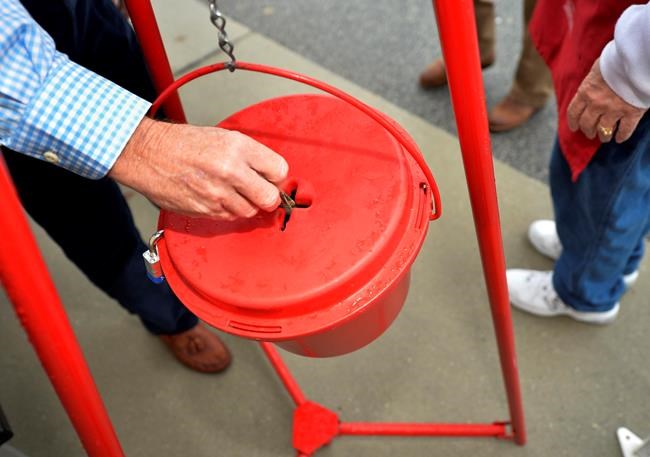
In this Nov. 9, 2018, file photo money gets dropped into the kettle during the Annual Salvation Army Red Kettle and Angel Tree Kick Off outside the Hobby Lobby store in Augusta, Ga. Canada's Salvation Army is testing out a new and faster way to allow cashless donations to its kettle stations via debit and credit card, making the process as quick and easy as dropping a toonie in the bubble. THE CANADIAN PRESS/AP-Michael Holahan/The Augusta Chronicle via AP, File

Those wanting to donate more can tap a disc up to 10 times.

The charitable organization has been offering debit and credit tap donation options during its annual Christmas Kettle Campaign for a couple of years across Canada now, but only through machines that require operator intervention.

Spokesman Maj. Rob Kerr says the new tap-and-go option will streamline the process and be as simple as walking up to the kettle, tapping, waiting for a beep confirming the transaction and leaving.

“We know of the folks who drop money in the kettle, one of the things that’s made it so appealing is that they can drop their cash in the bubble and just keep going,” Kerr said in a phone interview.

“It doesn’t slow them down from their busy day, and we just want to find technology that allows it to work that way, too.”

The new 30-by-30-centimetre tap-and-go machine is a red rectangle card mounted on the side of kettle stands.

It interfaces with Moneris Solutions Corp., a payments card processor.

Unlike the point-of-sale machines currently in use at kettle stations across Canada, the new tap-and-go option doesn’t require training or any action by those operating the stations.

The Salvation Army Christmas Kettle Campaign is already under way across Canada.

Kerr said the new pilot project will only be in certain locations in the GTA this year, but if successful, will expand to more locations next year.

Other cities in Canada can still donate at kettle stations via debit and credit on the regular point-of-sale machines this year.

And, of course, donors can still drop coins and bills into the kettle bubbles — a method Kerr said isn’t waning, despite our so-called cashless society.

“There’s some kind of a rewarding experience in dropping that cash in the bubble and seeing that happen,” Kerr said.

“So I’m not thinking we’re going to see a huge decline. We’re really hoping more and more that this is just going to enhance and augment those who are already giving cash.”

Kerr said Canada’s Salvation Army raised almost $23 million last year through the kettle campaign across the country.

He estimated that was up slightly over the year before. The Salvation Army has seen an increase in donations through the kettle campaign for the last couple of years now, he added.

This year’s donation goal for Canada is $23 million. Donations can also be made online.

“It’s amazing what people are giving to the Salvation Army still in cashless society,” Kerr said.

“They seem to have the loonies, toonies, fives and tens to drop in the bubble when they go by. And it continues to be a strong fundraiser for us.”

This report by The Canadian Press was first published Nov. 15, 2019.

Report Error Submit a Tip

More Stories

Scrounging bestie overdue for reality check

Maureen Scurfield 5 minute read Thursday, Sep. 10, 2026

DEAR MISS LONELYHEARTS: I’m almost 40, and one of my closest friends who was jobless for three years is once again earning decent money again — but she’s still acting like she’s broke!

I don’t care how people spend their money, but she still expects me to pay for her. For instance, if we go out for lunch, she’ll ask if we can do a 75-25 split, with her paying the lower amount. She also comes to potlucks with nothing to share, and then has the nerve to ask to take food home. She will also ask me to cover something and promise to pay me back, but then I have to hound her for weeks to get the money!

But it really took the cake recently when we went to a concert and she asked me to cover her ticket. Then she bought two T-shirts at the merch table! It feels underhanded to me — and insulting to my intelligence. It also feels weird to have to bring it up to her. We’ve been besties since high school —many, many years ago. Please help.

— Taking Advantage, Riverbend

Salvation Army testing tap-and-go donations

Victoria Ahearn, The Canadian Press 4 minute read Preview

Salvation Army testing tap-and-go donations

Victoria Ahearn, The Canadian Press 4 minute read Friday, Nov. 15, 2019

TORONTO - Canada's Salvation Army is testing out a new and faster way to allow cashless donations to its kettle stations via debit and credit card, making the process as quick and easy as dropping a toonie in the bubble.

A pilot project starting Dec. 1 will allow donations at some kettle stations in the Greater Toronto Area to be made through a new tap-and-go machine that eliminates having to swipe a card or enter a cash amount or PIN.

The machine will be mounted on the side of kettle stands and have three discs to tap — one for a $5 donation, another for $10 and another for $20.

Those wanting to donate more can tap a disc up to 10 times.

Read
Friday, Nov. 15, 2019

Is Trump about to poke Quebec’s political beehive?

Peter McKenna 5 minute read Preview

Is Trump about to poke Quebec’s political beehive?

Peter McKenna 5 minute read 2:00 AM CDT

When was the last time that a U.S. president seriously stirred the hornet’s nest of Quebec politics?

My best recollection is former U.S. president Bill Clinton. During the 1994 Quebec referendum campaign, Clinton made clear that the U.S. wholly endorsed a united and strong federal Canada — as opposed to a dismembered one. He went on to add that an independent Quebec would have no guarantee of joining the North American Free Trade Agreement as a full-fledged member.

Today, we see U.S. President Donald Trump inserting himself — unwittingly or wittingly — into the electoral and sovereignty politics of Quebec. It’s pretty clear that the resurgent Coalition Avenir Québec government is trying to make the Oct. 5 provincial election about anything other than its own governmental record and more about Trump’s economic coercion against Canada. Of course, the Parti Québécois, the odds-on-favourite, wants to make the electoral contest a referendum on the CAQ and its party leader, Christine Fréchette.

But what if Trump really wanted to make his presence felt in Quebec’s political life? How much influence could he have on shaping political outcomes in Quebec? How much of an “X factor” could he be?

Read
2:00 AM CDT

Media Literacy & Learning

0 minute read Tuesday, Oct. 28, 2025

Assisted living could alleviate ‘bed block’

Jesse Hajer and Tom Simms 5 minute read Yesterday at 2:00 AM CDT

There is a severe shortage of public and non-profit rent-geared-to-income/services-geared-to-income assisted-living housing for older adults in Manitoba. Seniors assisted living is a form of housing that includes rent, food, laundry and cleaning services.

Presently, the provincial government almost exclusively relies on the private market to provide assisted-living housing for seniors. Monthly private-market assisted-living housing rent for seniors ranges from $3,000 to $6,000 per month. The total income for an individual older adult receiving old age security (OAS) and guaranteed income supplement (GIS) pensions is less than $2,000 per month.

It is clear that low- and fixed-income seniors are not able to afford private-market assisted-living housing, resulting in the premature entry of these older adults into long-term care homes because seniors assisted-living housing is not publicly subsidized, whereas long-term care facilities do provide income-based subsidies.

Low- and fixed-income seniors are also experiencing a food affordability crisis which is negatively impacting their health and well-being. An enhanced assisted-living housing program that includes congregate meals would play an important role in addressing this growing affordability problem, along with reducing social isolation and loneliness.

Banjo Bowl a big deal for new and returning faces

Ken Wiebe 7 minute read Preview

Banjo Bowl a big deal for new and returning faces

Ken Wiebe 7 minute read Yesterday at 6:16 PM CDT

Kenneth Womack never doubted this day would come.

For all of the twists and turns along this journey, Womack believed in himself and the work he’s been putting in on the road to becoming a professional football player.

So, as the Winnipeg Blue Bombers receiver gets set to make his CFL on Saturday afternoon against the Saskatchewan Roughriders in the Banjo Bowl, you can be sure he’s going to take a moment to savour the experience while doing his best to make it feel like any other game he’s played previously.

“Once I run out the tunnel, it’s all going to sink in,” Womack said after Friday’s walkthrough.

Read
Yesterday at 6:16 PM CDT