Science Says: How daylight saving time affects health

Advertisement

Advertise with us

Office workers bemoan driving home in the dark. Night owls relish the chance to sleep in. As clocks tick toward the end of daylight saving time, many sleep scientists and circadian biologists are pushing for a permanent ban because of potential ill effects on human health.

Read this article for free:

or

Already have an account? Log in here »

To continue reading, please subscribe:

Subscribe and receive a limited-edition Free Press branded hat or tote.

Digital Subscription

One year of digital access for only $205*

  • Enjoy unlimited reading on winnipegfreepress.com
  • Read the E-Edition, our digital replica newspaper
  • Access News Break, our award-winning app
  • Play interactive puzzles

*First annual payment billed as $205.00 + GST for one year. This annual subscription will automatically renew at $233.00 + GST every 52 weeks (10% off the regular annual price of $259.35). Offer available to new and qualified returning subscribers only. Cancel any time.

To continue reading, please subscribe:

Add Free Press access to your Brandon Sun subscription for only an additional

$1 for the first 4 weeks*

  • Enjoy unlimited reading on winnipegfreepress.com
  • Read the E-Edition, our digital replica newspaper
  • Access News Break, our award-winning app
  • Play interactive puzzles
Start now

*Your next Brandon Sun subscription payment will increase by $1.00 and you will be charged $17.95 plus GST for four weeks. After four weeks, your payment will increase to $24.95 plus GST every four weeks.

Hey there, time traveller!
This article was published 31/10/2019 (2468 days ago), so information in it may no longer be current.

Office workers bemoan driving home in the dark. Night owls relish the chance to sleep in. As clocks tick toward the end of daylight saving time, many sleep scientists and circadian biologists are pushing for a permanent ban because of potential ill effects on human health.

Losing an hour of afternoon daylight sounds like a gloomy preview for the dark winter months, and at least one study found an increase in people seeking help for depression after turning the clocks back to standard time in November — in Scandinavia. Research shows the springtime start of daylight saving time may be more harmful, linking it with more car accidents, heart attacks in vulnerable people and other health problems that may persist throughout the time change.

Here’s what science has to say about a twice-yearly ritual affecting nearly 2 billion people worldwide.
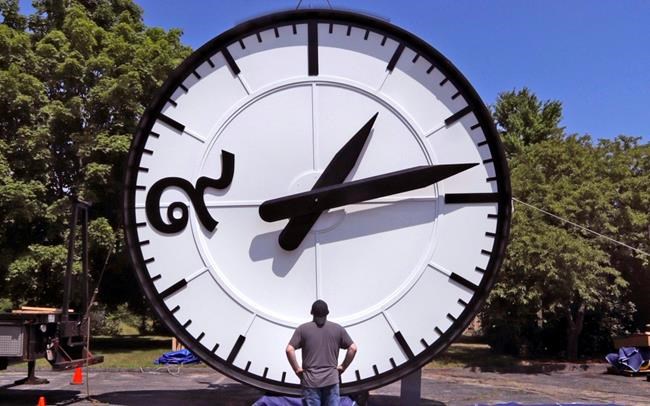
In this Thursday, July 25, 2019 photo, workers at the Electric Time Company in Medfield, Mass., test a 20 foot high clock, built for the a new train station in Bangkok, Thailand, prior to packing and shipment. The clock features a
In this Thursday, July 25, 2019 photo, workers at the Electric Time Company in Medfield, Mass., test a 20 foot high clock, built for the a new train station in Bangkok, Thailand, prior to packing and shipment. The clock features a "9" in Thai number script. Daylight saving time ends at 2 a.m. local time Sunday, Nov. 3, 2019, when clocks are set back one hour. Losing an hour of daylight sounds like a gloomy preview for the dark winter months, and at least one study found an increase in people seeking help for depression after turning the clocks back to standard time in November _ in Scandinavia. But far more research says that the springtime start of daylight saving time may be more harmful, linking it with more car accidents, heart attacks in vulnerable people and other health problems that may persist throughout the time change. (AP Photo/Charles Krupa)

SLEEP EFFECTS

Time changes mess with sleep schedules, a potential problem when so many people are already sleep deprived, says Dr. Phyllis Zee, a sleep researcher at Northwestern Medicine in Chicago.

About 1 in 3 U.S. adults sleep less than the recommended seven-plus hours nightly, and more than half of U.S. teens don’t get the recommended eight-plus hours on weeknights. One U.S. study found that in the week following the spring switch to daylight saving time, teens slept about 2 1/2 hours less than the previous week. Many people never catch up during the subsequent six months.

Research suggests that chronic sleep deprivation can increase levels of stress hormones that boost heart rate and blood pressure, and of chemicals that trigger inflammation.

HEART PROBLEMS

It has also been shown that blood tends to clot more quickly in the morning. These changes underlie evidence that heart attacks are more common in general in the morning, and may explain studies showing that rates increase slightly on Mondays after clocks are moved forward in the spring, when people typically rise an hour earlier than normal.

That increased risk associated with the time change is mainly in people already vulnerable because of existing heart disease, said Barry Franklin, director of preventive cardiology and cardiac rehabilitation at Beaumont Health hospital in Royal Oak, Michigan.

Studies suggest that these people return to their baseline risk after the autumn time change.

CAR CRASHES

Numerous studies have linked the start of daylight saving time in the spring with a brief spike in car accidents, and with poor performance on tests of alertness, both likely due to sleep loss.

The research includes a German study published this year that found an increase in traffic fatalities in the week after the start of daylight saving time, but no such increase in the fall.

Other studies on how returning to standard time in the fall might impact car crashes have had conflicting results.

OUR INTERNAL CLOCKS

Circadian biologists believe ill health effects from daylight saving time result from a mismatch among the sun “clock,” our social clock — work and school schedules — and the body’s internal 24-hour body clock.

Ticking away at the molecular level, the biological clock is entrained — or set — by exposure to sunlight and darkness. It regulates bodily functions such as metabolism, blood pressure and hormones that promote sleep and alertness.

Disruptions to the body clock have been linked with obesity, depression, diabetes, heart problems and other conditions. Circadian biologists say these disruptions include tinkering with standard time by moving the clock ahead one hour in the spring.

A mismatch of one hour daily is enough for ill effects, especially if it lasts for several months, according to Till Roenneberg, a circadian rhythm specialist at Ludwig-Maximilian University in Munich, Germany.

PRESSURE TO CHANGE

In the U.S., daylight saving time runs from the second Sunday in March to the first Sunday in November. It was first established 100 years ago to save energy. Modern-day research has found little or no such cost savings.

Federal law allows states to remain on standard time year-round but only Hawaii and most of Arizona have chosen to. Proposed legislation in several states would have them join suit — or switch to year-round daylight saving time, which would require congressional approval.

Roenneberg and Northwestern’s Zee are co-authors of a recent position statement advocating returning to standard time for good, written for the Society for Research on Biological Rhythms.

“If we want to improve human health, we should not fight against our body clock, and therefore we should abandon daylight saving time,” the statement says.

___

Follow AP Medical Writer Lindsey Tanner at @LindseyTanner.

___

The Associated Press Health and Science Department receives support from the Howard Hughes Medical Institute’s Department of Science Education. The AP is solely responsible for all content.

Report Error Submit a Tip

More Stories

Winnipeg-raised adventurer chronicles 6,400-km paddling expedition

Kittie Wong, Images courtesy of Jillian Brown 12 minute read Preview

Winnipeg-raised adventurer chronicles 6,400-km paddling expedition

Kittie Wong, Images courtesy of Jillian Brown 12 minute read Friday, Feb. 8, 2019

There are people who live life filled with curiosity and wanderlust in their hearts. Those two traits can lead a person into adventures, challenges and journeys the average person can only dream about. Winnipeg-raised photographer and adventurer Jillian Brown is one such person.

On April 28, 2018, she and fellow Canadian Martin Trahan set out on a 210-day, 7,600-km expedition to paddle across America by canoe, starting from the Pacific coast off Astoria, Ore., and finishing in the Florida Keys.

The expedition, dubbed Coursing Through America, was the result of Canoe & Kayak’s 2017 Dream Adventure Contest. It originally started as a four-person team with Trahan as its leader. But due to work complications for members of the original team, Trahan invited Brown, whom he had only known through her own paddling adventures via Instagram, to form a two-person paddling crew to tackle the expedition. They met in person for the first time three days before the start of the trip.

But 104 days into the journey, the Canadian duo parted ways to continue the expedition on their own. She arranged to have a kayak waiting for her in St. Louis and carried on travelling down the Mississippi River. Trahan followed the Atchafalaya River.

Read
Friday, Feb. 8, 2019

Palestinian Canadian stories belong

Isha Khan 5 minute read Saturday, Aug. 1, 2026

In June, the Canadian Museum for Human Rights opened a small exhibit focused on the human rights impacts of the forced displacement of Palestinians: infringements on their rights to life, education, equality, movement, and more.

Palestine Uprooted: Nakba Past and Present shares stories, memories and artifacts of Palestinian Canadians. It is on display in our Rights Today gallery, and that placement is intentional. It is a story unfolding before our eyes, demanding our attention.

The exhibit is also a reminder that behind every headline there are real people we must approach with empathy. Unfortunately, much of the coverage and commentary has failed to do that, often omitting Palestinian voices entirely.

Some of the dialogue, both critical and supportive, has contributed to the very things we need to resist — the dehumanization of one another, focusing on entrenched positions over dialogue and understanding.

Airport to delay capital projects as coronavirus shuts down travel

Martin Cash  5 minute read Preview

Airport to delay capital projects as coronavirus shuts down travel

Martin Cash  5 minute read Friday, Mar. 20, 2020

Like airports around the world, the global pandemic is gradually emptying out Winnipeg’s Richardson International Airport.

WestJet had announced it would suspend international and domestic flights as of Sunday night while Air Canada said it would gradually suspend the majority of its international and U.S. transborder flights by March 31.

As governments called for people to stop non-essential domestic travel, airlines slashed their schedules.

“It’s like slow rolling into quicksand,” said Barry Rempel, the CEO of Winnipeg Airports Authority, the not-for-profit entity that owns and operates the airport.

Read
Friday, Mar. 20, 2020

Doctor’s departure stressful for teen

Kevin Rollason 6 minute read Preview

Doctor’s departure stressful for teen

Kevin Rollason 6 minute read Sunday, Oct. 24, 2021

Morgan Walker is a typical teen — but only because a piece of his brain the size of a deck of cards was removed four years ago.

Walker, who had seizures multiple times a day before his surgery, fears other people might not be so lucky.

That’s because his surgeon, Dr. Demitre Serletis, is leaving the province and Health Sciences Centre. Serletis will start practising at the Cleveland Clinic in the new year.

“I was kind of shocked, but I understood why,” Walker said from his home in Brandon. “The government really hasn’t been respecting doctors.”

Read
Sunday, Oct. 24, 2021

SIU gives update on balcony death probe

Liam Casey, The Canadian Press 4 minute read Monday, Jun. 1, 2020

TORONTO - Ontario's police watchdog said Monday its investigators had spoken with all six officers who were at the home of a young Toronto woman before she fell off the balcony to her death.

A spokeswoman for the Special Investigations Unit said its team also found video security footage at the west-end building where Regis Korchinski-Paquet died last week.

Investigators have interviewed four other witnesses and are also set to interview Korchinski-Paquet's family this week, Monica Hudon said.

Korchinski-Paquet, 29, fell from a 24th-floor balcony last Wednesday while police were in her home. Her family has questioned the role of officers in her death.

‘Definitely a tough one’: Travel delays drag down Sea Bears in 114-90 loss to Vancouver Bandits

Joshua Frey-Sam 5 minute read Preview

‘Definitely a tough one’: Travel delays drag down Sea Bears in 114-90 loss to Vancouver Bandits

Joshua Frey-Sam 5 minute read Yesterday at 7:19 PM CDT

The Winnipeg Sea Bears will head into the playoffs on a disheartening note.

Winnipeg’s pro hoops squad had hoped to ride a wave of confidence into the Canadian Elite Basketball League post-season on the strength of locking up the top seed in the Western Conference.

Instead, the Sea Bears ended the regular season after being handed their worst defeat of the season, a 114-90 rout at the hands of the Vancouver Bandits at the Langley Events Centre in British Columbia on Sunday.

“Definitely a tough one, but we got a home game coming next week. Just get ready for that,” said Simon Hildebrandt, who was the only member of the Sea Bears available for a post-game interview.

Read
Yesterday at 7:19 PM CDT