‘Where people say goodbye… ‘

'Crypt Keeper' says needs of families top priority

Advertisement

Advertise with us

Dave Watts comes face-to-face with death every day.

Read this article for free:

or

Already have an account? Log in here »

To continue reading, please subscribe:

Subscribe and receive a limited-edition Free Press branded hat or tote.

Digital Subscription

One year of digital access for only $205*

  • Enjoy unlimited reading on winnipegfreepress.com
  • Read the E-Edition, our digital replica newspaper
  • Access News Break, our award-winning app
  • Play interactive puzzles

*First annual payment billed as $205.00 + GST for one year. This annual subscription will automatically renew at $233.00 + GST every 52 weeks (10% off the regular annual price of $259.35). Offer available to new and qualified returning subscribers only. Cancel any time.

To continue reading, please subscribe:

Add Free Press access to your Brandon Sun subscription for only an additional

$1 for the first 4 weeks*

  • Enjoy unlimited reading on winnipegfreepress.com
  • Read the E-Edition, our digital replica newspaper
  • Access News Break, our award-winning app
  • Play interactive puzzles
Start now

*Your next Brandon Sun subscription payment will increase by $1.00 and you will be charged $17.95 plus GST for four weeks. After four weeks, your payment will increase to $24.95 plus GST every four weeks.

Opinion

Hey there, time traveller!
This article was published 04/09/2009 (6158 days ago), so information in it may no longer be current.

Dave Watts comes face-to-face with death every day.

The lanky 43-year-old is a groundskeeper and maintenance man at the Shaarey Zedek cemetery, a sprawling Jewish cemetery in the North End. In plain terms, he’s a gravedigger.

He enjoys his job. His grandparents used to manage the cemetery. Watts remembers playing hide-and-seek among the tombstones when he was a kid.
WAYNE.GLOWACKI@FREEPRESS.MB.CA
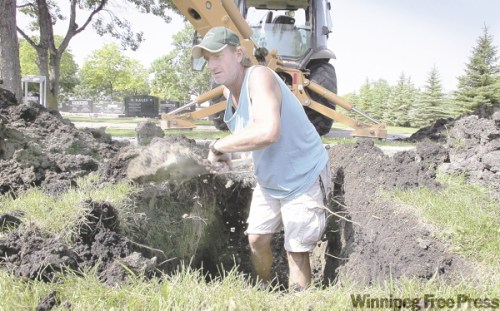
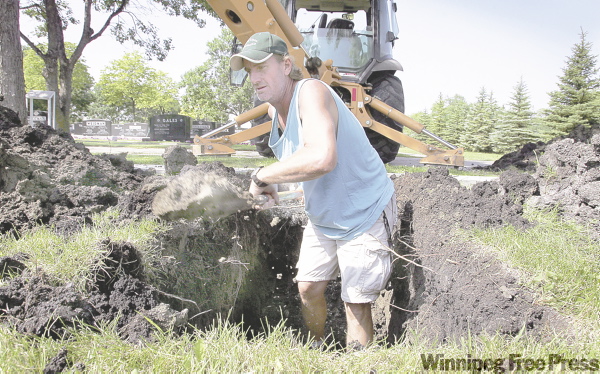
Dave Watts grabs his shovel at the Shaarey Zedek cemetery to tidy up a fresh grave he has roughed out with a backhoe. He admits being moved to tears at some funerals.
WAYNE.GLOWACKI@FREEPRESS.MB.CA Dave Watts grabs his shovel at the Shaarey Zedek cemetery to tidy up a fresh grave he has roughed out with a backhoe. He admits being moved to tears at some funerals.

When he was 14, he was hired to cut the grass at the cemetery.

"Sometimes, when I walk through I smell the flowers and the grass and it reminds me of my childhood," he says, laughing. "Kind of strange, huh?"

He moved on from grass-cutting to a career as a concrete man. He’d pour basements, sidewalks and stairs. It’s physically demanding work that hurts a body. The hours are long. You wear out eventually.

Four years ago, he came back to the cemetery.

"It’s still physical work but it’s a different kind," he says, his soil-caked work boots stretched out. "We have to move stones sometimes. We put a roller in but you have to be really careful. You don’t want to be breaking any stones."

To dig a grave, you start by marking out the plot lines. Watts then shovels a thin outline in the ground. The backhoe digs out most of the dirt.

"A grave is at least six feet by three-and-a-half feet," he explains. "The coffin has to have at least three-and-a-half feet of soil on top. I like to dig down at least six feet."

In warm weather, Watts can dig a grave in under half an hour. When the ground is frozen, it can take two hours of scraping to get below the frost line.

After the machine has done its work, Watts jumps into the grave.

"I finish it by hand. You want to even it out. Make it look nice for the family."

The gravediggers used to line the graves with fake grass. They’ve stopped that practice, although some families want a layer of grass over the coffin.

The needs of the family come up frequently when Watts talks about his job. It’s tough to see the grieving relatives, he says, many of whom he’s seen at other funerals. He does his job with a quiet dignity.

"I don’t start the tractor, putting dirt back over the coffin until the family has left, until the cars are gone," Watts says.

"You have to be careful because you’re burying someone’s family member. If they want to have certain things done, we’ll do them."

Although Watts is not Jewish, he has become aware of Jewish burial traditions through his work.

"I get to know the rabbis," he says. "One thing you have to be very careful of is not to smash the coffins. There’s not supposed to be any metal in them so you can’t just dump soil on top of them."

He admits he has been moved to tears at some funerals.

"There was this one guy, I guess he was about my age. The widow was there with the kids. She was crying so hard. She was laying on the coffin and begging us not to lower it."

He blinks away tears at the memory.

"You can’t forget something like that," he says gruffly.

"There’s one tombstone that says ‘survivor of Auschwitz.’ That kind of things get to you. You wonder who this person was, what they had to go through before they came to Canada."

His hours are regular, eight to 4:30. He sometimes works Sundays. Saturday is the Jewish sabbath and burials are forbidden on that day.

He earns roughly $30,000 a year.

Watts says he gets some teasing about his job.

"A lot of my friends call me the Crypt Keeper," he says with a tight smile. "It’s a job. It’s another day at the office for me. Some people get weirded out about it. Other people say: ‘Oooh, cool!’ It’s not cool. This is where people say goodbye to someone they love."

He still loves wandering through the cemetery. There’s a peacefulness to his workplace.

"If you’re here at night, it’s quiet. It looks so lovely and dark."

His job has convinced him of one thing. He wants to be cremated, not buried.

"I don’t want to be put in the ground like that. Sometimes you’re digging out a grave to bury someone next to their husband or wife. The smell is atrocious. It’s like rotten eggs times 20.

"I’ve gotten sick a few times. You realize what’s actually going on under the soil and the grass."

He doesn’t believe in an afterlife.

"My personal belief is once you’re done, that’s it."

The office phone rings shrilly. A co-worker has locked his keys in his truck and needs rescuing.

"Just another crazy day at the graveyard," Watts says with a smile. "Some days are just like that."

lindor.reynolds@freepress.mb.ca
Report Error Submit a Tip

More Stories

Column: Russia skates again in fight against Olympic doping

Paul Newberry, The Associated Press 7 minute read Preview

Column: Russia skates again in fight against Olympic doping

Paul Newberry, The Associated Press 7 minute read Monday, Feb. 14, 2022

Gabriella Papadakis and Guillaume Cizeron stayed for another four years after being edged out by Canada’s Tessa Virtue and Scott Moir at 2018 Games.

Read
Monday, Feb. 14, 2022

Captivating cabin crooner could be singing your song

Maureen Scurfield 6 minute read Saturday, Aug. 10, 2024

DEAR MISS LONELYHEARTS: I was crashing through the bush at the lake on a walk after lunch, when I heard a guy singing opera. At first I laughed, but then I sat down on a log and started listening.

I didn’t want to disturb him, as it was a really passionate song and quite beautiful. I even recognized the song. When he stopped, I wanted to clap, but then I thought I might embarrass him. I waited and snuck back down the path I had come out on and went back to my cabin — wondering what he looked like.

Later, I asked the clerk at the store if she knew about him and she said she did since he came to the store regularly. She said he was at the lake for the summer and she believed he was alone.

I’m here for another month, too, and I so want to meet him. How can I find him, other than camping out in the store every day and looking obvious?

U of M students add malt barley roots to chocolate for nutritious treat

Tiago Resko 4 minute read Preview

U of M students add malt barley roots to chocolate for nutritious treat

Tiago Resko 4 minute read 2:00 AM CDT

The brewing industry isn’t known for being health conscious but, for a team of University of Manitoba students, it was the key to creating a chocolate bar that combines nutrition and indulgence.

Rooties is a proposed product by food sciences students at U of M that upcycles leftover malt barley roots used to brew beer. The malt increases the chocolate bar’s protein and fibre content, making it a more nutritious option for consumers, said Sherwin Santiano, one of four team members who worked on the product.

“It has a chewy sweet layer, and it has malt barley rootlets infused into the chocolate, similar to a Mars Bar,” he said.

Rooties is a finalist in an international food development competition run by Mars Snacking in partnership with the Institute of Food and Technologies Student Association. The annual event, called IFT First, selects groups of students from around the world to develop a product and present it to a panel of judges in Chicago.

Read
2:00 AM CDT

History, quirky features of city's first five parkades subject of upcoming walking tours

Brenda Suderman 7 minute read Preview

History, quirky features of city's first five parkades subject of upcoming walking tours

Brenda Suderman 7 minute read Sunday, Apr. 3, 2022

Known to generations of Winnipeg drivers as convenient, if slightly pricey, places to park their vehicles, parkades have the particular distinction of originating in Winnipeg.

To be clear, it’s not the ginormous concrete-and-steel parking structures that stack cars on multiple levels that are Winnipeg- famous. Instead, it’s the moniker “parkade” that was invented here.

“It’s a combination of (the terms) retail arcade and parking lot,” explains history researcher and writer Christian Cassidy of the name coined for the city’s first downtown parking garage at 285 Memorial Blvd., connected to the Hudson’s Bay Company store.

Cassidy plans to include that fact about Winnipeg’s unique name for parking garages, as well as dozens of tidbits and back stories about the city’s first five parkades, in a two-hour walking tour 1:30 p.m. on Saturday, April 9, and Saturday, April 23. Part of Design Month sponsored by Winnipeg Architecture Foundation, the tour from Memorial Boulevard to Smith Street will explore some of the quirky features of early multi-level parking in this city.

Read
Sunday, Apr. 3, 2022

Councillors to vote on new parking plan that includes surge pricing

Nicole Buffie 4 minute read Preview

Councillors to vote on new parking plan that includes surge pricing

Nicole Buffie 4 minute read Friday, Oct. 31, 2025

The City of Winnipeg has unveiled a five-year parking strategy that includes more spaces and “surge pricing” during busy times and special events.

If the plan is adopted, the $270,000 strategy would pilot electric vehicle-charging stations downtown, develop an app for all parking needs and update accessibility signs for drivers with disabilities.

The strategy aims to manage the parking stock amid increased curb use.

“With the federal government providing funding for housing and transit, the city is densifying and we need our parking policies to better reflect that,” said Coun. Janice Lukes, who is chairwoman of the public works committee, which will vote on it Nov. 6. It requires final approval from council.

Read
Friday, Oct. 31, 2025

Plenty of losses all around

Gwynne Dyer 4 minute read 2:00 AM CDT

The last time oil-tankers were being shot up in the Persian Gulf, back in the 1980s, it was Saddam Hussein’s brutal tyranny in Iraq versus Ayatollah Khomeini’s revolutionary Islamist regime in Iran.

The United States backed Saddam because he was just another murderous thug, whereas the new regime in Tehran was an actual threat to American interests. It had overthrown Iran’s American-backed puppet king and wanted to spread its Islamist ideology across the region.

So, of course, Ronald Reagan’s administration chose Saddam’s side. It sent Iraq arms by clandestine means (because Congress wouldn’t authorize it) and even provided targeting information for Iraqi poison gas attacks on Iran. The Americans chose the “lesser evil,” but at least they knew it was evil.

Once in a while they would even say it out loud, quoting U.S. diplomat Henry Kissinger: “It’s a shame that both sides can’t lose.” But they never did anything about it, and after eight years of slaughter, the war ended in a no-score draw.