Food bank usage across Canada hit all-time high, nearly 1.5M visits in March: report

Advertisement

Advertise with us

The number of people using food banks across the country surged to an all-time high earlier this year, with high inflation and low social assistance rates cited as key factors in the rise, a new report from Food Banks Canada indicates.

Read this article for free:


By clicking the button above, an account will be created and you will begin to receive some of our recommended newsletters. You may opt out of any newsletter by visiting your Email and Communication Preferences page or by clicking "unsubscribe" at the bottom of any email.

or

Already have an account? Log in here »

To continue reading, please subscribe:

Digital Subscription

One year of digital access for only $1.44 a week*

  • Enjoy unlimited reading on winnipegfreepress.com
  • Read the E-Edition, our digital replica newspaper
  • Access News Break, our award-winning app
  • Play interactive puzzles

*Billed as $5.77 plus GST every four weeks. After 52 weeks, price increases to the regular rate of $19.95 plus GST every four weeks. Offer available to new and qualified returning subscribers only. Cancel any time.

To continue reading, please subscribe:

Add Free Press access to your Brandon Sun subscription for only an additional

$1 for the first 4 weeks*

  • Enjoy unlimited reading on winnipegfreepress.com
  • Read the E-Edition, our digital replica newspaper
  • Access News Break, our award-winning app
  • Play interactive puzzles
Start now

*Your next Brandon Sun subscription payment will increase by $1.00 and you will be charged $17.95 plus GST for four weeks. After four weeks, your payment will increase to $24.95 plus GST every four weeks.

Hey there, time traveller!
This article was published 26/10/2022 (1469 days ago), so information in it may no longer be current.

The number of people using food banks across the country surged to an all-time high earlier this year, with high inflation and low social assistance rates cited as key factors in the rise, a new report from Food Banks Canada indicates.

The annual report released Thursday said there were nearly 1.5 million visits to food banks in March, a figure that was 15 per cent higher than the number of visits in the same month last year and 35 per cent higher than visits in March 2019, before the pandemic hit.

The report, which looked at data from more than 4,750 food banks and community organizations, said the skyrocketing cost of food and housing, as well as high inflation and lowsocial assistance rates, have contributed to the rise in food bank usage.
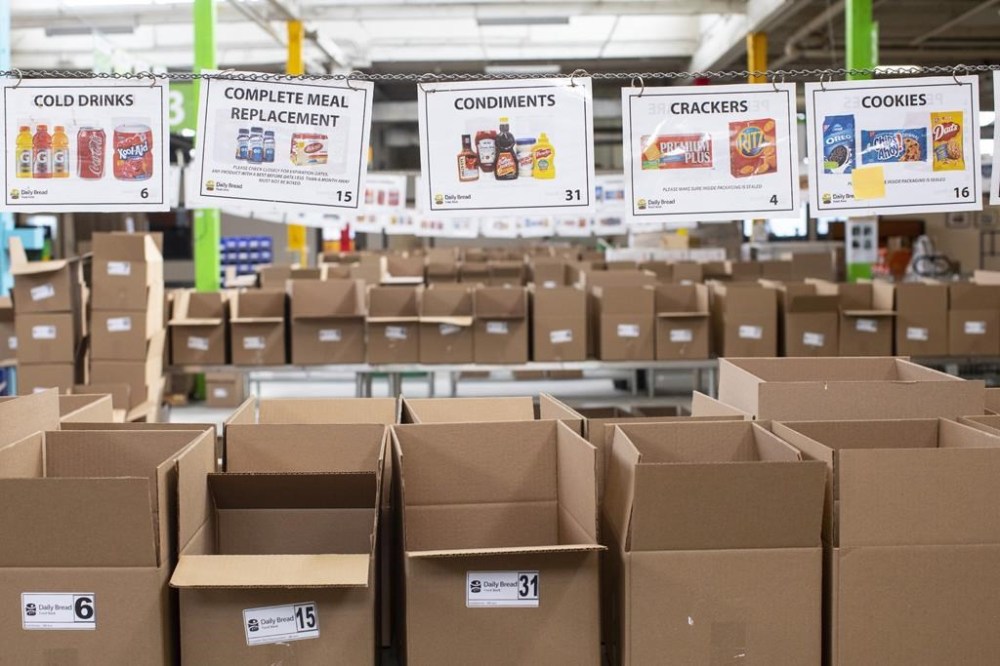
Boxes wait to be filled with provisions at The Daily Bread Food Bank warehouse in Toronto on Wednesday, March 18, 2020. THE CANADIAN PRESS/Chris Young

Kirstin Beardsley, the CEO of Food Banks Canada, called the numbers “devastating.”

“What we are seeing is the combination of long-term effects to a broken social safety net combined with the effects of inflation and high costs driving more people to use food banks than ever before in Canadian history,” she said in a phone interview.

“Behind each one of these numbers is a person who is struggling too much to get by.”

Fixed-income groups like seniors and employed but low-income people such as students have been hit harder because their paycheques can’t keep up with inflation, Beardsley said.

“We have got people like seniors, who have been able to afford to live, suddenly having to turn to the food bank for the first time in their lives because it doesn’t all add up,” Beardsley said.

“And students are the same, often they are on a very limited income, and so when the costs go up, the way we have seen, you just can’t stretch the dollar.”

The report said around 500,000 food bank clients – about one-third – are children, who make up around 20 per cent of the country’s total population.

Hunger among children is an issue that can have a lasting impact, Beardsley said.

“This is the future of our country, this is who is going to be our future leaders, scientists, artists,” she said. “When you’re going to school hungry, you’re not learning, you’re not focusing, you’re not setting yourself up to thrive.”

Food Banks Canada said food insecurity is especially dire in Northern Canada, calling for the development of community-based approaches in those areas to address the issue.

Beardsley called the report a “wake-up call” that should trigger moves to tackle food insecurity and the issues that contribute to it.

The report suggests long-term and short-term solutions, including creating a universal minimum income floor for lower-income Canadians and providing more affordable and rent-assisted housing.

It also suggests reforms are needed to employment insurance and the Canada Workers Benefit programs.

This report by The Canadian Press was first published Oct. 27, 2022.

Report Error Submit a Tip

More Stories

Netherlands Canada's top source for illicit meth shipments in 2018

Dylan Robertson 6 minute read Preview

Netherlands Canada's top source for illicit meth shipments in 2018

Dylan Robertson 6 minute read Monday, Mar. 9, 2020

OTTAWA — While Winnipeg was in the midst of its ongoing meth crisis in 2018, quantities of the drug were coming from an unexpected country, and through Canadians' most common mode of delivery.

According to documents obtained by the Free Press, there was an increase in "inbound seizures destined to Winnipeg addresses," of postal mail containing meth in 2018 from a year prior. "However, such shipments are likely for personal consumption,” as they were under 35 grams.

And though Canadian officials have called out meth smugglers in China and Mexico, the mailed drugs came from Europe.

"The Netherlands is the top transit country by number of seizures (of meth), while Mexico is the main transit country by quantity,” reads an internal Canada Border Services Agency report from mid-2018.

Read
Monday, Mar. 9, 2020

Submit a news tip

1 minute read Monday, Mar. 16, 2026

Submit a news tip

Province tabs $5M for potash mine growth

Gabrielle Piché 5 minute read Preview

Province tabs $5M for potash mine growth

Gabrielle Piché 5 minute read Yesterday at 7:49 PM EST

Manitoba’s only potash mine aims to more than double production after netting a $5 million loan from the province.

“When we have money, we drill more wells,” said Daymon Guillas, president of the Potash and Agri Development Corporation of Manitoba.

Last winter marked PADCOM’s first commercial production cycle. Workers at the Harrowby site, near Russell, mined roughly 10,000 tons of potash, a fertilizer component.

Government funding announced Monday will allow PADCOM to mine at least 22,000 tons this winter, Guillas said.

Read
Yesterday at 7:49 PM EST

Local women’s workwear brand founder snags entrepreneur award

Aaron Epp 3 minute read Preview

Local women’s workwear brand founder snags entrepreneur award

Aaron Epp 3 minute read Yesterday at 7:55 PM EST

A Winnipeg entrepreneur is $10,000 closer to helping people look like a million bucks.

Aderonke Akinloye has been awarded an RBC Rock My Business Youth Entrepreneur Award. The 29-year-old will use the $10,000 grant that comes with the award to kick-start Corporate Enclothè, a women’s workwear brand she’s been working on for the last five years.

Akinloye was one of eight Canadians — and the only Manitoban — to receive the award this year. She said she feels honoured RBC believes in her vision.

“It felt very great and humbling, to be honest, just to see my work and all the efforts I’ve put in recognized,” Akinloye said.

Read
Yesterday at 7:55 PM EST

Manitoba film and music ambassador calling it quits

Jen Zoratti 5 minute read Preview

Manitoba film and music ambassador calling it quits

Jen Zoratti 5 minute read Wednesday, Aug. 29, 2018

After more than three decades as a leader and champion in this province’s film and music industries, Manitoba Film & Music CEO and film commissioner Carole Vivier is retiring, effective June 2019.

Since joining MFM in 1985 — and serving at its helm for the past 26 years — Vivier has supported some of Manitoba’s biggest cultural exports, including Guy Maddin, the Weakerthans, Doc Walker, the Crash Test Dummies, Norma Bailey and Tanya Tagaq, since the beginning of their careers. She has built a local, national and international reputation for being a passionate and committed ambassador for Manitoba filmmakers, musicians, producers, creators and crew.

Vivier was not available on Tuesday to comment on the announcement, but had this to say in the press release:

“I am grateful to have been a part of this industry for the past three decades and to witness the growth and success of our amazing artists and professionals. I am immensely proud of the talent in this province. Although I will miss MFM, I am tremendously encouraged that a strong foundation is in place, from which new talent can reach even greater heights. The future of film and music in Manitoba is very bright.”

Read
Wednesday, Aug. 29, 2018

Finance minister has impossible choice as federal budget looms

Dan Lett 5 minute read Preview

Finance minister has impossible choice as federal budget looms

Dan Lett 5 minute read Yesterday at 3:24 PM EST

It’s federal budget week, and that means every newspaper columnist, self-proclaimed think tank subject matter expert and opposition critic has suggestions for what Ottawa “must” do.

In no particular order: Finance Minister François-Philippe Champagne “must” provide tax cuts for small business to survive, provide tax cuts for big business to become bigger and wealthier, massively increase transfer payments to the provinces, make life more affordable for average people and undertake enormous, strategic investments in the economy to make Canada less reliant on the United States.

If you’re wondering how any finance minster can do all of that, all at once, the answer is they can’t. But that’s the nature of pre-budget submissions: do what we want, even if it makes it impossible for you to do the things that other people think must be done.

That is not to say all budget submissions are worthless. It’s just that you can’t cut government taxes and levies on businesses while also providing more robust investment in industries, infrastructure and people — and still have any hope of containing the debt.

Read
Yesterday at 3:24 PM EST