Riot? Insurrection? Words matter in describing Capitol siege

Advertisement

Advertise with us

NEW YORK - At first, viewed from a distance, it was a rally or protest. Then it became an assault, a riot, an insurrection, domestic terrorism or even a coup attempt. The language used by the American media to describe last week's Capitol siege proves one thing whatever your perspective: Words matter.

Read this article for free:


or

Already have an account? Log in here »

To continue reading, please subscribe:

Subscribe and receive a limited-edition Free Press branded hat or tote.

Digital Subscription

One year of digital access for only $205*

  • Enjoy unlimited reading on winnipegfreepress.com
  • Read the E-Edition, our digital replica newspaper
  • Access News Break, our award-winning app
  • Play interactive puzzles

*First annual payment billed as $205.00 + GST for one year. This annual subscription will automatically renew at $233.00 + GST every 52 weeks (10% off the regular annual price of $259.35). Offer available to new and qualified returning subscribers only. Cancel any time.

To continue reading, please subscribe:

Add Free Press access to your Brandon Sun subscription for only an additional

$1 for the first 4 weeks*

  • Enjoy unlimited reading on winnipegfreepress.com
  • Read the E-Edition, our digital replica newspaper
  • Access News Break, our award-winning app
  • Play interactive puzzles
Start now

*Your next Brandon Sun subscription payment will increase by $1.00 and you will be charged $17.95 plus GST for four weeks. After four weeks, your payment will increase to $24.95 plus GST every four weeks.

Hey there, time traveller!
This article was published 14/01/2021 (2085 days ago), so information in it may no longer be current.

NEW YORK – At first, viewed from a distance, it was a rally or protest. Then it became an assault, a riot, an insurrection, domestic terrorism or even a coup attempt. The language used by the American media to describe last week’s Capitol siege proves one thing whatever your perspective: Words matter.

The coverage has sent Americans scurrying to the dictionary and news organizations carefully considering terminology.

The use of “riot” as a descriptor is almost universally accepted, even though the word has become fraught with racial connotations and despite the relatively gradual way the story unfolded.
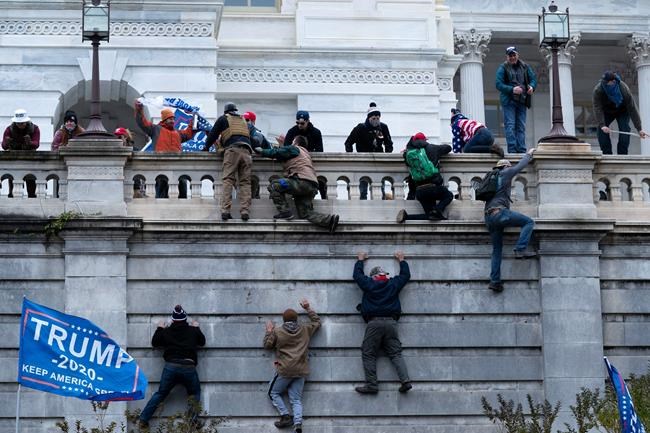
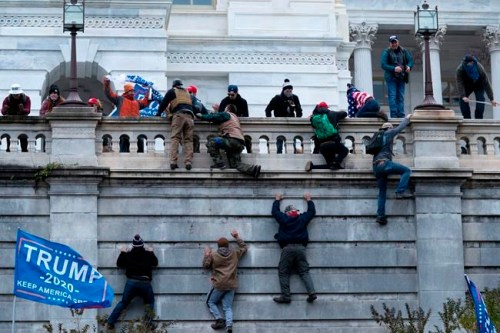
Supporters of President Donald Trump climb the West wall of the the U.S. Capitol on Wednesday, Jan. 6, 2021, in Washington. (AP Photo/Jose Luis Magana)

“Some stories evolve and reveal themselves over the course of hours and days and this was one of those stories,” said Al Ortiz, vice-president of standards and practices at CBS News.

The first images most people saw on Jan. 6 were from above, with attendees at a rally where President Donald Trump spoke who eventually moved, like sea water in a tsunami, toward and around the U.S. Capitol.

So, initially, they were called protesters. But it became clear, as many breached the Capitol and lawmakers fled for safety, that more was happening. The Associated Press told staff members that protest was too mild a word. Phrases like “mob,” “riot” and “insurrection” were appropriate, noted John Daniszewski, vice-president and editor at large for standards.

“Don’t call them protesters,” CBS’ Gayle King said during coverage the next morning.

Initially, Ortiz warned CBS journalists against going out of their way to use overly dramatic labels like terrorist attack or attempted coup in a story that had enough drama on its own. But that advice changed as more images and reporting became available.

“It was a lot more sinister than it first appeared,” he said.

Five people have died and more than 70 arrested for their actions that day, with the FBI expecting more arrests. The House voted to impeach Trump on Wednesday, citing his role inciting the siege.

Earlier this week, the conservative website RedState posted an article headlined “Enough! There was no riot, insurrection or storming” at the Capitol. Author Mike Ford described it as a “peaceful rally and a largely peaceful protest that was marred by some bad acts by a very few people.”

The next day, editors retracted Ford’s piece and scrubbed it from the site. Editors, who did not return messages seeking comment, explained to readers that “many details, opinions and analysis contained in the piece were either incorrect or inappropriate.”

“For RedState to keep maintaining that there wasn’t a riot or storming of the Capitol on that day would land the website on a very lonely island,” said Howard Polskin, who publishes The Righting newsletter about conservative media.

While the conservative website Big League Politics said it was “a historic civil rights march by President Donald Trump’s supporters,” it was in a distinct minority.

The New York Times, Washington Post, CBS, NBC, ABC and CNN have all used riot to describe the day. So have outlets with appeal to conservatives, like the Wall Street Journal, Fox News, Newsmax and the Washington Examiner.

The National Review tried to make a partisan point: “Your rioters are worse than our rioters,” was one of its headlines.

The near unanimity came despite riot sometimes being a loaded term, and a subject of debate for how it was applied last summer to unrest following George Floyd’s death and Black Lives Matter protests. Some feel it is too quickly applied to situations involving Black Americans.
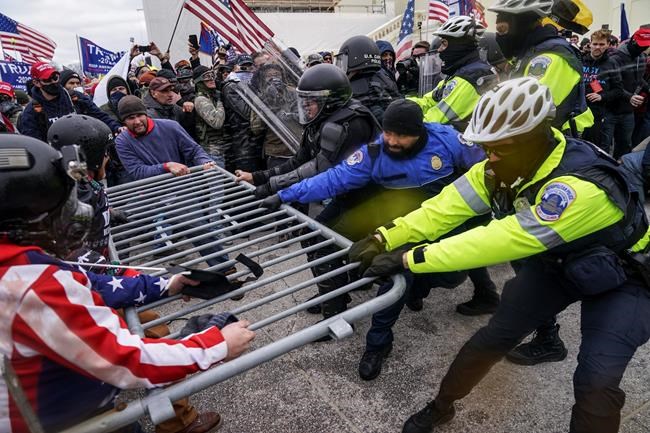
Trump supporters try to break through a police barrier, Wednesday, Jan. 6, 2021, at the Capitol in Washington. As Congress prepares to affirm President-elect Joe Biden's victory, thousands of people have gathered to show their support for President Donald Trump and his claims of election fraud.(AP Photo/John Minchillo)

During the past week, “I think that people in the media have been circumspect about their language and have been choosing their words carefully,” said Ben Zimmer, a linguist and a columnist on language for the Wall Street Journal.

News organizations have been careful not to use words like rebellion, revolt or uprising, which could cast those who stormed the Capitol in a heroic light, he said.

In its coverage, the Times has called it a “mob attack,” “deadly riot” and “violent assault,” and said Trump supporters “laid siege” to the Capitol. The Post has talked of a “horde of rioters” and “terrifying attack.”

“It’s hard to overstate what happened,” said Al Tompkins, a faculty member at the journalism think-tank Poynter Institute.

The past week has brought phrases not commonly seen into use. One is insurrection, defined as “an act or instance of revolting against civil authorities or an established government.” Another is sedition, or “incitement of resistance to or insurrection against lawful authority.”

Merriam-Webster said the top words looked up in its online dictionary on Wednesday were: insurrection, fascism, impeach and sedition.

“If the times call for these words, they should be used, even if not everybody has a perfect handle on their meanings,” Zimmer said.

The phrase “attempted coup” has been more controversial. It often has military overtones that were absent last week. The AP advises against it, absent evidence that the specific aim was to take over the government. Ortiz has allowed it, reasoning there was clearly an attempt by the executive branch to thwart the legislative branch.

Fiona Hill, a former national security adviser who testified in Trump’s first impeachment trial, argued in Politico that it was a “self-coup” done in plain sight on Trump’s behalf.

Heading into next week, it will be worth watching if the Capitol riot affects a phrase so commonly used during a presidential inaugural to be almost a cliche: peaceful transfer of power.

“That ship has sailed,” said CNN’s Jake Tapper. “We have already been denied a peaceful and orderly transfer of power.”

Report Error Submit a Tip

More Stories

Billions of dollars spent on health, but scattershot financial reporting leaves decision-makers, Manitobans in the dark, auditor general says

Nicole Buffie 3 minute read Preview

Billions of dollars spent on health, but scattershot financial reporting leaves decision-makers, Manitobans in the dark, auditor general says

Nicole Buffie 3 minute read Yesterday at 5:20 PM CDT

Manitoba’s auditor general says significant gaps in health-sector financial reporting make it difficult to understand how billions of dollars in public funds are spent.

Auditor General Tyson Shtykalo is calling for clearer, more transparent reporting in his latest report, titled Observations on Health Sector Financial Reporting and Accountability in Manitoba.

“Manitoba spends nearly $10 billion annually on health care, but current financial reporting does not provide a clear picture of how that money is spent, what services cost, or the financial pressures facing the system,” Shtykalo said in a news release.

While some financial information is available, the reports do not provide a “complete, consistent, or easily understood” picture of how health-care funds are spent, the report said.

Read
Yesterday at 5:20 PM CDT

Manitoba PCs choose Narth as interim leader; ‘deeply hurt’ Khan blasts former caucus colleagues

Carol Sanders 8 minute read Preview

Manitoba PCs choose Narth as interim leader; ‘deeply hurt’ Khan blasts former caucus colleagues

Carol Sanders 8 minute read Updated: Yesterday at 1:59 PM CDT

Manitoba’s Progressive Conservative caucus chose MLA Konrad Narth as interim party leader Tuesday to replace Obby Khan, who quit a day earlier after he said he was stabbed in the back by a small group of caucus members plotting in secret to oust him.

“I am deeply, emotionally hurt by this,” Khan told the Free Press Tuesday afternoon.

He announced late Monday afternoon that he was leaving the Tory caucus and will sit as an independent MLA. He was absent from the first question period in four months Tuesday as the legislature resumed sitting after the summer.

The former Winnipeg Blue Bombers offensive lineman said he prevailed in a confidence vote Friday; 13 caucus members voted for him to remain leader, six voted against and one person was absent.

Read
Updated: Yesterday at 1:59 PM CDT

No museum can tell the whole story

Stuart Williams 5 minute read Wednesday, Jul. 29, 2026

The continuing debate over the Canadian Museum for Human Rights’ Uprooted: Nakba Past and Present exhibit has focused significantly on what the exhibit leaves out.

Some critics argue that the exhibit should have explained the United Nations Partition Plan, the Arab rejection of that plan, the 1948 invasion by neighbouring Arab states, the displacement of Jews from Arab countries, Hamas, October 7, the hostages and the reasons for Israeli security measures.

Others argue with equal conviction that it should also have addressed the Deir Yassin massacre, the expansion of Israeli settlements, decades of occupation, the Right of Return, changing demographic realities and the experiences of Palestinian refugees throughout the Middle East.

All of those subjects matter. Many remain the subject of legitimate scholarly debate. But the controversy points to a broader question that extends well beyond this particular exhibit.

Riot? Insurrection? Words matter in describing Capitol siege

David Bauder, The Associated Press 6 minute read Preview

Riot? Insurrection? Words matter in describing Capitol siege

David Bauder, The Associated Press 6 minute read Thursday, Jan. 14, 2021

NEW YORK - At first, viewed from a distance, it was a rally or protest. Then it became an assault, a riot, an insurrection, domestic terrorism or even a coup attempt. The language used by the American media to describe last week's Capitol siege proves one thing whatever your perspective: Words matter.

The coverage has sent Americans scurrying to the dictionary and news organizations carefully considering terminology.

The use of “riot” as a descriptor is almost universally accepted, even though the word has become fraught with racial connotations and despite the relatively gradual way the story unfolded.

“Some stories evolve and reveal themselves over the course of hours and days and this was one of those stories,” said Al Ortiz, vice-president of standards and practices at CBS News.

Read
Thursday, Jan. 14, 2021

Plenty of losses all around

Gwynne Dyer 4 minute read Wednesday, Jul. 15, 2026

The last time oil-tankers were being shot up in the Persian Gulf, back in the 1980s, it was Saddam Hussein’s brutal tyranny in Iraq versus Ayatollah Khomeini’s revolutionary Islamist regime in Iran.

The United States backed Saddam because he was just another murderous thug, whereas the new regime in Tehran was an actual threat to American interests. It had overthrown Iran’s American-backed puppet king and wanted to spread its Islamist ideology across the region.

So, of course, Ronald Reagan’s administration chose Saddam’s side. It sent Iraq arms by clandestine means (because Congress wouldn’t authorize it) and even provided targeting information for Iraqi poison gas attacks on Iran. The Americans chose the “lesser evil,” but at least they knew it was evil.

Once in a while they would even say it out loud, quoting U.S. diplomat Henry Kissinger: “It’s a shame that both sides can’t lose.” But they never did anything about it, and after eight years of slaughter, the war ended in a no-score draw.

‘In Normandy, we remember’

Aaron Epp 4 minute read Preview

‘In Normandy, we remember’

Aaron Epp 4 minute read Saturday, Sep. 26, 2026

Travelling nearly 7,000 km from his home in France to Winnipeg gave Gabriel Zaranski a new perspective on warfare.

“It’s very different to speak about war in school (than) to speak with real people who (have fought) in a war,” he said. “We can feel the emotion when they speak … The testimony has more impact when it’s real soldiers.”

Zaranski is one of 14 Grade 12 students from Bayeux, a town in France’s Normandy region, in Winnipeg this week for a learning tour.

The students, who attend Lycée Arcisse de Caumont high school, met on Saturday with veterans from the Queen’s Own Cameron Highlanders of Canada, a local military regiment, to discuss their studies and the regiment’s role in the Second World War.

Read
Saturday, Sep. 26, 2026