Weinstein lawyers seek mercy after his ‘historic’ fall

Advertisement

Advertise with us

NEW YORK - With prosecutors seeking a severe punishment for Harvey Weinstein in his landmark #MeToo case, his lawyers argued on Monday that he deserves mercy for his already “historic fall from grace” and serious health issues.

Read this article for free:


or

Already have an account? Log in here »

To continue reading, please subscribe:

Subscribe and receive a limited-edition Free Press branded hat or tote.

Digital Subscription

One year of digital access for only $205*

  • Enjoy unlimited reading on winnipegfreepress.com
  • Read the E-Edition, our digital replica newspaper
  • Access News Break, our award-winning app
  • Play interactive puzzles

*First annual payment billed as $205.00 + GST for one year. This annual subscription will automatically renew at $233.00 + GST every 52 weeks (10% off the regular annual price of $259.35). Offer available to new and qualified returning subscribers only. Cancel any time.

To continue reading, please subscribe:

Add Free Press access to your Brandon Sun subscription for only an additional

$1 for the first 4 weeks*

  • Enjoy unlimited reading on winnipegfreepress.com
  • Read the E-Edition, our digital replica newspaper
  • Access News Break, our award-winning app
  • Play interactive puzzles
Start now

*Your next Brandon Sun subscription payment will increase by $1.00 and you will be charged $17.95 plus GST for four weeks. After four weeks, your payment will increase to $24.95 plus GST every four weeks.

Hey there, time traveller!
This article was published 10/03/2020 (2397 days ago), so information in it may no longer be current.

NEW YORK – With prosecutors seeking a severe punishment for Harvey Weinstein in his landmark #MeToo case, his lawyers argued on Monday that he deserves mercy for his already “historic fall from grace” and serious health issues.

In a letter filed in advance of Weinstein’s sentencing on Wednesday for his New York City rape conviction, his defence team asked Judge James Burke to give him to only five years behind bars — a far cry from the potential 29-year maximum term allowed by law.

A man who was once admired for putting part of his fortune into charitable causes during his rise to one of Hollywood’s most powerful producers now “cannot walk outside without being heckled,” the papers say. “He has lost his means to earn a living. Simply put, his fall from grace has been historic, perhaps unmatched in the age of social media.”
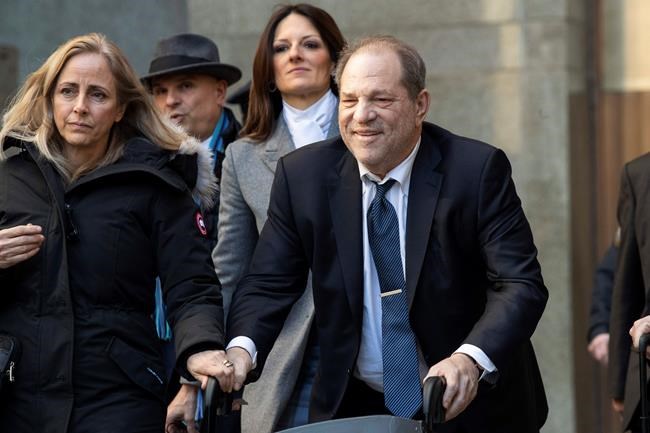
FILE - In this Feb. 21, 2020, file photo, Harvey Weinstein leaves the courthouse during jury deliberations in his rape trial in New York. With Weinstein facing sentencing this week, his lawyers argued Monday, March 9, that the disgraced movie mogul deserves mercy in his New York City rape case because he's already suffered a
FILE - In this Feb. 21, 2020, file photo, Harvey Weinstein leaves the courthouse during jury deliberations in his rape trial in New York. With Weinstein facing sentencing this week, his lawyers argued Monday, March 9, that the disgraced movie mogul deserves mercy in his New York City rape case because he's already suffered a "historic" fall from grace and is dealing with serious health issues. (AP Photo/Mary Altaffer, File)

Even if the ailing 67-year-old defendant is given a lesser term, “the grave reality is that Mr. Weinstein may not even outlive that term” making it “a de facto life sentence,” the papers say.

From the start, Weinstein’s use of a walker to get in and out of court each day at his trial raised questions about his health. After his Feb. 24 conviction, he was sent to Bellevue Hospital amid concerns about high blood pressure and heart palpitations for more than a week before being transferred late last week in an infirmary on the notorious Riker Island jail complex.

In addition to the heart issues, Weinstein’s lawyers have said he was also dealing with the ramifications of unsuccessful back surgery stemming from a car crash last summer and a condition that requires shots in his eyes so he does not go blind.

In their own filing last week, prosecutors detailed a litany of allegations starting with a claim by a woman that she woke up in the middle of the night in a Buffalo, New York, hotel room in 1978 to find Weinstein on top of her and “forcing himself sexually on her.” They said it fit a pattern that continued for decades: Weinstein getting young women alone in hotel rooms and other settings before sexually attacking them, often while trying to trick them into thinking it was a path to stardom.

The judge had told potential jurors during jury selection that the trial “was not a referendum on the #metoo movement” and to consider only the specific allegations contained in the charges. But prosecutors said that by law, Burke is allowed “to consider all aspects of a defendant’s life and characteristics” and a “broad spectrum of information” in considering a proper sentence.

Based on “a lifetime of abuse toward others, sexual and otherwise,” the judge should impose a sentence that “reflects the seriousness of the defendant’s offences” and punishes him for “his total lack of remorse for the harm he has done,” prosecutors wrote.

On the criminal sex act count, Weinstein faces a minimum of five years in prison and a maximum of 25 years in prison, while the third-degree rape count carries a maximum penalty of four years in prison.

Judges often run sentences concurrently, meaning a defendant can serve both sentences at the same time.

At Weinstein’s sentencing hearing, his accusers will again get a chance to confront him in court, and the former producer will be afforded another opportunity to speak. He declined to testify on his behalf at his trial, but at sentencing he wouldn’t have to worry about getting grilled by the prosecution like he would’ve on cross-examination.

Once Weinstein is sentenced, he’ll be transferred from the city’s jail system to the state prison system. There, he will undergo a thorough evaluation, including a comprehensive medical review, to determine which facility is best for his physical and security needs.

Report Error Submit a Tip

More Stories

Mayoral candidate Vogiatzak criticized for living outside Winnipeg

Malak Abas 4 minute read Preview

Mayoral candidate Vogiatzak criticized for living outside Winnipeg

Malak Abas 4 minute read 5:08 PM CDT

A mayoral hopeful took heat from other candidates Friday for living outside Winnipeg while running in the civic election.

Mike Vogiatzakis’s primary residence is in the Rural Municipality of St. Andrews, about 25 kilometres north of Winnipeg — a community with its own mayor and councillors.

But the funeral director said he owns a home in Winnipeg where he divides his time, and he would move to the city full-time if elected mayor.

“It doesn’t matter where a person lives. Why are we dividing St. Andrews and Manitoba and Winnipeg? I’ve met the criteria to run for mayor,” Vogiatzakis said Friday morning.

Read
5:08 PM CDT

Software glitch caused multi-provincial 911 outage: Bell

Chris Kitching 5 minute read Preview

Software glitch caused multi-provincial 911 outage: Bell

Chris Kitching 5 minute read Updated: 5:25 PM CDT

A 911 outage that affected Manitoba and four other provinces for about 90 minutes last month was caused by a software failure, according to Bell Canada’s report to a federal regulator.

An abridged version of the report, which was made public Friday, did not say how many callers were affected when Bell’s next-generation 911 platform stopped receiving new calls and transferring new calls to local 911 communications centres, putting backup systems into use.

The outage, which lasted from 2:13 a.m. to 3:40 a.m. central time on Sept. 17, was not caused by a cyberattack or any change activity, Bell said.

“Rather, the outage was caused by a latent software issue that triggered an unexpected condition in certain network components within the (next-generation 911) network,” Philippe Gauvin, Bell’s assistant general counsel, wrote in the report, which was published on the Canadian Radio-television and Telecommunications Commission’s website.

Read
Updated: 5:25 PM CDT

Americanizing education is pure folly

John R. Wiens 5 minute read Thursday, Apr. 8, 2021

BILL 64, if passed, would succeed in cutting some of the last strands tying education to democracy in the English-speaking western world, a movement which had its beginnings in the post-war European continent.

Friedrich von Hayek, the founder of neoclassical economic theory, persuaded the political elite of the day that their future lay in a deregulated capitalistic marketplace, and in the reduction of government investment in public services. But even he would be shocked by the latest developments in Manitoba.

A rough timeline would have had Hayek meeting the newly elected Tory leader, Margaret Thatcher, in 1975. Immediately upon her election as prime minister in 1979, she began to implement his economic theory of mass privatization of state assets. The oil and gas industry and the national British Airways were privatized. The powerful miners’ unions were relentlessly pilloried as enemies of the state.

Public services such as health and education were methodically dismantled, systematically privatized in the name of personal choice, while taxes for the wealthy were reduced. In the name of creativity, entrepreneurship and innovation, among other public goods, airlines, telecommunications, banking, trucking and environmental protections were deregulated. Is this starting to sound familiar?

Cops handcuffed by bail issues, lack of mental-health options, WPS chief tells residents in crime-ridden North End neighbourhood

Nicole Buffie 6 minute read Preview

Cops handcuffed by bail issues, lack of mental-health options, WPS chief tells residents in crime-ridden North End neighbourhood

Nicole Buffie 6 minute read 5:30 PM CDT

Weak bail reform and a lack of mental-health resources and addictions treatment beds are making it more difficult to tackle crime in inner-city neighbourhoods such as William Whyte, where there has been a significant increase in criminal behaviour compared to last year, the city’s top police officer says.

Winnipeg Police Services Chief Gene Bowers made the remarks Thursday night at an event hosted by the William Whyte Neighbourhood Association, where about two dozen residents gathered to share their concerns about crime in the North End community.

“Fentanyl and meth, that’s caused a strain on all our front lines and and all these agencies that are trying to help people,” Bowers told the room of people at Inner City Youth Alive on Aberdeen Avenue Thursday night.

“What really is the problem is there’s no treatment. That’s the gap, because (police and agencies) are all churning the same people through, and we’re all seeing them. We’re all frustrated that there’s no help.”

Read
5:30 PM CDT

Who has been invited to the table?

Stephen Borys 6 minute read Preview

Who has been invited to the table?

Stephen Borys 6 minute read Yesterday at 2:01 AM CDT

Last Friday, I spoke at Booth University College’s inaugural Honour and Hope Harvest Dinner in support of Shelter U. I had been asked to speak about the power of art in the community, a subject I have spent much of my professional life thinking about — as a museum director, writer and teacher, and now through my consulting work with Civic Muse.

What continues to interest me is not simply what museums, universities and other public institutions do, but whether their work actually matters — whether they make a difference in the lives of the people and communities around them.

Preparing for the evening brought me back to an even more fundamental question: Who has been invited in?

One of my museum mentors used to remind me that institutions often begin the conversation about public engagement too late. Before engagement comes the welcome, and before the welcome comes the invitation. We can create extraordinary buildings, exhibitions and programs and say that everyone is welcome. But unless people believe that these places are also meant for them, many will never cross the threshold.

Read
Yesterday at 2:01 AM CDT

Churchill draws scientists from around the world researching impacts of climate change

Sarah Lawrynuik 13 minute read Preview

Churchill draws scientists from around the world researching impacts of climate change

Sarah Lawrynuik 13 minute read Friday, Oct. 23, 2020

CHURCHILL — There is something special about this town.

People who have been here know, though it is challenging to describe. Those who haven’t are told tales of a nearly mystical small community, the unique geography and the magnificent wildlife.

Exactly what makes it such a special place is hard to define, but whatever that intrinsic character is, it acts as a magnetic force for humans and animals alike.

Every summer — as if on cue — the sleek white backs of more than 50,000 beluga whales begin peeking out of the waters of southwestern Hudson Bay as they return to the estuaries of northern Manitoba. Their fidelity to this summer habitat is centuries old, passed on from one generation to the next. This loyalty to the region ensures for as long as this site is safe, these alien-like, curious whales will continue to return.

Read
Friday, Oct. 23, 2020