Struggling Sri Lankan refugees swindled

Advertisement

Advertise with us

The inscription at the beginning of Hustle, Baby: “Common sense will not accomplish great things. Simply become insane and desperate. — Lord Naushige, the Samurai warlord.”

Read this article for free:


or

Already have an account? Log in here »

To continue reading, please subscribe:

Subscribe and receive a limited-edition Free Press branded hat or tote.

Digital Subscription

One year of digital access for only $205*

  • Enjoy unlimited reading on winnipegfreepress.com
  • Read the E-Edition, our digital replica newspaper
  • Access News Break, our award-winning app
  • Play interactive puzzles

*First annual payment billed as $205.00 + GST for one year. This annual subscription will automatically renew at $233.00 + GST every 52 weeks (10% off the regular annual price of $259.35). Offer available to new and qualified returning subscribers only. Cancel any time.

To continue reading, please subscribe:

Add Free Press access to your Brandon Sun subscription for only an additional

$1 for the first 4 weeks*

  • Enjoy unlimited reading on winnipegfreepress.com
  • Read the E-Edition, our digital replica newspaper
  • Access News Break, our award-winning app
  • Play interactive puzzles
Start now

*Your next Brandon Sun subscription payment will increase by $1.00 and you will be charged $17.95 plus GST for four weeks. After four weeks, your payment will increase to $24.95 plus GST every four weeks.

The inscription at the beginning of Hustle, Baby: “Common sense will not accomplish great things. Simply become insane and desperate. — Lord Naushige, the Samurai warlord.”

And what a fitting inscription it is for the story of a family of women who fled Sri Lanka’s civil war and are struggling to survive in the relative safety of Scarborough, Ont.

Hustle, Baby is the second novel by Priya Guns, the Sri Lankan-born, Canadian-raised writer now based in London, U.K., and the Middle East. Her debut novel, Your Driver is Waiting, was lauded by critics as a satirical, gender-flipped retelling of the 1970s film Taxi Driver.
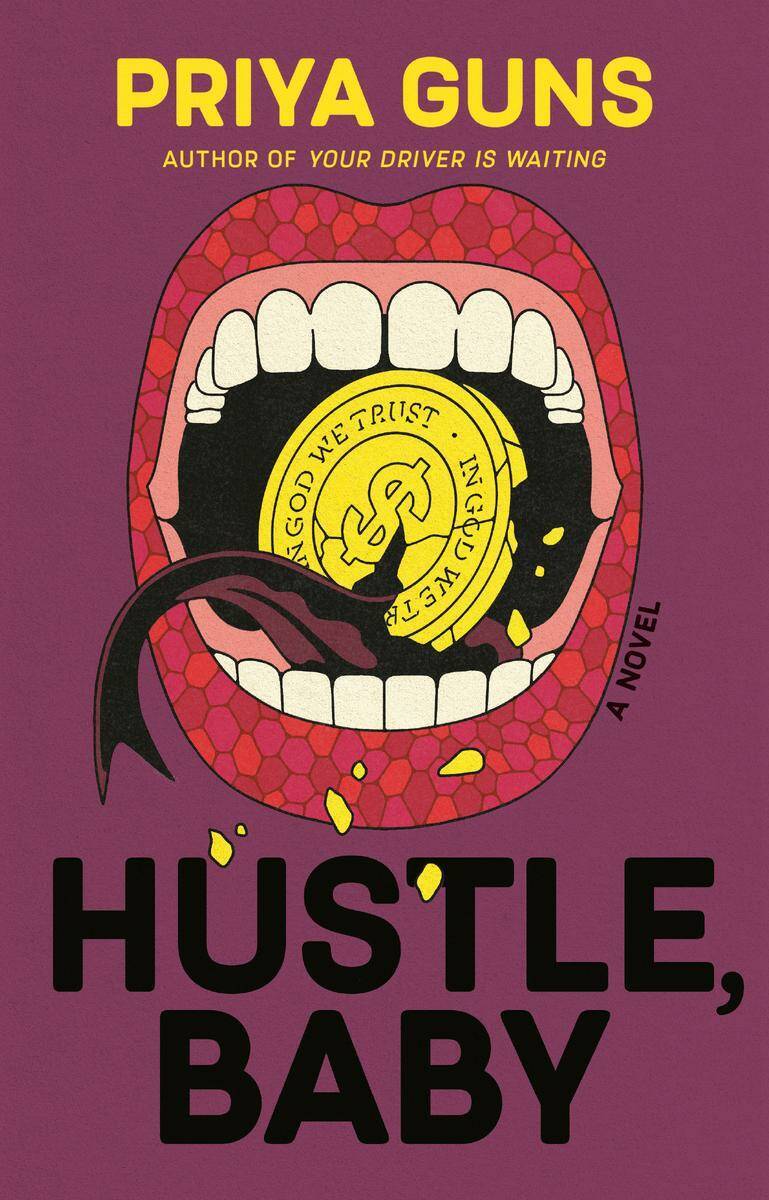
Hustle, Baby

Hustle, Baby

Perhaps Naushige knew families wild with desperation in the face of eviction with the deck truly stacked against them. Maybe he witnessed the insanity with which such families responded. But it is doubtful his families rode out their crises with quite the aplomb this family does.

But then, Naushige’s families probably didn’t have a matriarch who was a God-fearing Christian woman who blows kisses to a portrait of Jesus in her kitchen and can morph into a cobra at will, as Mary does. And probably they didn’t have a family member who had been a terrorist, a member of the Tamil Tigers, like the brainy, beautiful Anji, Mary’s sister.

Dilo — the Hustle Baby of the title — is Mary’s daughter, a high school student and promising scholar who shoulders the family’s economic woes as thoroughly as the two adults do. At school, she sells weed and snacks to fatten the family’s coffers.

And lastly there’s Maysha, Anji’s young daughter.

Guns applies an interesting structure that captures the chaos of the family’s situation from all angles. Each chapter is written in the first person by one of the main characters — even tiny Maysha has a couple of short chapters. It mirrors the chaotic home environment — often too thoroughly, as the reader must keep turning back to each chapter’s opening to remember who is writing.

We first meet the family, dead broke and facing eviction, on a shoplifting trip to Z-Mart which they’ve planned with the meticulous care of a military operation. They work from a shopping list, sliding goods they need into extended coat pockets and Maysha’s blankets, finally dodging the alarms at the door by sliding a pricy perfume bottle into the bag of one of Mary’s church friends they follow to the checkout. The perfume sets off the alarm, and as the “friend” is taken away by security, the family slides out the door.

Even stocking up for free like this, the family knows they won’t be able to raise the back rent for which they are in arrears, plus months up front, by their landlord’s impossible deadline.

Enter Mark, the slick day trader who offers them hope.

It’s clear to readers what Mark is up to as he inveigles himself into the bosom of the family, wooing them with gifts and using them to access members of their evangelical church. The family doesn’t seem to see what readers do, which makes the surprise twist of an ending — actually, several twists to the ending — well, tortuous is not too strong a word, along with implausible, improbable and potentially preposterous. And so satisfying.

The family is more on the comedy end of this tragicomedy, and Guns’ writing is rife with clever, dark humour and occasional laugh-out-loud moments. The story starts off painfully slow, plodding onward for the first two-thirds before becoming lively as Mark’s role in the story heats up.

At times some passages read almost like poetry, like a veil draped over the actual meaning, making it hard to follow the plot. But by the book’s end, the novel does an entertaining job as social commentary.

Julie Carl is a freelance journalist living in Toronto.
Report Error Submit a Tip

More Stories

Struggling Sri Lankan refugees swindled

Reviewed by Julie Carl 4 minute read Preview

Struggling Sri Lankan refugees swindled

Reviewed by Julie Carl 4 minute read Saturday, Aug. 8, 2026

The inscription at the beginning of Hustle, Baby: “Common sense will not accomplish great things. Simply become insane and desperate. — Lord Naushige, the Samurai warlord.”

And what a fitting inscription it is for the story of a family of women who fled Sri Lanka’s civil war and are struggling to survive in the relative safety of Scarborough, Ont.

Hustle, Baby is the second novel by Priya Guns, the Sri Lankan-born, Canadian-raised writer now based in London, U.K., and the Middle East. Her debut novel, Your Driver is Waiting, was lauded by critics as a satirical, gender-flipped retelling of the 1970s film Taxi Driver.

Perhaps Naushige knew families wild with desperation in the face of eviction with the deck truly stacked against them. Maybe he witnessed the insanity with which such families responded. But it is doubtful his families rode out their crises with quite the aplomb this family does.

Read
Saturday, Aug. 8, 2026

Letters, Sept. 21

7 minute read 2:00 AM CDT

Treat the disease

I understand there are valid concerns regarding specific short term rentals (STR) in Winnipeg. However, the article raised other alarms for me.

Winston Yee, the city’s manager of licensing and bylaw enforcement, stated the purpose of the new requirement (reporting 911 calls for STR) is “so we can become aware of issues.” So he isn’t aware of “the issues” yet? Are there not systems in place to obtain this information? Doesn’t the city know which addresses have high calls for emergency service? I sure hope the city’s systems aren’t so antiquated that it can’t cross-reference emergency calls with the STR registry.

I think the focus needs to be on the behavior, rather than the ownership structure. Part of the proposed solution to “parties, noise, violence, vandalism and other criminal activity” is to require owners of STR to advise the city when an emergency responder attends the property.

It’s like renaming the Great Barrier Reef

Ralph Pirozzo 5 minute read Thursday, Sep. 3, 2026

I write as a proud Canadian-Australian who is experiencing something I never imagined possible — watching Canada’s sovereignty, economic security and national identity being repeatedly challenged by the country it has long regarded as its closest neighbour and ally.

This is not an abstract diplomatic disagreement to me. Canada is my beloved country. To witness its name, dignity and independence treated as though they may be diminished, negotiated away or simply disregarded is profoundly painful.

Any one of the events that has occurred might be dismissed as another dispute between governments. Taken together, however, three developments provide unmistakable evidence that a red line has been crossed.

First came the tariffs affecting Canadian steel, aluminum, automobiles and softwood lumber. These measures were introduced despite the Canada-United States-Mexico Agreement — CUSMA — intended to provide stability, predictability and largely tariff-free trade across North America.

Manitoba announces $832-M deficit — in line with previous projections

Carol Sanders 6 minute read Preview

Manitoba announces $832-M deficit — in line with previous projections

Carol Sanders 6 minute read 7:22 PM CDT

Manitoba’s audited public accounts for the last fiscal year show the province is “moving in the right direction,” NDP Finance Minister Adrien Sala said Monday.

The provincial deficit for fiscal 2025-26 was $832 million, nearly half the $1.67-billion deficit forecast in December, and in line with the $794-million estimate in Budget 2026.

“I’m particularly proud of this final result, (given the potential) implications of tariffs on our economy, the worst wildfire season in 30 years — which resulted in significant emergency expenditures — and, of course, a significant drought,” Sala said at a news conference.

The province reported revenues of $25.1 billion and expenses of $25.9 billion, resulting in the $832-million deficit. Manitoba’s net debt is $36.5 billion and costs the province $2.3 billion a year in debt-servicing charges.

Read
7:22 PM CDT

Three charged with trafficking catalytic converters after police raid scrapyard

Chris Kitching 7 minute read Preview

Three charged with trafficking catalytic converters after police raid scrapyard

Chris Kitching 7 minute read Friday, Jun. 17, 2022

Three men are facing charges after police targeted a scrapyard in a four-month investigation — dubbed Project Precious — into sales of stolen catalytic converters, as thefts skyrocket in Manitoba.

Heavily armed officers from the Winnipeg police tactical support team were involved in a raid at a lot in the Rural Municipality of Springfield, just east of the city, on June 2.

City police spokeswoman Const. Dani McKinnon said people at the scrapyard were suspected of buying “large quantities” of stolen converters and trafficking them for a “lucrative” sum.

“Over the four months, (officers) learned that (scrapyard) was a prevalent player in taking these stolen catalytic converters and then selling them to a third party, so that’s how both the buyer and seller were profiting,” McKinnon said at a news conference Friday. “Sellers were profiting quite well.”

Read
Friday, Jun. 17, 2022

Jobs report shows how work has changed

Editorial 4 minute read Preview

Jobs report shows how work has changed

Editorial 4 minute read Tuesday, Oct. 12, 2021

Employment gains in September brought Canada’s total employment back to the pre-pandemic level of 19.1 million, Statistics Canada announced last week. Total employment had fallen to 16.1 million in April 2020, two months after the pandemic struck.

In effect, it took Canada just two months to lose three million jobs in the first stages of the campaign against COVID-19. It then took 17 months of struggle and re-adjustment to recover the lost ground. Falling off the cliff was quick. Climbing back up was slow and painful work.

Since Canada’s population increased by 1.4 per cent during that period of collapse and recovery, we are not exactly back to where we started. And since some industries have fared worse than others, the world of work has been transformed almost beyond recognition by the pandemic experience.

The virus seemed to be in retreat in most of the country this past summer, but still a quarter of the people who worked in Canada in September were working from home. Though some employers were starting to call employees back into their offices, working from home was as common last month as it had been a year earlier. The habit of remote work was proving tough to break.

Read
Tuesday, Oct. 12, 2021