First World War medical narratives ghastly

Advertisement

Advertise with us

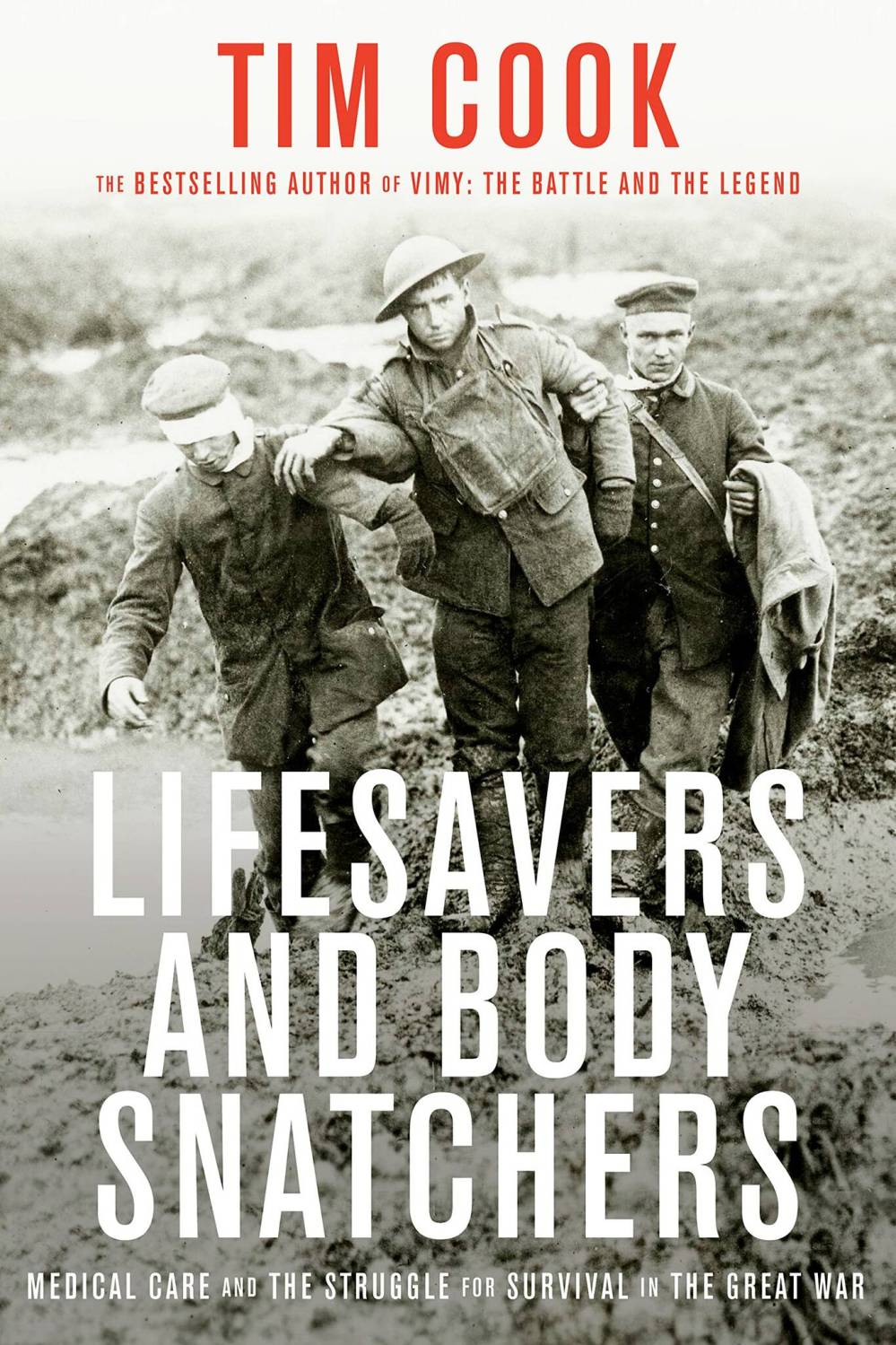
Can anything good come out of a world war? Canadian historian Tim Cook answers that question in this detailed doorstopper, with a focus on the medical personnel featuring personal narratives — which includes just enough statistics to reinforce his conclusions.

Read this article for free:


By clicking the button above, an account will be created and you will begin to receive some of our recommended newsletters. You may opt out of any newsletter by visiting your Email and Communication Preferences page or by clicking "unsubscribe" at the bottom of any email.

or

Already have an account? Log in here »

To continue reading, please subscribe:

Digital Subscription

One year of digital access for only $1.44 a week*

  • Enjoy unlimited reading on winnipegfreepress.com
  • Read the E-Edition, our digital replica newspaper
  • Access News Break, our award-winning app
  • Play interactive puzzles

*Billed as $5.77 plus GST every four weeks. After 52 weeks, price increases to the regular rate of $19.95 plus GST every four weeks. Offer available to new and qualified returning subscribers only. Cancel any time.

To continue reading, please subscribe:

Add Free Press access to your Brandon Sun subscription for only an additional

$1 for the first 4 weeks*

  • Enjoy unlimited reading on winnipegfreepress.com
  • Read the E-Edition, our digital replica newspaper
  • Access News Break, our award-winning app
  • Play interactive puzzles
Start now

*Your next Brandon Sun subscription payment will increase by $1.00 and you will be charged $17.95 plus GST for four weeks. After four weeks, your payment will increase to $24.95 plus GST every four weeks.

Hey there, time traveller!
This article was published 19/11/2022 (1427 days ago), so information in it may no longer be current.

Can anything good come out of a world war? Canadian historian Tim Cook answers that question in this detailed doorstopper, with a focus on the medical personnel featuring personal narratives — which includes just enough statistics to reinforce his conclusions.

This is not a book for the squeamish. We tend to expect that film or photographs have the power to disturb or move us, but I have never felt such distress as reading Cook’s litany of horrors faced by those who served Canada in the First World War.

In the static trench system he describes, the smell of the dead is ever-present.
Lifesavers and Body Snatchers

Lifesavers and Body Snatchers

Add to that the accompanying rats, the rot that is known as trenchfoot from standing in water, cholera, typhus and dysentery, shrapnel and bullet wounds — to say nothing of the flies and ever-present lice.

As the war continued, new weapons arrived. Cook offers graphic descriptions of the use of gas: chlorine, phosgene and, worst of all, mustard. As Cook describes it, “The vile mustard gas that turned lungs to fluid, and burned skin from the body… it retained its ability to burn and blind for up to two weeks.”

These are just some of the challenges that stretcher-bearers, nurses and doctors faced. Keep in mind that when the war began in 1914, the Canadian Army Medical Corps (CAMC) had only 20 permanent forces officers. During the war, the medical services expanded to over 20,000 volunteers, men and women, with about half of all Canadian doctors in uniform and about one-third of the country’s nurses.

Cook’s answer to the question — can anything good come out of war? — was the realization that disease kills more combatants than wounds. This, and the effort to transport the wounded as quickly as possible to nearby medical aid, led to the result that “nine out of 10 wounded soldiers survived their injury if they were cared for by a medical practitioner.”

As to disease, “Canadians had the highest rates of venereal disease in the British Forces,” about five times more than British soldiers. This problem seems to have been approached as a moral one rather than as a medical one, which was accompanied by blaming the women involved rather than the soldiers, according to Cook.

Two other engrossing issues stand out in Lifesavers and Body Snatchers as indicated in the title. Shellshock was renamed at the military’s insistence to NYD, Not Yet Diagnosed.

Here the civilian doctors came up against the military insistence to get soldiers back into the front lines after they were mentally incapacitated by what they had experienced. Grave doubts were expressed about the diagnosis as merely excusing cowardice and malingering.

The second was in the term “body snatchers.” In a practice that was known at the time but a revelation to readers of the book today, almost 800 Canadian soldiers who died from combat had some of their organs or bones sent back to Canada, with the idea that they would be part of a medical museum as an aid to medical practitioners. No soldier had given his permission, nor was their next of kin aware this had been done.

An unusual, seemingly disturbing footnote to another fine book from Tim Cook.

The closest Ron Robinson ever came to the smell of cordite was six years as an air cadet.

Report Error Submit a Tip

More Stories

Ford cruises in giant slalom for 1st career World Cup win

Pat Graham, The Associated Press 3 minute read Preview

Ford cruises in giant slalom for 1st career World Cup win

Pat Graham, The Associated Press 3 minute read Sunday, Dec. 8, 2019

BEAVER CREEK, Colo. - Tommy Ford cruised across the finish line, glanced up at the scoreboard and immediately pumped his right glove.

It was simply the start of the celebration as Ford earned his first career World Cup win.

The American racer glided through the fog and the falling snow to finish the Birds of Prey giant slalom in a combined time of 2 minutes, 31.25 seconds Sunday. Henrik Kristoffersen of Norway was second, 0.80 seconds back, while fellow Norwegian Leif Kristian Nestvold-Haugen took third.

Ford found himself in new territory — leading after the first run. He didn't show any hint of nerves before pushing out of the start gate for his final pass. He gazed down at the awaiting course for a moment, before attacking. He flowed through the gates with the home crowd urging him to the finish line.

Read
Sunday, Dec. 8, 2019

Resumé fib creates unnecessary distraction

Editorial 4 minute read Preview

Resumé fib creates unnecessary distraction

Editorial 4 minute read Wednesday, Oct. 2, 2019

Here’s the thing about closets: if they’re of the literal variety — in other words, those tiny rooms in your home in which clothing, linens and assorted household items are stored — they can usually be securely locked so the contents therein are protected.

But if they’re the figurative sort of “closet” in which the embarrassing secrets from your past are concealed, there is very little chance in the current era of cyber-snoop scrutiny that those skeletons will remain behind closed doors.

The discomfiting truth of this 21st-century reality was brought into focus — again — when it was revealed that Conservative party Leader Andrew Scheer was less than truthful in his career resumé’s description of private-sector work experience he accumulated before entering politics.

The profile posted on his party’s official website stated that “Before entering public life, Andrew worked in the private sector as an insurance broker.” The trouble is, he did not. When confronted with fact-checked inconsistencies between the resumé and reality, Mr. Scheer was forced to admit he was never actually a credentialed broker in Saskatchewan, but instead worked in a support role in an insurance office while “the licensed brokers finalized all the transactions.”

Read
Wednesday, Oct. 2, 2019

Ontario’s top court paves way to reopen challenge of Hamilton’s anti-encampment law

Jordan Omstead, The Canadian Press 3 minute read Preview

Ontario’s top court paves way to reopen challenge of Hamilton’s anti-encampment law

Jordan Omstead, The Canadian Press 3 minute read Friday, Oct. 9, 2026

A challenge to Hamilton’s anti-encampment bylaw was revived on Friday by Ontario’s top court, after a panel of appeal judges found the lower court relied on stereotypes to discount the testimony of some homeless residents. 

The Ontario Court of Appeal left the constitutionality of the bylaw and the city’s enforcement practices for a new trial judge to decide. 

The challenge was brought by 14 encampment residents who argued their evictions and the city's bylaw that blocks sleeping in parks were unconstitutional. It's among a number of court cases in Canada to grapple with whether a city can clear an encampment when there's no viable alternative place to shelter and city-run sites are filled up. 

The Appeal Court's unanimous ruling found the trial judge's rejection leaned heavily on his finding that none of those evictions had taken place overnight, contrary to the testimony of several residents. 

Read
Friday, Oct. 9, 2026

Hydro to power down old infrastructure

Chris Kitching 5 minute read Preview

Hydro to power down old infrastructure

Chris Kitching 5 minute read 2:43 PM CDT

Manitoba Hydro is promising fewer power outages in Winnipeg while it replaces or converts 41 electrical substations in a project the utility says will last up to 20 years and cost as much as $1.2 billion.

Peter Chura, a spokesman for the Crown corporation, said upgrades to the electrical distribution system will improve safety, reliability and resiliency, and reduce maintenance costs.

“We’ve been clear for a few years now that aging infrastructure is a challenge for the province going forward, so our programs like this are solving that problem incrementally,” he said Friday.

Many substations in Winnipeg are nearing the end of their service life or operating close to capacity, Hydro said.

Read
2:43 PM CDT

Violence directed at Winnipeg School Division support staff surges, union reports

Maggie Macintosh 4 minute read Preview

Violence directed at Winnipeg School Division support staff surges, union reports

Maggie Macintosh 4 minute read Updated: 1:13 PM CDT

Kicking, biting and other types of student aggression toward educational assistants in Winnipeg has surged 118 per cent since 2022-23.

On Friday, the Manitoba Government and General Employees’ Union released a breakdown of violent incidents involving support staff in the Winnipeg School Division, the province’s largest.

“You don’t need to teach math to see the numbers are going the wrong way,” MGEU president Kyle Ross said in a news release.

The data shows a surge in “student-related aggression” involving both children with additional needs and other students between 2022-23 and 2025-26.

Read
Updated: 1:13 PM CDT

Database issues cloud city homeless numbers

Scott Billeck 5 minute read Preview

Database issues cloud city homeless numbers

Scott Billeck 5 minute read 2:00 AM CDT

The head of End Homelessness Winnipeg says she has no confidence in data about the city’s homeless population due to problems with the federal system that tracks those numbers.

Jennifer Rattray, the organization’s chief executive officer, told the Free Press Thursday it continues to work with the federal government to resolve problems with the Homeless Individuals and Families Information System, which keeps tabs on people who access homelessness services.

CBC has reported it obtained an internal memo from EHW that shows that as of the end of March, the number of chronically homeless Winnipeggers had fallen to 436 from about 4,400, as a result of efforts to correct the database.

Earlier this year, the organization had reported more than 8,000 people were accessing services.

Read
2:00 AM CDT