

Violence directed at Winnipeg School Division support staff surges, union reports

Advertisement
Read this article for free:
or
Already have an account? Log in here »
To continue reading, please subscribe:
Digital Subscription
One year of digital access for only $1.44 a week*
- Enjoy unlimited reading on winnipegfreepress.com
- Read the E-Edition, our digital replica newspaper
- Access News Break, our award-winning app
- Play interactive puzzles
*Billed as $5.77 plus GST every four weeks. After 52 weeks, price increases to the regular rate of $19.95 plus GST every four weeks. Offer available to new and qualified returning subscribers only. Cancel any time.
To continue reading, please subscribe:
Add Free Press access to your Brandon Sun subscription for only an additional
$1 for the first 4 weeks*
- Enjoy unlimited reading on winnipegfreepress.com
- Read the E-Edition, our digital replica newspaper
- Access News Break, our award-winning app
- Play interactive puzzles
*Your next Brandon Sun subscription payment will increase by $1.00 and you will be charged $17.95 plus GST for four weeks. After four weeks, your payment will increase to $24.95 plus GST every four weeks.
Read unlimited articles for free today:
or
Already have an account? Log in here »
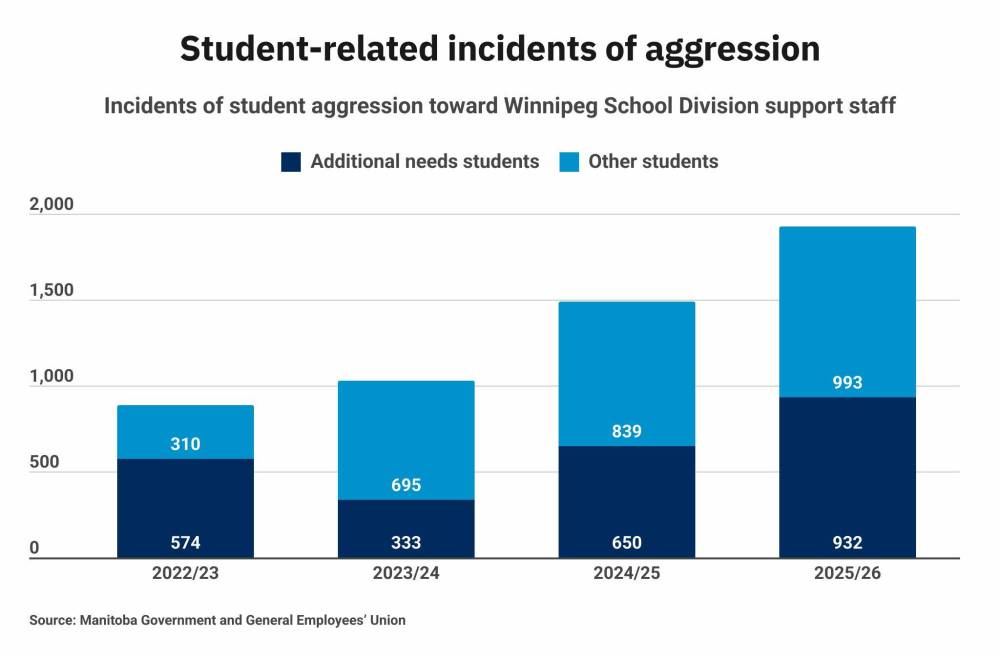
Kicking, biting and other types of student aggression toward educational assistants in Winnipeg has surged 118 per cent since 2022-23.
The Manitoba Government and General Employees’ Union released a breakdown Friday of violent incidents involving support staff in the Winnipeg School Division, the province’s largest.
“You don’t need to teach math to see the numbers are going the wrong way,” MGEU president Kyle Ross said in a news release.
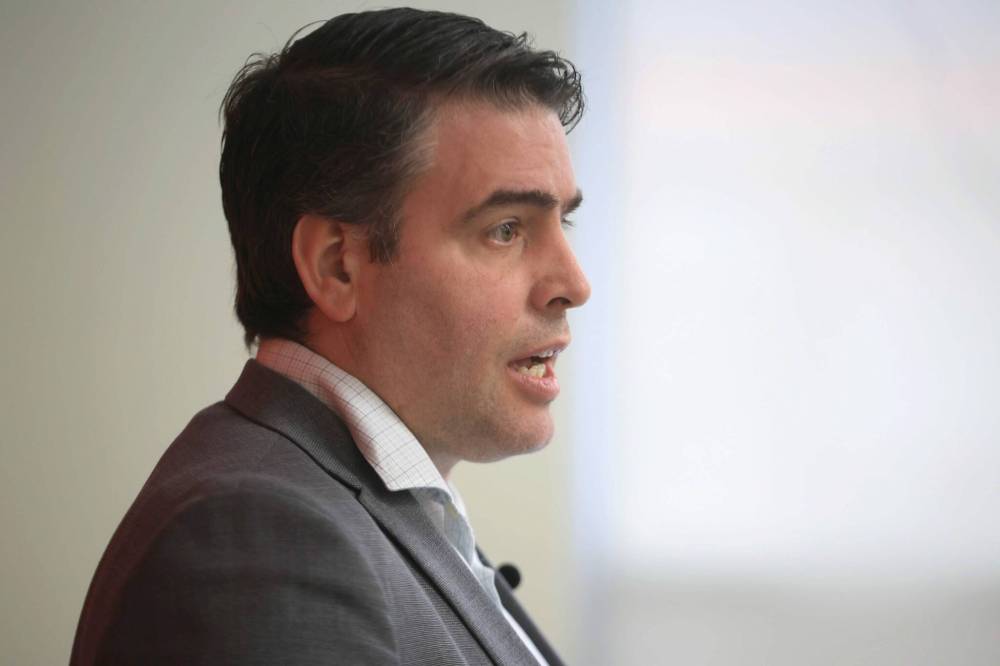
MGEU President Kyle Ross (Ruth Bonneville / Winnipeg Free Press files)
The data shows a surge in “student-related aggression” involving both children with additional needs and other students between 2022-23 and 2025-26.
During the 2022-23 school year, there were 884 reports of a non-teaching employee in the WSD being bitten, kicked or subjected to related behaviour. There were 1,925 incidents last school year.
MGEU represents more than 1,900 division support staff, including educational assistants, administrative clerks, secretaries and library technicians in public schools across inner-city and central Winnipeg.
Ross told the Free Press the union obtained the figures through a freedom of information request in response to anecdotal concerns that came from the workforce.
“It was really eye-opening for me to see this (data) and see it continue to grow over the last couple of years. It’s not a good situation for the students,” he said Friday.
The overwhelming majority of aggression incidents in the division — 99 per cent of them, year over year — are reported by EAs.
Hitting was the most common type of aggression in both 2024-25 and 2025-26.
A student hit a staff member at least 855 times between September 2025 and June, an increase of 224 from the previous school year.
One employee told the Free Press these figures don’t account for all incidents, despite what she said was her division’s top-notch reporting system, because staff are nervous to make disclosures.
“I’m seeing coworkers hurt. I’ve been hurt. We just don’t have the staffing that we need and that is critical,” said the EA who agreed to an interview on the condition of anonymity because she didn’t have WSD approval.
As a result, staff have to carry out tasks they are not qualified nor paid to do, such as changing diapers, she said.
“EAs are going to do it because they care. They’re not going to leave a student without getting their needs met. The division knows we care and I think that gets taken advantage of.”
MGEU is calling for more training in de-escalation tactics and for new hires so that WSD staff can spend quality time developing relationships with individual children they are assigned to support.
The union has also identified concerns that its members are being hired into lower-level EA positions and asked to complete tasks beyond their pay grade once they’re on the front lines.
WSD Superintendent Matt Henderson said he wants staff to know their employer views workplace safety as “paramount” and efforts are ongoing to protect them and prevent burnout while classroom complexity increases.
“These incidents are, oftentimes, when we’re trying to figure out what a child is trying to communicate to us,” Henderson said.
“All children should be loved and cherished and it’s really incumbent around systems and adults to really understand what (their) needs are.”
He noted the division has committed in collective bargaining with MGEU to train more EAs to use mechanical lifts and support hygiene-related tasks. Significant money and time is required to facilitate the process of moving EAs from Classification C to D.
Since he assumed his position three years ago, the division has established professional development days for EAs, added 300 new positions and ensured individual employees have at least six hours of daily work. “Support comes in a variety of ways,” the superintendent added.
While noting the union is appreciative of the division’s efforts to bolster training to help staff better support students who are neurodivergent, Ross said more needs to be done because the incident tally is “far too high.”
He said violence affects staff morale and work-life balance and makes recruitment and retention more difficult.
“It’s not fair to the workers to say, ‘That’s part of the job,’” he said.
The Manitoba Teachers’ Society has been raising concerns in recent years about an increase in violence in all corners of the province.
“It’s a significant and concerning problem,” said Alan Campbell, executive director of the Manitoba School Boards Association.
“At the end of the day, the question around safe learning spaces and safe work spaces for staff comes down to the same conversation around adequate provincial government support.”

Campbell called provincial funding for students with intellectual and physical disabilities, as well as public dollars available for mental-health resources, “20 years behind what it should be.”
Boards are hiking local education property taxes to make up for shortfalls as student needs increase, but the status-quo isn’t sustainable, said the former trustee and father of an eight-year-old with Down syndrome.
Manitoba’s latest school finance reports show funding for “special needs,” including purchasing equipment and hiring staff to support students who have physical, cognitive and emotion or behaviour-related challenges, has risen by $62 million over the last two decades.
Since 2005-06, it has increased from $117 to $180 million — meaning it is has roughly kept pace with the cost of living over time.
maggie.macintosh@winnipegfreepress.com
Maggie Macintosh reports on education for the Winnipeg Free Press. Funding for the Free Press education reporter comes from the Government of Canada through the Local Journalism Initiative.
Our newsroom depends on a growing audience of readers to power our journalism. If you are not a paid reader, please consider becoming a subscriber.
Our newsroom depends on its audience of readers to power our journalism. Thank you for your support.
Maggie Macintosh reports on education for the Winnipeg Free Press. Funding for the Free Press education reporter comes from the Government of Canada through the Local Journalism Initiative.
Our newsroom depends on a growing audience of readers to power our journalism. If you are not a paid reader, please consider becoming a subscriber.
Our newsroom depends on its audience of readers to power our journalism. Thank you for your support.
Advertisement Advertise With Us
Advertisement Advertise With Us
History
Updated on Friday, October 16, 2026 1:13 PM CDT: Adds chart.
Updated on Friday, October 16, 2026 5:00 PM CDT: Adds details, comments.