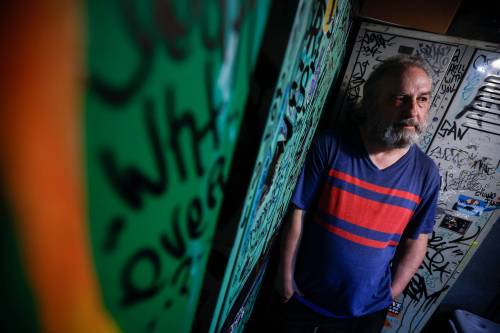
Day-in-the-life film took three decades to complete
‘I made the film that I wanted to make’

Advertisement
Read this article for free:
or
Already have an account? Log in here »
To continue reading, please subscribe:

Digital Subscription
One year of digital access for only $205*
- Enjoy unlimited reading on winnipegfreepress.com
- Read the E-Edition, our digital replica newspaper
- Access News Break, our award-winning app
- Play interactive puzzles
*First annual payment billed as $205.00 + GST for one year. This annual subscription will automatically renew at $233.00 + GST every 52 weeks (10% off the regular annual price of $259.35). Offer available to new and qualified returning subscribers only. Cancel any time.
To continue reading, please subscribe:
Add Free Press access to your Brandon Sun subscription for only an additional
$1 for the first 4 weeks*
- Enjoy unlimited reading on winnipegfreepress.com
- Read the E-Edition, our digital replica newspaper
- Access News Break, our award-winning app
- Play interactive puzzles
*Your next Brandon Sun subscription payment will increase by $1.00 and you will be charged $17.95 plus GST for four weeks. After four weeks, your payment will increase to $24.95 plus GST every four weeks.
Read unlimited articles for free today:
or
Already have an account? Log in here »
Hey there, time traveller!
This article was published 06/06/2025 (495 days ago), so information in it may no longer be current.
Depending on the day, Greg Hanec is a sculptor, an archivist, an abstract digital painter, a street photographer, a freeform musical improviser or a performance artist, toying with the artificial boundary between reality and something else.
But what he’s never been is in any particular rush.
Chalk it up to a combination of hyperactive energy — the 64-year-old has at least a dozen projects on the go at any given moment — and insatiable curiosity. But Hanec’s productivity has served as both his most propulsive asset and a persistent obstacle.
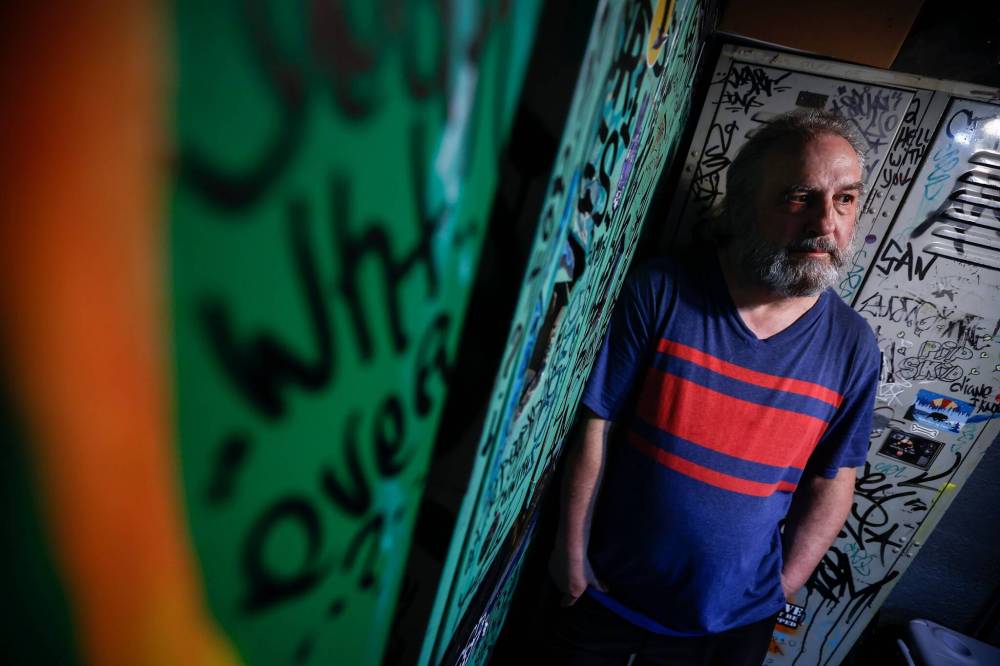
JOHN WOODS / FREE PRESS
Winnipeg filmmaker Greg Hanec’s long-simmering Think at Night screens Sunday as part of the Winnipeg Underground Film Festival.
An intrinsic side effect of perpetual artistic motion is that certain projects are left sitting, the psychic burden of their incompletion growing heavier with every passing year.
“Films are like your children,” he says; in the case of his latest feature, Think at Night, the gestational period far exceeded a typical duration. It takes place over the course of a single day, but Hanec began shooting in 1992.
Thirty-three years later, Think at Night will screen Sunday as part of the Winnipeg Underground Film Festival.
“I think I gave up hope about five or six times that the film would be finished,” jokes actor Alerry Lavitt, who shot her first scene for Hanec’s film in 1992 and did some voice work last year, once the director finished his edit.
“But every 10 years or so, I get a little message from Greg saying, ‘I’m still working on it, and one day, it’ll be out.’”
● ● ●
Beginning with 1980’s 3 Minutes Before 8, Hanec was discovering elements that would become his directorial calling cards: depictions of sealed-off domesticity, excursions into shredding guitar and thrilling full-colour montages of a rapidly changing urban environment, shot with “a preservationist’s eye” and cut together “with the zest of an elated beginner who has found his medium,” according to Caelum Vatnsdal, who profiled Hanec for Place, an anthology of 13 Manitoba filmmakers.
Released in 1982, Hanec’s second short, Work and Money, ended with Hanec’s onscreen character, a budding director, rallying his crew. “The big question,” his character asks, “will this film ever get finished?” Then the real Hanec looks into the lens to call “Cut.”
“This gauzy barrier between truth and fiction, particularly where he himself is concerned, is a feature of all Hanec’s work,” Vatnsdal writes.
By 1983, Hanec turned his attention to feature filmmaking. With $15,000 in film group grants, he set to work with co-writer Mitch Brown on Downtime, a 62-minute feature.
“It’s about loneliness and ennui after high school, but shot in a deliberately slow, black-and-white fashion,” he says.
Released in 1985, nine years before Kevin Smith’s Clerks, it earned comparisons to Jim Jarmusch’s Stranger Than Paradise.
Downtime was selected for the experimental program at that year’s Berlin Film Festival, where his film showed four times in 10 days.
“I was at a reception with Gina Lollobrigida and Harvey Keitel,” Hanec recalls. Federico Fellini was also in the room.
When a pair of feature-length screenplays failed to muster funding, Hanec delved further into music and performance art.
Then in 1992, he decided to shoot and edit the first 20 minutes of Think at Night, not knowing where, how or when it would end.
“Greg is the consummate artist. He’s always going to be creating no matter what he’s doing, and he’s going to do it unapologetically, on his own terms,” says Lavitt.
As DJ Salinger, he created looping soundscapes. With Campbell Martin, Hanec took advantage of blank billboards and available power outlets by conducting a series of “guerilla projections,” a style of rebellious public punk art. He started doing performance art as Comocont in the early 2000s.
But Think at Night stayed on the shelf until, using leftover “short-ends” in the film group’s fridge, Hanec shot about 40 minutes of additional footage in the summer of 2007.
Over the next seven years, Hanec edited footage on the film group’s aging Steenbeck, which broke down in 2014. Local documentarian Patrick Lowe then got Hanec access to the National Film Board’s Steenbeck machine, and other filmmakers assisted Hanec with editing, digitizing and colour-correcting.
Before the pandemic, Hanec, who has never had a cellphone, edited on the computer at the Graffiti Gallery, where until earlier this year, he worked as an archivist.
During COVID, the gallery lent Hanec a home computer and covered part of his monthly internet bill, enabling him to continue his archival work.
“I thought, ‘Great. Now I can work on the film every day,’ but still I didn’t do it as much as I’d like,” he says.

In 2023, Hanec says he made “the big push.”
In December 2024, Think at Night had its world première at the Kinoscop Festival in Belgrade, Serbia. In January 2025, it had its Canadian première at the Available Light Festival in Whitehorse. And on Sunday, a Winnipeg audience will watch Hanec — and the city he documents — transform in one day, as captured over the course of three decades.
In the film, Hanec portrays a bitter ex-artist, which might have once played as a worst-case scenario but now serves as evidence the filmmaker never became the type of person to give up.
“I felt a lot of shame,” Hanec says of the lengthy interval between start and end. ‘But then I thought I should feel perseverant. You shouldn’t feel shame. You finished the film. A lot of people wouldn’t have. They’d say, ‘Oh, it’s been too long — let’s just let it go.’ But I can’t ever put down this film because I made the film that I wanted to make.”
ben.waldman@freepress.mb.ca
If you value coverage of Manitoba’s arts scene, help us do more.
Your contribution of $10, $25 or more will allow the Free Press to deepen our reporting on theatre, dance, music and galleries while also ensuring the broadest possible audience can access our arts journalism.
BECOME AN ARTS JOURNALISM SUPPORTER
Click here to learn more about the project.
Ben Waldman covers a little bit of everything for the Free Press.
Our newsroom depends on a growing audience of readers to power our journalism. If you are not a paid reader, please consider becoming a subscriber.
Our newsroom depends on its audience of readers to power our journalism. Thank you for your support.
Film Preview
Think at Night
by Greg Hanec
● Winnipeg Underground Film Festival
● Dave Barber Cinematheque
● Sunday, 6:30 p.m.
If you value coverage of Manitoba’s arts scene, help us do more.
Your contribution of $10, $25 or more will allow the Free Press to deepen our reporting on theatre, dance, music and galleries while also ensuring the broadest possible audience can access our arts journalism.
BECOME AN ARTS JOURNALISM SUPPORTER
Click here to learn more about the project.
Ben Waldman covers a little bit of everything for the Free Press.
Our newsroom depends on a growing audience of readers to power our journalism. If you are not a paid reader, please consider becoming a subscriber.
Our newsroom depends on its audience of readers to power our journalism. Thank you for your support.
Advertisement Advertise With Us
Advertisement Advertise With Us