Jake Burton alive and bristling in ‘Dear Rider’ documentary

Advertisement

Advertise with us

People who know the sport — really know it — will tell you that the best snowboarding movies are those that never let you get too comfortable.

Read this article for free:


or

Already have an account? Log in here »

To continue reading, please subscribe:

Subscribe and receive a limited-edition Free Press branded hat or tote.

Digital Subscription

One year of digital access for only $205*

  • Enjoy unlimited reading on winnipegfreepress.com
  • Read the E-Edition, our digital replica newspaper
  • Access News Break, our award-winning app
  • Play interactive puzzles

*First annual payment billed as $205.00 + GST for one year. This annual subscription will automatically renew at $233.00 + GST every 52 weeks (10% off the regular annual price of $259.35). Offer available to new and qualified returning subscribers only. Cancel any time.

To continue reading, please subscribe:

Add Free Press access to your Brandon Sun subscription for only an additional

$1 for the first 4 weeks*

  • Enjoy unlimited reading on winnipegfreepress.com
  • Read the E-Edition, our digital replica newspaper
  • Access News Break, our award-winning app
  • Play interactive puzzles
Start now

*Your next Brandon Sun subscription payment will increase by $1.00 and you will be charged $17.95 plus GST for four weeks. After four weeks, your payment will increase to $24.95 plus GST every four weeks.

Hey there, time traveller!
This article was published 26/10/2021 (1784 days ago), so information in it may no longer be current.

People who know the sport — really know it — will tell you that the best snowboarding movies are those that never let you get too comfortable.

That might explain how “Dear Rider” could very well end up in that category, even though nobody dropped out of a helicopter or plunged off a cliff to make this film.

Instead, the best storytelling in the documentary about snowboarding icon Jake Burton, who died in 2019 after a relapse of testicular cancer, comes from the nimble stitching together of decades of home movies and archival media interviews to paint a well-rounded portrait of the man who saw a sport in that undefined slab of fiberglass and forever changed life on the mountain.
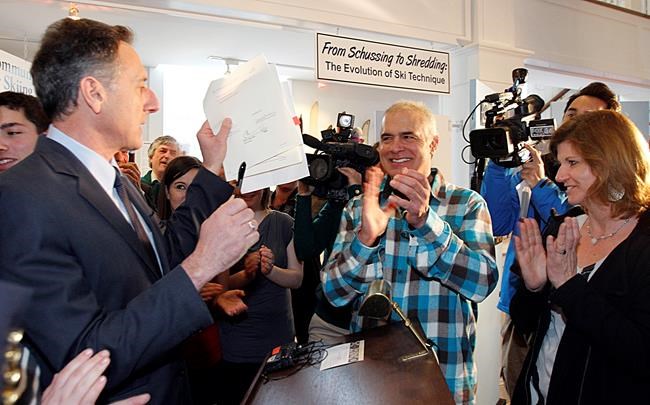
FILE - Jake Burton, the creator of Burton Snowboards, center, and his wife Donna Carpenter, right, applaud Gov. Peter Shumlin after he signed a bill in Stowe, Vt., making skiing and snowboarding the official sports of Vermont, in this March 8, 2012, file photo. A new documentary on the late snowboarding pioneer Jake Burton is more than a glossy retrospective of his life. Jake Burton had been approached about a movie of his life story and had started planning to make it. His wife, Donna, let the project move forward after Burton's death. One of her instructions to director Fernando Villena was that there was no subject that would be out of bounds.(AP Photo/Toby Talbot, File)

Some might argue the wounds from Burton’s death are too fresh to allow for an unflinching narrative about a man whose life and influence on the sport he created are detailed in this 90-minute film, which debuts on HBO on Nov. 9.

But in large part because Burton had been plotting out the movie of his life story well before his death, and knew exactly where he wanted to go with it, much of the fluff that might have accompanied such a project so soon after his passing never makes the cut. A lot of the hard truth of what it took to build a snowboarding empire, then leave it behind too soon, comes to light.

What results is a movie that is, no doubt, an homage to Burton. But it also serves as a history lesson about a pastime that became a sport in the late 1970s when Burton quit his Wall Street job to produce snowboards in his garage in Vermont. It’s a lesson that does not shirk from the uncomfortable realities of his undertaking: Yes, he built it for fun, freedom and who-gives-a-crap rebellion, but no billion-dollar industry sprouts up purely on good vibes and bro hugs.

Some of the most enlightening moments revolve around the sport’s first superstar, Craig Kelly, and his role in the business side’s first major rivalry, between Burton and another snowboard maker, Tom Sims.

It includes backbiting and lawsuits, while also touching on Burton’s potentially career-killing miscalculations at the sport’s outset. The most notable involves prickly issues surrounding the patent for the snowboard that turned Burton, both the man and the company, into something of a pariah within the sport they created. The chapter ends with Kelly’s untimely death in an avalanche in 2003.

It is instructive, not always easy to watch. And while Sims, who died in 2012, would certainly have had a different take on many of these events, the fact this unvarnished portrayal of the main subject makes it into the movie at all is a testament to what Burton, his wife, Donna, and his son, George, were trying to do with this project.

“He was a very resilient man, but the more we could honestly show what his demons were, what his struggles were, and then show how he overcame them, that was always our focus,” said director Fernando Villena, who met several times with Burton before being chosen for the project.

The documentary shows Burton growing as a man while his snowboard becomes both a sport and an industry. He accepts the Olympics and marvels that his invention helped produce a champion such as Shaun White, whose two Rolling Stone magazine covers essentially cemented the sport’s acceptance into the mainstream. Those triumphs also lock in the reality that snowboarding will never return to the days of hand-dug halfpipes and using the legs from overturned park benches as makeshift starting gates.

Being OK with that allowed Burton, and his company, to overcome their rough beginnings and blossom into what they became as the upstart ’80s became the 2010s.

Lest anyone get too comfortable, the last 25 minutes of this movie are mostly sad but partly uplifting. Dozens of family photos and film clips follow Burton as he overcomes cancer, then a paralyzing autoimmune disease, then another bout with cancer that takes him away just as the snow starts falling in the late fall of 2019.
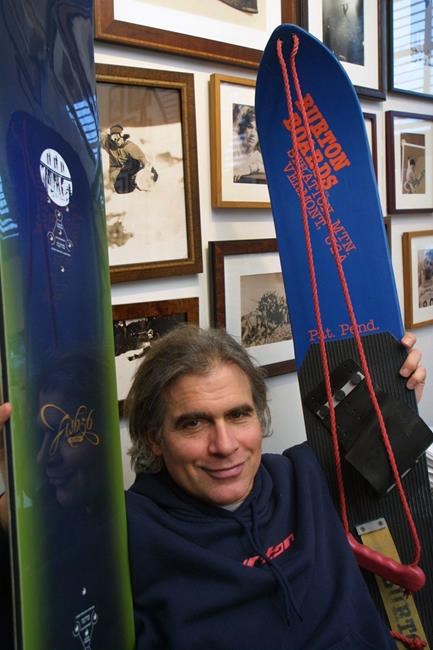
FILE - In this March 8, 2002, file photo, Jake Burton Carpenter, owner of Burton Snowboards, shows an early model, right, and one of the newer snowboards, left, in his office in Burlington, Vt. A new documentary on the late snowboarding pioneer Jake Burton is more than a glossy retrospective of his life. It's a raw, unflinching examination of the trials and tribulations Burton went through over a four-decade career in which he shaped both the snowboard and the the billion-dollar industry that forever changed life on the mountain. The movie: “Dear Rider: The Jake Burton Story,” premieres on HBO on Nov. 9, 2021. (AP Photo/Alden Pellett, File)

“We worked very consciously not to make this too sad, because Jake wasn’t a sad guy,” said his wife, Donna Carpenter. “But it had this certain rawness that maybe it wouldn’t have had” had the movie been completed while Burton was still alive.

For those new (two decades or less) to the snowboarding scene, the old snapshots and film clips of Burton — sometimes sneering, always bristling, never afraid to challenge the snobby ski suits in America and across Europe — are a stark reminder of how much work it took to elbow out room for himself and his baggy-panted diehards on the mountain.

Years passed and Burton Snowboards, always privately owned, branched out and became a behemoth that many in the industry thought was too big. The movie doesn’t flinch from this topic, either.

An interview with a Burton distributor, Andres Erlandsen, about the company’s largesse taps into the main undercurrent of this film — one that’s particularly poignant when viewed through the lens of Burton’s recent death.

“One day I asked him, ‘Have you ever thought about selling Burton?’” Erlandsen said. “And he told me: ‘Anyone who owns Burton Snowboards has to love snowboarding more than me. And I don’t know anyone yet.’”

___

More AP sports: https://apnews.com/hub/apf-sports and https://twitter.com/AP_Sports

Report Error Submit a Tip

More Stories

50 years ago, we thought we could change the world

Robert Milan and Miriam Cooley 8 minute read Preview

50 years ago, we thought we could change the world

Robert Milan and Miriam Cooley 8 minute read 2:00 AM CDT

Winnipeg, 50 years ago.

We began as a small loose unorganized group of teaching friends and educators who shared the same political and social convictions.

We defined ourselves as socialists, feminists and political activists. We were a cross section of educational minds — language arts and social studies teachers, an art teacher, an early childhood educator, a Winnipeg school trustee, a school principal — making our group quite representative of school culture at the time.

Our questions and discussions about politics, education and society arose from a diversity of backgrounds, yet reflected a progressive cohesiveness. The political climate in Manitoba helped bring us together. Sterling Lyon was premier and his Conservative government was pursuing policies that we strongly opposed. To us, his government represented a determined assault on many of the social and political values we believed in, particularly related to education. Eventually we decided that perhaps we should do more than talk. And so the Socialist Teachers Education Movement — STEM — was born.

Read
2:00 AM CDT

COVID-19 tracking apps raise concerns: watchdogs

Nick Wells, The Canadian Press 6 minute read Preview

COVID-19 tracking apps raise concerns: watchdogs

Nick Wells, The Canadian Press 6 minute read Saturday, May. 2, 2020

VANCOUVER - Privacy watchdogs are voicing concerns over proposals across the country to implement smartphone apps to help track COVID-19.

New Brunswick, Manitoba, Newfoundland and Labrador, and Saskatchewan are among the provinces looking at or planning on creating smartphone apps that would track a user's whereabouts.

Alberta is the first province to launch an app.

Known as contact tracing, the apps track those who the user comes in to contact with, commonly by monitoring a device's Bluetooth signal.

Read
Saturday, May. 2, 2020

Man, 21, killed in animal attack on Manitoba First Nation

Free Press staff 2 minute read 9:32 AM CDT

A 21-year-old man was killed in an animal attack in northwestern Manitoba on Wednesday.

An investigation into a suspicious death reported on Sapotaweyak Cree Nation is ongoing, RCMP said in a news release Monday.

Officials were called to the scene, located on the southeast shore of Dawson Bay, on Wednesday and found the man dead on a community road.

“Following an autopsy, the preliminary cause of death was determined to be from an animal attack. The type of animal has not been determined,” RCMP said in the release.

Convicted mail bomber loses parole-denial appeal

Tyler Searle 4 minute read Preview

Convicted mail bomber loses parole-denial appeal

Tyler Searle 4 minute read Thursday, Apr. 2, 2026

Convicted mail bomber Guido Amsel has lost his fight for full parole, after his appeal for release was shot down by the Parole Board of Canada.

In 2018, Amsel received a life sentence with no chance of parole for 10 years for the attempted murders of his ex-wife Iris Amsel and lawyers Maria Mitousis and George Orle in 2015 by mailing explosives to them. One of the bombs, placed inside a hand-held tape recorder with instructions to press the “play” button, exploded in Mitousis’s office, resulting in the loss of her right hand.

He was also sentenced to 12 years minus time served for an earlier attempt to murder his ex-wife in 2013.

He was 59 years old in August, when he appeared before the board to argue for full parole. Had it been granted, he would have been released from federal custody and deported to Germany, where he was born and lived for decades.

Read
Thursday, Apr. 2, 2026

Letters, Sept. 14

7 minute read 2:00 AM CDT

Transit troubles and passes

Re: Growing pains? Maybe, but it’s worth it, Think Tank, Sept. 10.

Worth it for who? Our transit system has been undergoing growing pains for the past year, ever since city staff completely messed up the system with their redesign.

The net result of those changes is reduced ridership, leading to a projected deficit of $18 million in revenues this year (not including the capital costs of those changes). Add that to the annual $126-million subsidy to operate Winnipeg Transit and that’s $144 million being paid annually by Winnipeg taxpayers.

Canada overlooks scores of workers

Krista Carr and Jonathan Lai 4 minute read Wednesday, Jul. 22, 2026

Canada has a labour shortage and a labour surplus at the same time. Canada’s labour force shortages are no longer a temporary challenge. Across the country, “help wanted” signs are everywhere.

A report this spring by RBC Economics said the situation will be exacerbated by retirements and changes in immigration policy.

Employers across the country say they can’t find enough workers. There is a solution, however, that continues to be overlooked. Roughly three-quarters of working-age Canadians with an intellectual disability or autism remain unemployed or underemployed despite being ready, willing and able to work. These two realities should not exist side by side.

For decades, many employers have overlooked this talented and motivated group of workers, often due to misconceptions about workplace accommodations or assumptions about productivity. The result is a labour market that is leaving approximately 500,000 capable individuals on the sidelines while businesses simultaneously report difficulty finding reliable employees.