Japan bans fans at Tokyo-area Olympics venues due to virus

Advertisement

Advertise with us

TOKYO (AP) — Fans will be banned from Tokyo-area stadiums and arenas when the Olympics begin in two weeks, the city’s governor said Thursday after meeting with organizers of the pandemic-postponed games.

Read this article for free:


or

Already have an account? Log in here »

To continue reading, please subscribe:

Subscribe and receive a limited-edition Free Press branded hat or tote.

Digital Subscription

One year of digital access for only $205*

  • Enjoy unlimited reading on winnipegfreepress.com
  • Read the E-Edition, our digital replica newspaper
  • Access News Break, our award-winning app
  • Play interactive puzzles

*First annual payment billed as $205.00 + GST for one year. This annual subscription will automatically renew at $233.00 + GST every 52 weeks (10% off the regular annual price of $259.35). Offer available to new and qualified returning subscribers only. Cancel any time.

To continue reading, please subscribe:

Add Free Press access to your Brandon Sun subscription for only an additional

$1 for the first 4 weeks*

  • Enjoy unlimited reading on winnipegfreepress.com
  • Read the E-Edition, our digital replica newspaper
  • Access News Break, our award-winning app
  • Play interactive puzzles
Start now

*Your next Brandon Sun subscription payment will increase by $1.00 and you will be charged $17.95 plus GST for four weeks. After four weeks, your payment will increase to $24.95 plus GST every four weeks.

Hey there, time traveller!
This article was published 08/07/2021 (1910 days ago), so information in it may no longer be current.

TOKYO (AP) — Fans will be banned from Tokyo-area stadiums and arenas when the Olympics begin in two weeks, the city’s governor said Thursday after meeting with organizers of the pandemic-postponed games.

That means the Olympics will be a largely TV-only event, after the Japanese government put the capital under a COVID-19 state of emergency because of rising new infections and the highly contagious delta variant.

The declaration was made by Prime Minister Yoshihide Suga, and the spectator ban was agreed to by Japanese Olympic organizers, the International Olympic Committee, the International Paralympic Committee, and the metropolitan government of Tokyo.
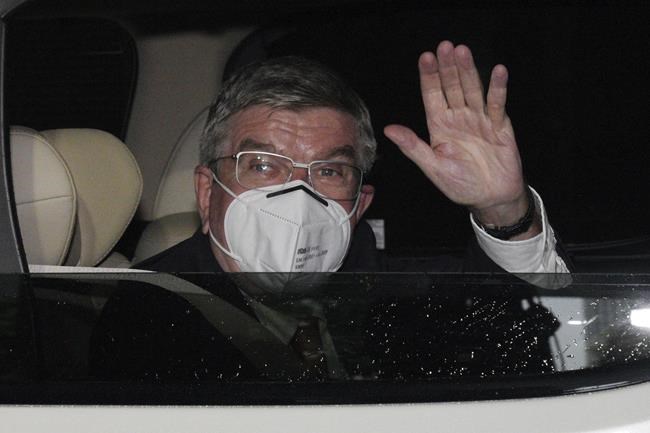
International Olympic Committee (IOC) President Thomas Bach waves from the vehicle to media upon his arrival an accommodation Thursday, July 8, 2021, in Tokyo. Bach arrived on Thursday, July 8, 2021, in Tokyo as Japan Prime Minister Yoshihde Suga was set to declare a state of emergency that is likely to result in a ban on fans from the Tokyo Olympics as coronavirus infections spread across the capital. (AP Photo/Eugene Hoshiko, Pool)

It was a serious blow for Japanese taxpayers and local organizers of the games, which already had been postponed from 2020 by the coronavirus. Hundreds of millions of dollars in ticket revenue will be lost, and that must be made up by the government. Fans also have endured months of uncertainty about whether the Olympics will go ahead.

“Many people were looking forward to watching the games at the venues, but I would like everyone to fully enjoy watching the games on TV at home,” Tokyo Gov. Yuriko Koike said after the meeting. “It’s gut-wrenching because many people looked forward to watching at the venues.”

Fans from abroad were banned months ago, and the new measures will mean no spectators in stadiums and arenas around Tokyo — both indoor and outdoor venues.

The ban covers Tokyo and three surrounding prefectures — Kanagawa, Saitama and Chiba. A smattering of events in outlying areas, like baseball in the northeastern prefecture of Fukushima, will allow a limited number of fans.

The state of emergency begins July 12 and runs through Aug. 22. The Olympics, which open July 23 and run through Aug. 8, fall entirely under the emergency period, while the Paralympics open Aug. 24.

“Taking into consideration the impact of the delta strain, and in order to prevent the resurgence of infections from spreading across the country, we need to step up virus prevention measures,” Suga said.

In principle, the July 23 opening ceremony at the new $1.4 billion National Stadium will be without paying fans, although some dignitaries, sponsors, IOC officials and others will be allowed to attend.

“We will have to review the situation about the dignitaries and stakeholders,” organizing committee President Seiko Hashimoto said of the opening ceremony.

“No fans was a very difficult decision,” she added.
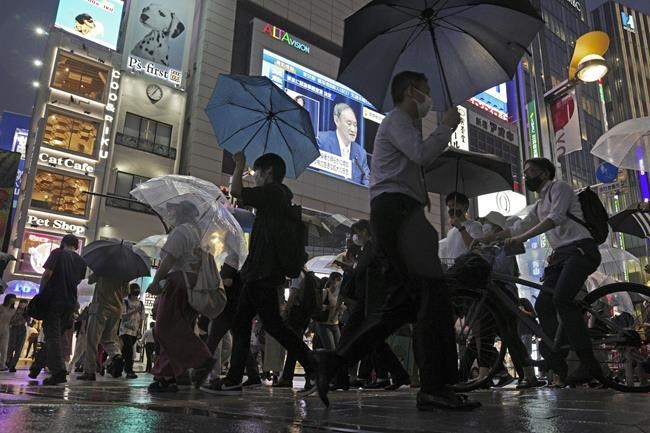
Pedestrians walk past a giant public TV with a live broadcast of a news conference by Japanese Prime Minister Yoshihide Suga after he announced a state of emergency because of rising coronavirus infections Thursday, July 8, 2021, in Tokyo. Suga said the state of emergency would go in effect on Monday and last through Aug. 22. This means the Olympics, opening on July 23 and running through Aug. 8, will be held entirely under emergency measures. The Paralympics open on Aug. 24. (AP Photo/Eugene Hoshiko)

Hashimoto acknowledged some regrets, particularly about the decision coming so late.

“We had no choice but to arrive at the no-spectator decision,” she said. “We postponed and postponed, one after another. I have done some soul-searching about that.”

The emergency declaration made for a rude arrival for IOC President Thomas Bach, who landed Thursday in Tokyo for the games. He attended the virtual meeting on fans from his five-star hotel for IOC officials where he was self-isolating for three days.

“What can I say? Finally we are here,” Bach said, sounding upbeat as he opened the late night meeting that ended close to midnight. “I have been longing for this day for more than one year.”

Toshiro Muto, the CEO of the organizing committee, said many sponsors, federation officials and others would be considered to be “organizers” and thus would be allowed to attend venues. He said some might occupy public seating, but he said he did not know “the numerical details.”

Organizers had expected to generate about $800 million in ticket sales. Any shortfall — and it could be almost the entire amount — will have to be made up by Japanese government entities.

Japan is officially spending $15.4 billion on the Olympics, and several government audits say it’s much larger. All but $6.7 billion is public money.

Two weeks ago, organizers and the IOC allowed venues to be filled to 50% of capacity, with crowds not to exceed 10,000. The state of emergency forced the late turnaround, which was always an option if infections got worse.
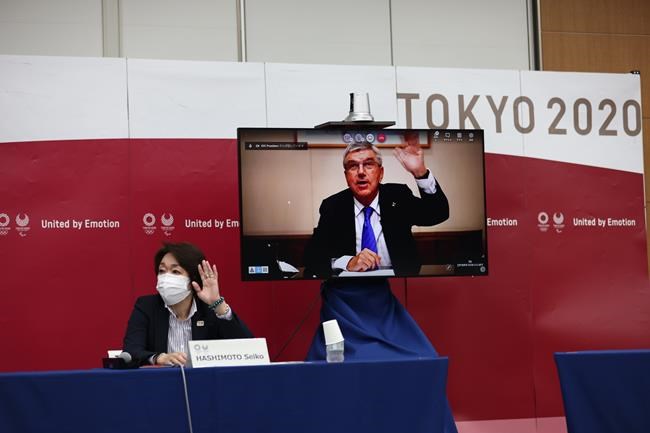
International Olympic Committee (IOC) president Thomas Bach (on-screen) and Tokyo 2020 president Seiko Hashimoto, left, wave at the beginning of the five-party meeting in Tokyo, Thursday, July 8, 2021. (Behrouz Mehri/Pool Photo via AP)

On Thursday, Tokyo reported 896 new cases, up from 673 a week earlier. It’s the 19th straight day that cases have topped the mark set seven days prior. New cases on Wednesday hit 920, the highest total since 1,010 were reported on May 13.

The main focus of the emergency is a request for bars, restaurants and karaoke parlors serving alcohol to close. A ban on serving alcohol is a key step to tone down Olympics-related festivities and keep people from drinking and partying. Tokyo residents are expected to face requests to stay home and watch the games on TV.

“How to stop people enjoying the Olympics from going out for drinks is a main issue,” Health Minister Norihisa Tamura said.

The rise in infections also has forced the Tokyo city government to pull the Olympic torch relay off the streets, allowing it only on remote islands off the capital’s coast.

“The infections are in their expansion phase and everyone in this country must firmly understand the seriousness of it,” said Dr. Shigeru Omi, a top government medical adviser.

He urged authorities to take tough measures quickly ahead of the Olympics, with summer vacations approaching.

Omi has repeatedly called for a spectator ban, calling it “abnormal” to stage an Olympics during a pandemic.

A government COVID-19 advisory panel on Wednesday expressed concerns about the resurgence of infections.

“Two-thirds of the infections in the capital region are from Tokyo, and our concern is the spread of the infections to neighboring areas,” said Ryuji Wakita, director-general of the National Institute of Infectious Diseases.
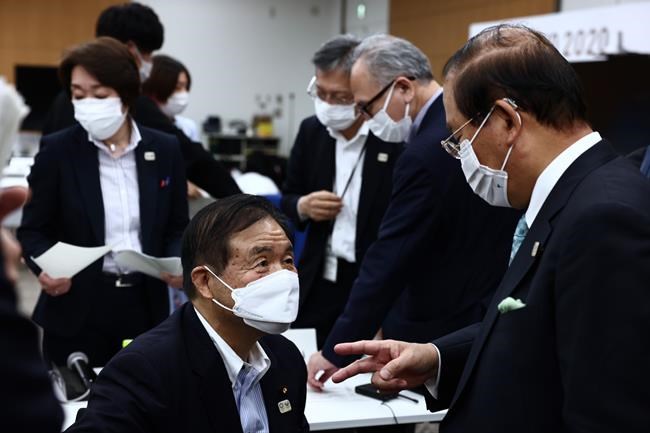
Tokyo 2020 organising committee vice-president Toshiaki Endo, second left, speaks with Tokyo 2020 CEO Toshiro Muto after the five-party meeting in Tokyo, Thursday, July 8, 2021. (Behrouz Mehri/Pool Photo via AP)

The Olympics are pushing ahead against most medical advice, partially because the postponement stalled the IOC’s income flow. It gets almost 75% from selling broadcast rights, and estimates suggest it would lose $3 billion to $4 billion if the Olympics were canceled altogether.

About 11,000 Olympians and 4,400 Paralympians are expected to enter Japan, along with tens of thousands of officials, judges, administrators, sponsors, broadcasters and media. The IOC says more than 80% of Olympic Village residents will be vaccinated.

Nationwide, Japan has had about 810,000 cases and nearly 14,900 deaths. Only 15% of Japanese are fully vaccinated, still low compared with 47.4% in the United States and almost 50% in Britain.

___

More AP Olympics: https://apnews.com/hub/olympic-games and https://twitter.com/AP_Sports

Report Error Submit a Tip

More Stories

Roughing it (less)

AV Kitching 6 minute read Preview

Roughing it (less)

AV Kitching 6 minute read Monday, Jul. 6, 2026

I hate camping.

I loathe the very idea of leaving the comfort and safety of home to sleep in a random field, where not only will I be exposed to the elements, but will also be at the mercy of all manner of creatures, from ursine to canine to insectan.

I do not want to hike up a hill just to share one outdoor tap with 12 others, standing alongside them as I brush my teeth.

I do not want to queue for 15 minutes, then part with a $2 coin to wedge myself into a shower stall just to stand under a piddly stream of lukewarm water while trying my best to swiftly soap up and sponge off lest I irk the rapidly growing line of campers outside.

Read
Monday, Jul. 6, 2026

City considers first-come, first-served Transit Plus

Kevin Rollason 5 minute read Preview

City considers first-come, first-served Transit Plus

Kevin Rollason 5 minute read Friday, Sep. 11, 2020

The city's much-maligned Transit Plus, which is for people with disabilities, could soon do away with a system that prioritizes jobs and medical trips over recreation and visits with friends, in favour of first-come, first-served bookings.

While the city says the changes could mean Transit Plus users would no longer be guaranteed to get to work or medical appointments, several disability advocates are in favour of the move. They don't believe any trip should take priority over another.

Natalie Pirson has used Transit Plus, and the former Handi Transit system, for more than 20 years. She is pleased with the proposed changes, which will be discussed by the city's public works committee next week. Pirson was quick to point out the city will have to do more than change the booking system.

"I rely on Transit Plus for every aspect of my life," Pirson said on Thursday.

Read
Friday, Sep. 11, 2020

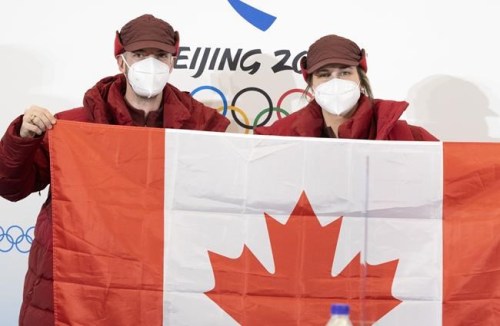
Hamelin, Poulin named Canada's flag-bearers

Lori Ewing, The Canadian Press 5 minute read Preview

Hamelin, Poulin named Canada's flag-bearers

Lori Ewing, The Canadian Press 5 minute read Wednesday, Feb. 2, 2022

Also, a reader expresses support for a husband who keeps in touch with an ex from 30 years ago.

Read
Wednesday, Feb. 2, 2022

Ferraro gets a call-up to the Jets

Mike McIntyre 6 minute read Preview

Ferraro gets a call-up to the Jets

Mike McIntyre 6 minute read 1:46 PM CDT

Landon Ferraro vividly recalls the moment his NHL career came to an extremely painful end — Oct. 20, 2017, in downtown Winnipeg.

“My last play was a breakaway on Connor Hellebuyck,” Ferraro told the Free Press this week.

“I tried to poke the puck past the first D. It was me and (Dustin) Byfuglien chasing it down. I thought he was going to throw me across the ice, so I tried to cut in on him, and he moved. I overextended, and I literally ripped my abductor off the bone and gave myself a hernia.”

Ferraro — at the time playing forward for the visiting Minnesota Wild — said he managed to get off a weak shot that hit the Jets goaltender square in the chest. But his 77th appearance in the big leagues would be his last following previous stops with Detroit (which drafted him 32nd overall in 2009) and Boston.

Read
1:46 PM CDT

Eliminating short-term sick notes ‘big step forward’: Doctors Manitoba

Matthew Frank 4 minute read Preview

Eliminating short-term sick notes ‘big step forward’: Doctors Manitoba

Matthew Frank 4 minute read Updated: Yesterday at 6:32 PM CDT

Manitoba doctors will no longer be required to issue sick notes for short-term employee absences due to illness or injury, starting Thursday.

The new provincial legislation, which officially passed in June, will only allow employers to request the medical documents when an employee has been absent for more than a week or if they’ve called in sick 10 or more times in a calendar year.

Dr. Nichelle Desilets, Doctors Manitoba board chair, said the legislation will free up time for physicians to concentrate on medical appointments and called the new rules among the strongest in Canada.

“What may be a small change in the labour code can be a big step forward on improving access to medical care for all Manitobans and using our health care resources wisely,” she said during a news conference Tuesday.

Read
Updated: Yesterday at 6:32 PM CDT

Hydro reports $446-M loss in 2025-26, points to fourth drought year in past five

Scott Billeck 3 minute read Preview

Hydro reports $446-M loss in 2025-26, points to fourth drought year in past five

Scott Billeck 3 minute read Yesterday at 6:38 PM CDT

Manitoba Hydro posted a $446-million loss in 2025-26, as drought conditions slashed hydroelectric generation, forcing the Crown corporation to buy more power while leaving it with less electricity to sell outside the province.

The loss was $666 million worse than the $220-million profit Hydro had budgeted. The utility posted a $63-million loss the previous year, according to the utility’s annual report released Tuesday.

Hydro said the 2025-26 fiscal year, which ended on March 31, marked its fourth low-water year in the past five years, among the worst stretches of water-flow conditions in its recorded history.

Hydroelectric generation fell 23 per cent to 24 billion kilowatt-hours from 31 billion the previous year, leaving Hydro a net importer of electricity.

Read
Yesterday at 6:38 PM CDT