Tokyo Olympics to allow local fans – but with strict limits

Advertisement

Advertise with us

TOKYO (AP) — A sharply limited number of fans will be allowed to attend the Tokyo Olympics, organizers announced Monday as they tried to save some of the spirit of the Games where even cheering has been banned.

Read this article for free:


or

Already have an account? Log in here »

To continue reading, please subscribe:

Subscribe and receive a limited-edition Free Press branded hat or tote.

Digital Subscription

One year of digital access for only $205*

  • Enjoy unlimited reading on winnipegfreepress.com
  • Read the E-Edition, our digital replica newspaper
  • Access News Break, our award-winning app
  • Play interactive puzzles

*First annual payment billed as $205.00 + GST for one year. This annual subscription will automatically renew at $233.00 + GST every 52 weeks (10% off the regular annual price of $259.35). Offer available to new and qualified returning subscribers only. Cancel any time.

To continue reading, please subscribe:

Add Free Press access to your Brandon Sun subscription for only an additional

$1 for the first 4 weeks*

  • Enjoy unlimited reading on winnipegfreepress.com
  • Read the E-Edition, our digital replica newspaper
  • Access News Break, our award-winning app
  • Play interactive puzzles
Start now

*Your next Brandon Sun subscription payment will increase by $1.00 and you will be charged $17.95 plus GST for four weeks. After four weeks, your payment will increase to $24.95 plus GST every four weeks.

Hey there, time traveller!
This article was published 21/06/2021 (1934 days ago), so information in it may no longer be current.

TOKYO (AP) — A sharply limited number of fans will be allowed to attend the Tokyo Olympics, organizers announced Monday as they tried to save some of the spirit of the Games where even cheering has been banned.

Organizers set a limit of 50% capacity — up to a maximum of 10,000 fans, all of whom must be Japanese residents — for each Olympic venue, regardless of whether it is indoors or outdoors. Officials said that if coronavirus cases rise again the rules could be changed and fans could still be barred all together. Spectators from abroad were banned several months ago, and now some local fans who have tickets will be forced to give them up.

The decision comes as opposition among Japanese to holding the Games in July remains high, though may be softening, and as new infections in Tokyo have begun to subside.
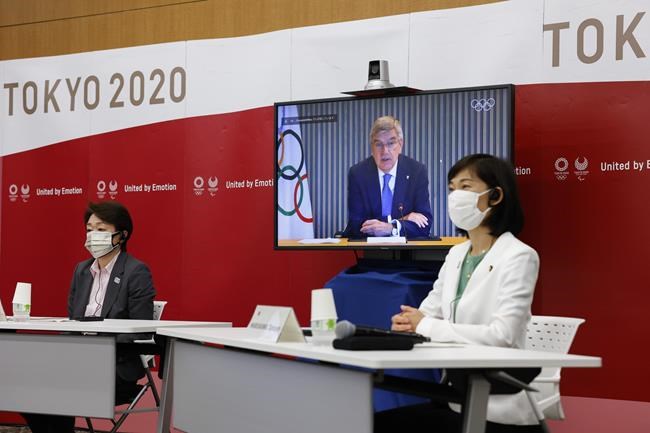
Tokyo 2020 President Seiko Hashimoto, left, Japanese Olympic Minister Tamayo Marukawa, right, and IOC President Thomas Bach, on a screen, attend a five-party online meeting at Harumi Island Triton Square Tower Y in Tokyo Monday, June 21, 2021. The Tokyo Olympics will allow some local fans to attend when the games open in just over a month, Tokyo organizing committee officials and the IOC said on Monday. (Rodrigo Reyes Marin/Pool Photo via AP)

Still, health officials fear that in a country where the vast majority of people have yet to be vaccinated, crowds at the Olympics could drive cases up. The country’s top medical adviser, Dr. Shigeru Omi, recommended last week that the safest way to hold the Olympics would be without fans. Allowing fans presents a risk not just at the venues but will also lead to more circulation on commuter trains, in restaurants and other public spaces.

It’s already become clear that these Olympics Games will be unlike any others, but organizers have said they are determined to hold them and billions of dollars in broadcast rights and ticket sales are at stake. Still, much of the fanfare that surrounds them — people from around the world rubbing elbows, a celebratory atmosphere in the host city and the showcasing of the host country’s culture — will be off the table or far more muted this year.

Seiko Hashimoto, the president of the Tokyo Olympic organizing committee, called the decision “the last piece for the Olympics” to proceed on July 23.

But as with everything about these Olympics — the first postponed in the history of the Modern Games dating from 1896, though previous ones were canceled during both World Wars — the decision raised many questions.

For one, it is not quite what it seems. Although a maximum of 10,000 fans will be allowed in any given venue, so-called stakeholders — including sponsors and sporting federation officials — will not be counted toward that total, according to organizing committee CEO Toshiro Muto. Japanese media, for instance, reported that up to 20,000 people might attend the opening ceremony, over and above athletes, though Muto said he thought it would be less than that.

The decision on local fans was announced after so-called Five Party talks online with local organizers, the International Olympic Committee, the International Paralympic Committee, the Japanese government and the government of metropolitan Tokyo. A decision on the Paralympics comes on July 16.

Hashimoto, meanwhile, left the door open for a no-fans Olympics if the conditions worsen around the pandemic.

“We need to be very flexible. If there is any abrupt change in the situation, we will hold five-party meetings again to make other decisions,” Hashimoto said. “If there is an announcement of a state of emergency during the Games, all the options like no-spectator games will be examined.”

Officials say local fans will be under strict rules. They will not be allowed to cheer, must wear masks, and are being told to go straight home afterward.

“We would like people to go directly home from the venue without stopping by anywhere,” Muto said.

He said 3.64 million tickets were already in the hands of Japanese residents. He indicated that was about 900,000 more than the seats likely to be available. That will mean a lottery to see who can attend.

Tokyo organizers had expected about $800 million in revenue from ticket sales, but Muto said the actual figure would be no more than half that. Any shortfall will have to be picked by some Japanese government entity.

The University of Oxford has said these are the most expensive Olympics on record. The official cost is $15.4 billion, but several government audits suggest it might be twice that much. All but $6.7 billion is public money.
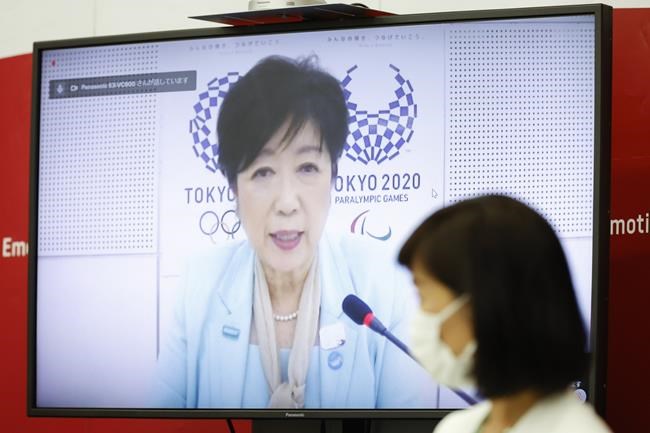
Tokyo Gov. Yuriko Koike, on a screen, speaks as Japanese Olympic Minister Tamayo Marukawa listens during a five-party online meeting at Harumi Island Triton Square Tower Y in Tokyo Monday, June 21, 2021. The Tokyo Olympics will allow some local fans to attend when the games open in just over a month, Tokyo organizing committee officials and the IOC said on Monday. Organizers set a limit of 50% of capacity up to a maximum of 10,000 fans for all Olympic venues. (Rodrigo Reyes Marin/Pool Photo via AP)

The IOC relies on selling broadcast rights for almost 75% of its income. Another 18% is from sponsors. A cancelation would cost the IOC an estimated $3 billion-$4 billion in lost broadcast income — an enormous blow especially at a time when its income flow has already been slowed by the pandemic.

The decision comes just as Tokyo has emerged from a state of emergency as the curve of new cases has flattened. The seven-day average for new infections in the city is about 400 daily.

The capital and other areas are now under “quasi-emergency” status until July 11. The new rules will allow restaurants to serve alcohol during limited hours, the main outcome from the reduced restrictions.

Overall, more than 14,000 deaths have been attributed to COVID-19 in Japan, which has managed the pandemic better than many countries but not as well as some others in Asia. Its vaccination campaign remains behind many Western ones, with about 6.5% of Japanese fully vaccinated and 16.5% with at least one shot.

Prime Minister Yoshihide Suga, who has favored allowing fans, said before the official announcement that he would bar fans if conditions change. Tokyo Governor Yuriko Koike echoed that.

“If a state of emergency is necessary, I will be flexible and open to no fans in order to achieve that the Games give top priority to safety and security for the people,” Suga said.

He said he took “seriously” Omi’s recommendations but did not follow them.

In recent polls, support seems to be increasing for holding the Olympics, though a majority still appear to favor postponing or canceling the Games, depending how the question is worded.

___

More AP Olympics: https://apnews.com/hub/olympic-games and https://twitter.com/AP_Sports

Report Error Submit a Tip

More Stories

Michael Douglas comes to terms with fears, fame, father

Hillel Italie 6 minute read Preview

Michael Douglas comes to terms with fears, fame, father

Hillel Italie 6 minute read 2:01 AM CDT

NEW YORK — Michael Douglas, the award-winning actor and producer, recently turned 82. He is a cancer survivor, a recovered addict, a married man, the father and son of actors.

He is also an author, who begins his memoir with a message of thanks to his family — past and present and future — for the “sense of immortality.”

“Many times my father was asked, ‘Kirk, are you jealous of your son?’” he said during a recent interview at a Manhattan hotel, referring to his late father, fellow actor and sometime combatant Kirk Douglas.

“And he said, ‘Jealous?’ This is a sense of immortality, a continuity of generations.’”

Read
2:01 AM CDT

Dealing now with increasing judicial dangers

Ben Wickstrom 5 minute read Tuesday, Sep. 29, 2026

For years, the Manitoba Association of Crown Attorneys (“MACA”) has been engaged in a dispute with the Manitoba government over the workload of its lawyers. That dispute is expected to come to a head at the end of November, when two weeks of grievance hearings are scheduled.

We remain hopeful that we can reach an agreement with our employer. But if we cannot, our union’s lawyers are prepared to make our case. As those hearings approach, we want to explain how we got here, what is at stake, and why this dispute matters beyond the working conditions of our members.

These problems are longstanding and predate the election of Manitoba’s current government. Our concern with the current government is not that it created these problems, but that it is now responsible for addressing them.

Despite the evidence before it, the government has not meaningfully addressed the workload concerns we have raised throughout its time in office.

Scare up some social reconnection this fall

Maureen Scurfield 4 minute read Yesterday at 2:00 AM CDT

DEAR MISS LONELYHEARTS: I’m an emotional mess. My lesbian girlfriend and I broke up in August, and now I hold the lease on the apartment we shared. It’s a great big old place with two spacious balconies.

I just got new roommates — two younger friends who really love it here — but secretly I’m still feeling lonely. Every minute of living here reminds me of my girlfriend because we decorated the place together and hung out on the balconies to sunbathe in the summer.

Would it help to move out of my beloved old block with its memory triggers? Maybe, but what if I died of loneliness in a new place? I need people around me, and no one but my ex-girlfriend has really been the right person. Please help. I feel sick about this.

— Love-Nest Sadness, Winnipeg

Youth centre library cancellation baffles

Editorial 4 minute read Preview

Youth centre library cancellation baffles

Editorial 4 minute read 2:00 AM CDT

It’s difficult to understand why Manitoba Corrections would shut down a library program that cost taxpayers nothing, was popular with young inmates and was designed to help them learn.

But that is what happened at the Manitoba Youth Centre, where a volunteer-run pop-up library has been cancelled by the province.

The Prison Libraries Committee, part of the Manitoba Library Association, provided the program at no cost to Corrections. Once a month, volunteer librarians brought books into the youth centre, helped young people find reading material, assisted with school research and provided something that can be in short supply in a correctional institution — positive interaction with people from outside its walls.

The program became so popular that the youth centre asked for it to be offered more frequently.

Read
2:00 AM CDT

Corporate declaration of action takes flight

Gabrielle Piché 4 minute read Preview

Corporate declaration of action takes flight

Gabrielle Piché 4 minute read 2:01 AM CDT

Businesses pledging to support reconciliation will meet in Assiniboine Park today as a national project launches.

Victoria Grant plans to attend. She’s been working on this nationwide corporate declaration of action for years — skipping Wednesday morning’s event in Winnipeg means missing launch time.

The private-sector-led declaration will gain its first signees during a ceremony, running from 10 a.m. to noon in the Pavilion.

Signatories agree to learn about the past, build cultural awareness, support Indigenous entrepreneurs and incorporate reconciliation into their corporate policies, among other things.

Read
2:01 AM CDT

AI governance: Canada’s next structural test

Anne Thompson 4 minute read 2:00 AM CDT

Artificial intelligence is accelerating faster than the governance structures meant to contain it. Canada now faces a structural test — whether our institutions can protect autonomy, dignity, and continuity in an era when decision-making is increasingly mediated by systems we did not design, cannot fully audit, and do not yet constitutionally constrain.

This is not a technological problem. It is a governance problem.

AI systems influence how information flows, how institutions behave, and how decisions are made. They shape the conditions under which harm becomes predictable. They amplify both the strengths and weaknesses of the systems into which they are deployed. And they do all of this at a scale and speed that outpaces traditional regulatory tools.

Canada’s current approach to AI governance relies heavily on policy, guidelines, and sector-specific regulation. These are important, but they are not sufficient. What is missing is structural clarity — a constitutional-grade framework that defines authority, responsibility, accountability, and the minimum conditions under which AI systems may operate without undermining human dignity or institutional credibility.