High on passion, low on fuel
Canadian artists grapple with touring difficulties as gas prices rise
Advertisement
Read this article for free:
or
Already have an account? Log in here »
To continue reading, please subscribe:
Digital Subscription
One year of digital access for only $1.44 a week*
- Enjoy unlimited reading on winnipegfreepress.com
- Read the E-Edition, our digital replica newspaper
- Access News Break, our award-winning app
- Play interactive puzzles
*Billed as $5.77 plus GST every four weeks. After 52 weeks, price increases to the regular rate of $19.95 plus GST every four weeks. Offer available to new and qualified returning subscribers only. Cancel any time.
To continue reading, please subscribe:
Add Free Press access to your Brandon Sun subscription for only an additional
$1 for the first 4 weeks*
- Enjoy unlimited reading on winnipegfreepress.com
- Read the E-Edition, our digital replica newspaper
- Access News Break, our award-winning app
- Play interactive puzzles
*Your next Brandon Sun subscription payment will increase by $1.00 and you will be charged $17.95 plus GST for four weeks. After four weeks, your payment will increase to $24.95 plus GST every four weeks.
Read unlimited articles for free today:
or
Already have an account? Log in here »
It’s a story as old as rock and roll: some kids hop in a van, fill up on cigarettes and gas, and let ‘er rip on the Trans-Canada Highway in pursuit of fun, fame and fortune.
Or, failing fortune, a wad of 20s and loose change to cover gas on the way home two weeks later.
If they turn on the radio before reaching the Perimeter, hopefully the bad news and bad vibes they hear won’t persuade them into pulling a U-turn.

In June, it was reported that Manitoba’s annual inflation rate had jumped to 4.6 per cent in May, topping all provinces alongside Nova Scotia. Statistics Canada said drivers were paying the highest for gas since June 2022, when Russia’s invasion of Ukraine threw global supply chains into chaos.
The 2026 war in oil-rich Iran has likewise sent shockwaves through supply chains. Drivers across the country are feeling their back pockets burn.
Canadian musicians depend crucially on travelling long distances to reach critical masses of audiences. And when discretionary spending — money spent on non-essential things like concert experiences — takes a nosedive, it can be an unsettling sign of bigger economic problems.
“People think that it starts and ends with musicians, but the reality is that the entertainment industry as a whole is one of Canada’s largest industries,” says Amit Mehta, band manager and founding partner at Good Company Productions.
He was in Winnipeg in June for the Winnipeg International Jazz Festival, managing Shebad, one of Guelph’s most successful acts, through a North American tour.
“They’re getting paid relatively well. We’re still netting out in the negative … If artists are creating less, it’s because they have less free income, or less time, or too much stress in some cases to actually be creative (and) it’s an indicator of how much discretionary money people have.”
• • •
Leavesliketinyflames, whose members are all Manitobans in their late teens or early 20s, are gearing up to tour the West Coast this August.
Almost everything about them feels like a throwback.
Their sound evokes screamo or hardcore, genres whose mainstream heyday about 20 years ago made an impressive dent on international airplay with CanCon bands like Alexisonfire, Billy Talent and Winnipeg’s Comeback Kid.
But even this unique moment in Canadian music was supported by broad, informal networks across the country of DIY enthusiasts with a couch to spare or access to alternative venues.
Leavesliketinyflames says these loose networks still animate domestic independent rock — even if some of its infrastructure, once strongly linked to college radio and music ‘zines, is shrinking.

“The nice thing about being in a band that’s adjacent to hardcore, or heavier music genres, is that there’s such a strong sense of community there. There’s a feeling of these people, even though they’re halfway across Canada — they’ll have my back,” says guitarist Hunter Schmidt.
But with all this good will, the band aims to treat its fans as more than consumers.
“With the price of everything going up, we, in turn, have to raise the price of our merch. We don’t want to scalp our friends and fans,” drummer Desmond Young.
“Our friends are already broke,” adds Schmidt to laughter from his bandmates. All the same, the energy is mostly positive. Their hope is to break even.
“Hunter and (bassist) Shane (Grant) have done incredible work getting the vehicle set up in order and calculating gas,” says Young. “We hope to God people show up, otherwise we just might be dead broke and flat on our ass. If something goes wrong with the car, it’s over.”
• • •
Surging fuel prices are hitting Canadian musicians across genres and degrees of professionalism.
Airfares have risen sharply compared with 2025. As of late June, Canadians were paying about 11 per cent more for domestic airfare than they were a year before.
The effects on full-time Canadian artists, especially those more likely to fly to gigs, are not always obvious at first glance.
Many of Canada’s classical soloists, sectional players and smaller ensembles fly within Canada. They are supported by some of Canada’s oldest and better-funded music institutions, mostly through donations and government support. That’s a source of stability, but arguably it also makes many institutions slower to respond to market realities.
Madeline Hildebrand lives in Wolseley and — as a faculty of music professor at Memorial University in St. John’s, N.L., and in-demand pianist — she’s often on the road or in the sky.
She says while concert contracts are supposed to reflect the cost of travel, right now many agreements are lagging behind the real fiscal burdens of travel.
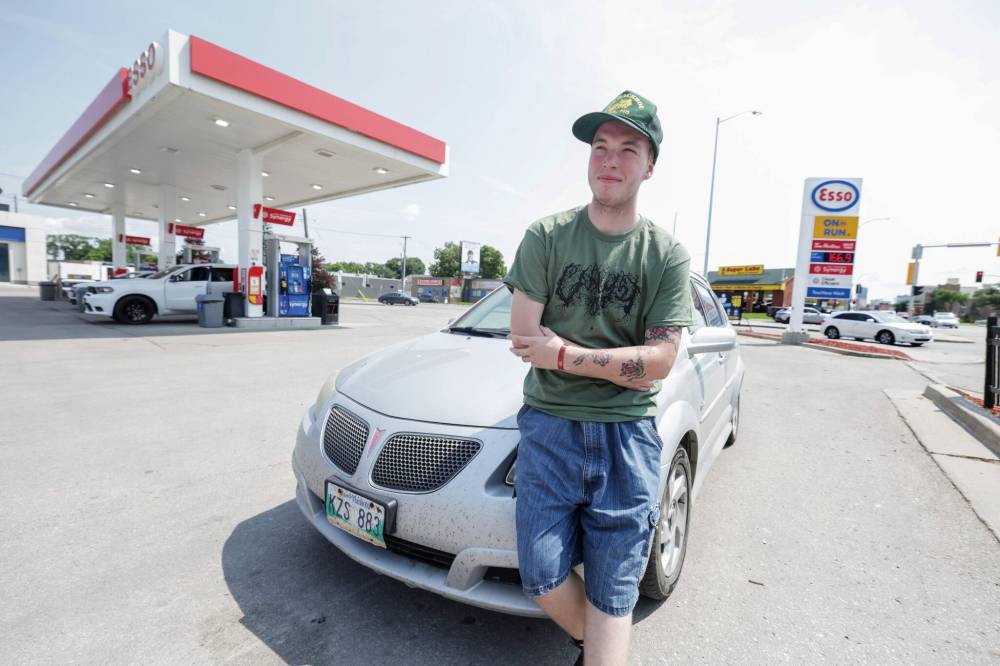
Ruth Bonneville / Free Press ent - gas costs for touring bands Photo of Desmond Williams at a local gas station. Desmond Williams, a member of a young local band going on a BC tour; This is for a story focusing on the impact of gas prices on musicians Reporter: Conrad Sweatman July 10th, 2026
“I think it’s not on the radar for a lot of orgs. So we have to ask for it … risking that the contractor can’t accommodate,” she says. “(Even) for smaller contracts, like a week of adjudicating … the price hasn’t changed in a long time.”
Hildebrand says she’s already flown in and out of St. John’s 11 times this year and four times out of Winnipeg — but only once to the U.S., where she completed her music doctorate at the prestigious Stony Brook University in New York.
Strictures surrounding continental travel add a whole other layer of challenge for Canadian musicians. On top of rising ticket prices, there are steep U.S. visa and processing fees, an unfavorable exchange rate and tougher border requirements.
“The reality is that if you want to pursue this as a career, you need to activate a lot of American markets as a Canadian artist, which means you have to travel there,” says Mehta, Shebad’s manager.

“Right now we’re spending close to $10,000 every time we need that visa.”
As he tours this summer with Shebad through the U.S. and Canada, the accomplished music professional is thinking about the future of Canadian music — at moment when he feels too many Canadians have given into “bedroom communities.”
“It’s easy for people to just stay home and have their quote-unquote needs met without realizing that they’re missing certain things in their lifestyle,” he says.
“A musician is pursuing this career … usually to connect with other people and bring people together, and there are already so many barriers in the way. Gas is just one more thing that’s making it even harder to do.”
winnipegfreepress.com/conradsweatman
Conrad Sweatman is an arts reporter and feature writer. Before joining the Free Press full-time in 2024, he worked in the U.K. and Canadian cultural sectors, freelanced for outlets including The Walrus, VICE and Prairie Fire. Read more about Conrad.
Our newsroom depends on a growing audience of readers to power our journalism. If you are not a paid reader, please consider becoming a subscriber.
Our newsroom depends on its audience of readers to power our journalism. Thank you for your support.