Powder keg of drama
Puccini’s classic tragedy brought brilliantly to life
Advertisement
Read this article for free:
or
Already have an account? Log in here »
To continue reading, please subscribe:

Digital Subscription
One year of digital access for only $205*
- Enjoy unlimited reading on winnipegfreepress.com
- Read the E-Edition, our digital replica newspaper
- Access News Break, our award-winning app
- Play interactive puzzles
*First annual payment billed as $205.00 + GST for one year. This annual subscription will automatically renew at $233.00 + GST every 52 weeks (10% off the regular annual price of $259.35). Offer available to new and qualified returning subscribers only. Cancel any time.
To continue reading, please subscribe:
Add Free Press access to your Brandon Sun subscription for only an additional
$1 for the first 4 weeks*
- Enjoy unlimited reading on winnipegfreepress.com
- Read the E-Edition, our digital replica newspaper
- Access News Break, our award-winning app
- Play interactive puzzles
*Your next Brandon Sun subscription payment will increase by $1.00 and you will be charged $17.95 plus GST for four weeks. After four weeks, your payment will increase to $24.95 plus GST every four weeks.
Read unlimited articles for free today:
or
Already have an account? Log in here »
Hey there, time traveller!
This article was published 25/11/2025 (286 days ago), so information in it may no longer be current.
Ever since its Roman première in 1900, Puccini’s Tosca has packed more explosive drama into its three acts than a keg full of gunpowder, its tale of evil battling the enduring power of love still riveting audiences more than a century later.
Manitoba Opera opened its 2025/26 season Saturday night with the melodramatic thriller last staged here October 2010. (A subsequent production had been slated for 2021, with the verismo opera, based on an Italian libretto by Luigi Illica and Giuseppe Giacosa, cancelled after COVID-19 shuttered entire arts seasons worldwide.)
Its latest production — stage directed by Anna Theodosakis, who also helmed last season’s La Bohème — boasts a particularly strong cast of principals. All but one have appeared here numerous times, making the nearly three-hour evening (including two intermissions) feel an “old home” week, with 1,800 fans delighted to see their favourites tread these boards again.
Ruth Bonneville / Free Press
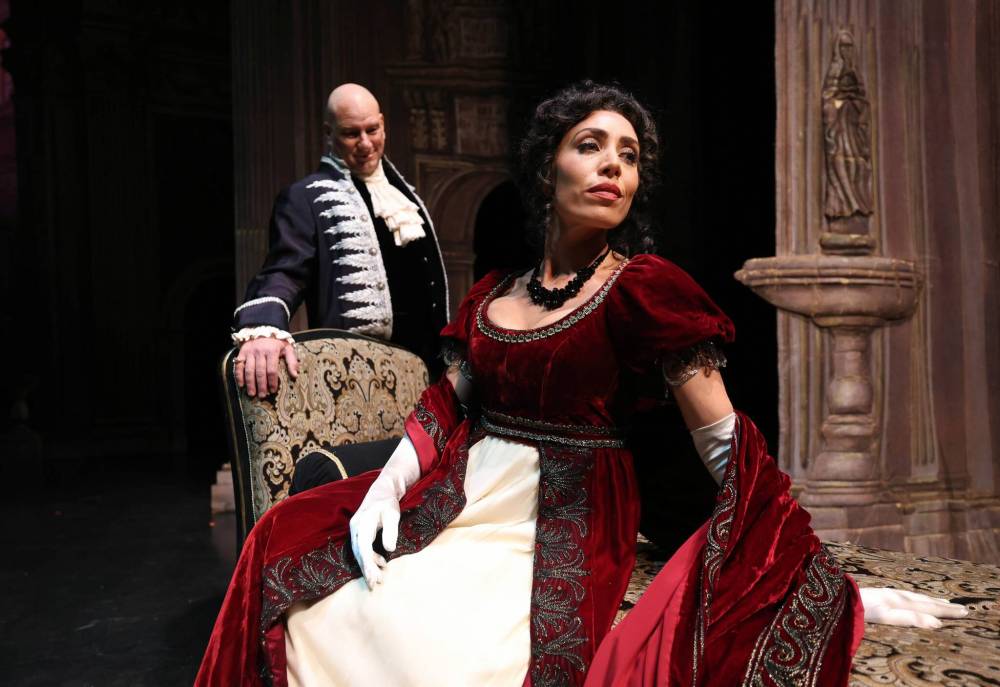
Italian-American soprano Marina Costa-Jackson (left) enthrals as the doomed Tosca, while Winnipeg baritone Gregory Dahl captures the depths of Baron Scarpia’s depravity.
An exception to that illustrious coterie is Italian-American soprano Marina Costa-Jackson, marking her Canadian debut in the title role. Her enthralling portrayal of the doomed heroine, who ultimately chooses to plunge to her death, recalls the equally fiery performance of her sister, mezzo-soprano Ginger Costa-Jackson, as Carmen in MO’s 2023 production.
Set in Rome following the French Revolution in 1800, the through-composed opera’s whipsaw narrative follows Floria Tosca, a prima donna planning a romantic rendezvous with her lover, artist Mario Cavaradossi (tenor David Pomeroy), as the Sacristan (baritone Peter McGillivray; also Jailer) tends to his duties while providing comic levity.
Enter Baron Scarpia (baritone Gregory Dahl), a diabolical police chief on a manhunt for Cavaradossi’s friend, escaped political prisoner Angelotti (bass-baritone David Watson; also Sciarrone), with his henchman Spoletta (tenor James McLennan).
He quickly sets his crosshairs on Tosca, blackmailing her into revealing Angelotti’s hiding place as he vows to have her for his own lecherous appetites.
The audience knows it’s in for a treat from Costa-Jackson’s first offstage cry of “Mario! Mario! Mario!” The soprano embarks on an emotional trajectory from jealous diva — believing her lover is having an affair with Angelotti’s sister, the Marchesa Attavanti — to flesh-and-blood heroine willing to risk it all for love, even dying for her principles.
The singer’s impeccable vocals — pitch-perfect intonation in her uppermost notes, and a full, throaty chest voice (although her lowest register was occasionally subsumed by the orchestra) — are matched equally by flawless acting skills. These are immediately displayed during her Act I duet, Quale occhio al mondo, when Cavaradossi assures her of his fidelity.
She proves especially strong during Act II’s interrogation scene, in which Scarpia cruelly bullies her into submission, her rising desperation palpable. She finally takes matters into her own hands, literally, as she repeatedly stabs her tormentor in the heart.
The production does not shy away from the violent depiction of Tosca’s near rape; kudos to the artists for neither sugarcoating, nor overly stylizing the depths of Scarpia’s depravity. It’s integral to the plot, though still difficult to watch; Act III’s mock execution scene is also disturbingly realistic, even for opera.
The evening’s still point is Costa-Jackson’s searing solo, Vissi d’arte, where she sings “I lived for art, I lived for love,” as Tosca’s fate appears sealed. Every shimmering, deeply felt note reveals her ill-fated character’s soul, earning mid-show applause and cries of “Brava!”
Pomeroy paints his own heroic character with dramatic flair; an early, swoon-worthy highlight is his opening aria, Recondita armonia, in which his resonant tenor voice send ringing high notes soaring throughout the entire hall. Every clearly enunciated syllable propels his sweeping lyrical phrases. His triumphant Vittoria! Vittoria! nails its treacherous high A sharps, eliciting goose bumps.
His “big aria,” Act III’s E lucevan le stelle, was immortalized by the late, great Italian tenor Luciano Pavarotti. Pomeroy wrings every ounce of raw emotion from his solo, climaxing in his grief-soaked exclamation, “Never have I loved life so much!”
The Winnipeg-born Dahl chills to the bone as the villainous Scarpia. He booms through Act II’s Ha più forte sapore and Già, mi dicon venal. He delivers his “bad guy” in a performance that’s a study in carefully nuanced character motivation.
Ruth Bonneville / Free Press
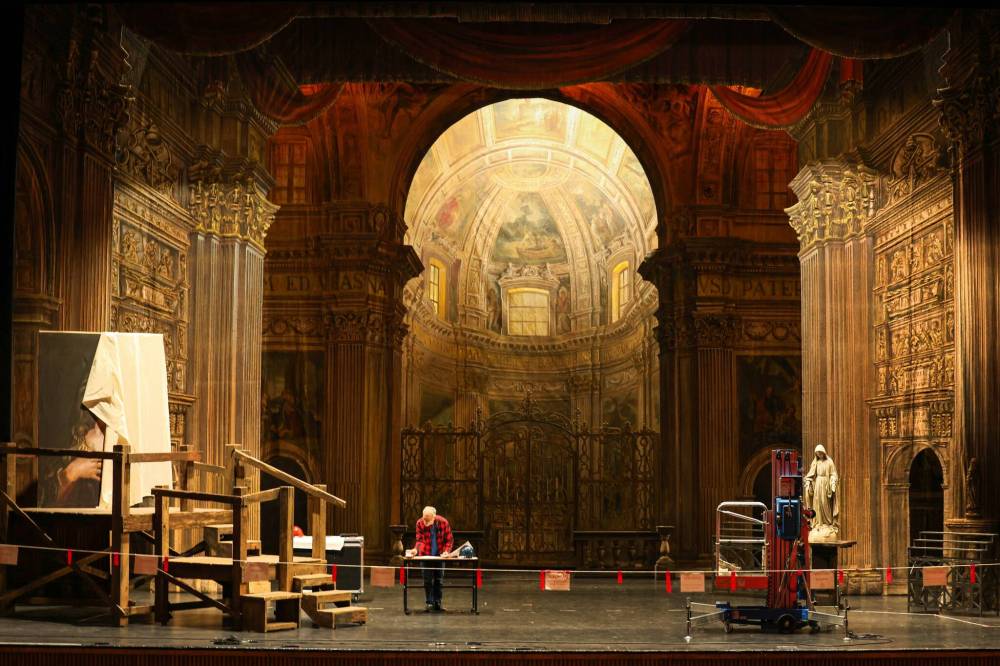
The Tosca set is the last remaining vintage hand-painted backdrop of its kind in North America.
Despite these stellar performances, Theodosakis’s stage direction feels uneven at times, with Act I suffering from relatively static blocking. Singers too often delivered their arias from centre stage, in the proverbial “park and bark.” Various townspeople suddenly floating into the church to pray add visual texture, but feel like a superfluous distraction.
Act III fares better, though the sentries’ overly prolonged marching after the second intermission makes one fear they will be on watch until the final bows. Act II offers the tightest, strongest and most compelling scenes of the night, with dramatic tension rising to fever pitch.
Another undeniable star of the show is also its oldest: the hand-painted canvas “soft sets” built in the 1950s in Milan on loan from Seattle Opera. The last example of “trompe l’oeil” sets still being used today, they conjured the opera’s three locales — inside the church of Sant’Andrea della Valle, Scarpia’s apartment within the Palazzo Farnese, and on the battlements of the Castel Sant’Angelo — to glorious 3-D effect.
Tyrone Paterson brilliantly leads the Winnipeg Symphony Orchestra through Puccini’s lushly romantic score (the maestro is officially retiring from his 20-plus-year tenure as MO’s music adviser and principal conductor following this production).

Sumptious period costumes designed by Andrew Marley for New York City Opera are rounded out with additional designs by Heidi Zamora (for Seattle Opera). Local lighting designer Larry Isacoff creates effectives shadows and light throughout, including a striking spotlight on Tosca during Vissi d’art.
The Manitoba Opera Chorus (prepared by Tadeusz Biernacki) and Children’s Chorus (Carolyn Boyes) infuse the stage with energy during their Te Deum, which caps Act I. The juxtaposition of pious religious priests, monks, nuns, and youthful choir boys against the blackhearted Scarpia creates striking counterpoint while encapsulating Tosca’s entire theme.
Kudos to chorus member Nathaniel Mercer in his first MO solo role as the Young Shepherd Boy; his offstage treble voice is a haunting prelude to the shocking execution scene.
Puccini’s beloved tragedy still strikes a resonant chord today; as expected, the audience leaped to its feet at the end. The crowd also delivered thunderous boos for the villainous Scarpia, with a grinning Dahl gamely blowing kisses back.
holly.harris@shaw.ca