Hard-working Colombian beetles clean garbage, retire as pets

Advertisement

Advertise with us

TUNJA, Colombia (AP) — Three yellow-and-black beetles clung to the shirt of Germán Viasus Tibamoso, a Colombian environmental engineer who uses beetle larvae to transform food waste into fertilizers.

Read this article for free:


or

Already have an account? Log in here »

To continue reading, please subscribe:

Subscribe and receive a limited-edition Free Press branded hat or tote.

Digital Subscription

One year of digital access for only $205*

  • Enjoy unlimited reading on winnipegfreepress.com
  • Read the E-Edition, our digital replica newspaper
  • Access News Break, our award-winning app
  • Play interactive puzzles

*First annual payment billed as $205.00 + GST for one year. This annual subscription will automatically renew at $233.00 + GST every 52 weeks (10% off the regular annual price of $259.35). Offer available to new and qualified returning subscribers only. Cancel any time.

To continue reading, please subscribe:

Add Free Press access to your Brandon Sun subscription for only an additional

$1 for the first 4 weeks*

  • Enjoy unlimited reading on winnipegfreepress.com
  • Read the E-Edition, our digital replica newspaper
  • Access News Break, our award-winning app
  • Play interactive puzzles
Start now

*Your next Brandon Sun subscription payment will increase by $1.00 and you will be charged $17.95 plus GST for four weeks. After four weeks, your payment will increase to $24.95 plus GST every four weeks.

Hey there, time traveller!
This article was published 22/11/2022 (1359 days ago), so information in it may no longer be current.

TUNJA, Colombia (AP) — Three yellow-and-black beetles clung to the shirt of Germán Viasus Tibamoso, a Colombian environmental engineer who uses beetle larvae to transform food waste into fertilizers.

As he encouraged them to move along, he murmured to them in Japanese — trying to get them accustomed, he said, to the sounds of their future homes.

The not-so-little bugs — which can grow up to 17 centimeters (6.5 inches) long — have a remarkably productive and complicated life among the humans who breed and collect them.

Viasus operates a company called Tierra Viva in a rural area around the city of Tunja, a city some 150 kilometers (95 miles) northwest of the Colombian capital of Bogota.

An attempt as a postgraduate student to produce organic fertilizer with worms failed, Viasus said, but he found beetle larvae in the bags of earth that remained. He tried using them instead. And it worked.

Tons of food scraps collected from nearby communities are spread in concrete ditches and covered with earth. Then beetle larvae — the stage between egg and adulthood — are introduced.

They chew through the refuse and their digestive microorganisms transform it into a fertilizer rich in nitrogen and phosphorous.

After four months or so, the product passes through a filter that separates the fertilizer from the larvae, who are at the point of becoming adult beetles.

They mate, and their eggs are used to start the process anew. The adults, however, go on very different journeys. Some are headed for scientific labs. And a lucky few embark on a future across the Pacific in Japan, where beetles are popular as pets, and are even sold over online emporiums such as Amazon.

Tierra Viva has been exporting the bugs — largely Hercules beetles — since 2004, and Viasus said they can bring as much as $150 each.

This year the company sent 100 beetles to Tokyo — down from 300 last year — held in little plastic cases with air holes and food.
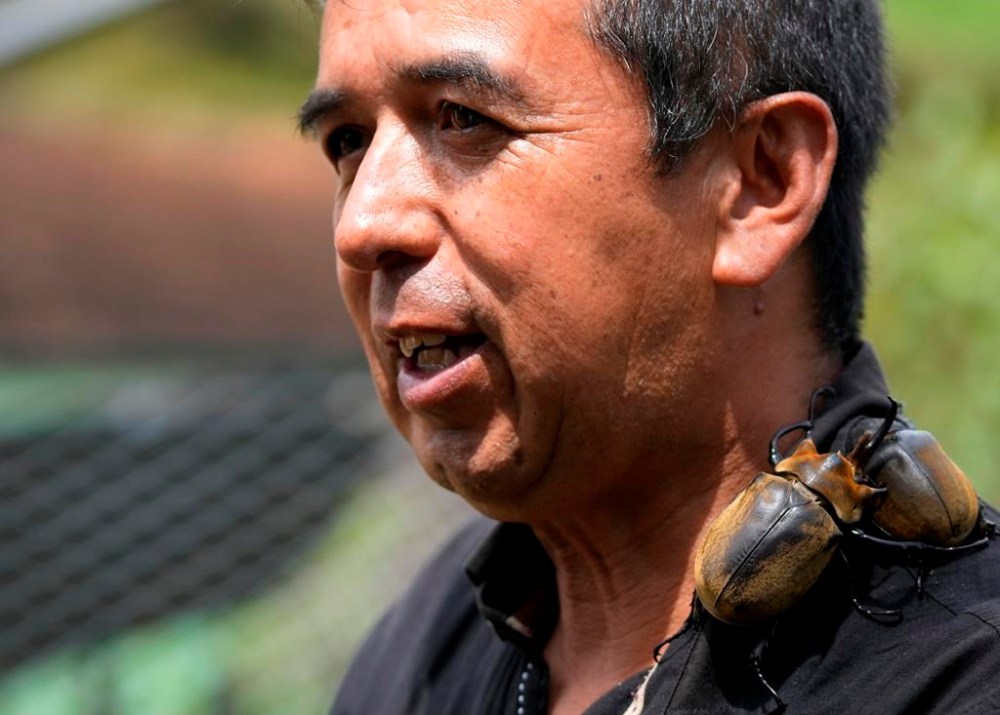
Colombian environmental engineer Germán Viasus Tibamoso, owner of Tierra Viva, gives an interview as two rhinoceros beetles climb on his neck, in Tunja, Colombia, Tuesday, Nov. 15, 2022. The company transforms solid, organic waste, with the help of beetle larvae's digestive microorganisms, that transform the waste into a compost rich in nitrogen and phosphorous. Once adults, some of the beetles are sent to scientific labs and others to Japan where they are popular as pets. (AP Photo/Fernando Vergara)

The sales are often in the company’s variant of cryptocurrency, called “Kmushicoin” — a variant on a Japanese word for beetle.

Viasus, 52, said he hopes the project can grow and prosper for another century — perhaps with its fertilizer used in reforestation projects.

“It’s very difficult in Colombia … because we do it without any help from the state or any other entity. In any other country of the world, a project like this would get a lot of help,” he said.

___

Associated Press writer Mari Yamaguchi in Tokyo contributed to this report.

Report Error Submit a Tip

More Stories

A mission to make hearing care easier to access

Aaron Epp 5 minute read Preview

A mission to make hearing care easier to access

Aaron Epp 5 minute read 2:00 AM CDT

Armando Di Lello was four years old when he was diagnosed with hearing loss in both ears and received his first hearing aids. He doesn’t remember that moment, but he recalls moments that followed.

“Going through elementary, middle school, high school — it was definitely something that was not a positive experience for me,” he said.

Di Lello’s hearing aids were big, bulky and noisy, and he chose not to wear them much of the time.

“I didn’t perceive the benefit as a kid,” he said. “No kid wants to appear different.”

Read
2:00 AM CDT

Put in the work to find fulfilling relationship

Maureen Scurfield 4 minute read 2:00 AM CDT

DEAR MISS LONELYHEARTS: I made it four months without a girlfriend. Although I miss the sex, I have never felt more free! I’ve had overlapping girlfriends since the age of 13, and it’s like having a job for a guy like me. I’m always serving the woman, keeping her happy, giving her what she wants.

After my last break-up in June, I told my best friend I needed to stop serving princesses. He said “Well, you pick ’em! They can see you coming a mile away, and they’re ready.”

I start university this fall, and I swear I’m not going to end up in the same kind of messes with women in my life I always do. There’s a chance to start over, but I don’t know how to be anything different from what I am — a guy like my dad. He totally looks after my mom’s needs — but she loves it, and she looks after him in return.

I don’t know how to be a hard-headed guy who looks out for himself, like a few of my buddies who seem to get what they want with women. But I don’t see them finding any great relationships, either.

Grim outlook for airport authority

Temur Durrani 5 minute read Preview

Grim outlook for airport authority

Temur Durrani 5 minute read Thursday, Apr. 29, 2021

The Winnipeg Airports Authority revealed a particularly grim outlook of their consolidated financial statements at their annual public meeting Thursday morning.

A year marred by COVID-19, executive members from the airports authority said urgent support is needed from the federal government to save them from their dire future beyond the pandemic, outlining the many ways in which Ottawa has failed regional airports like Winnipeg's so far.

Nicole Stefaniuk, vice-president of finance and administration, said 2020 was the worst year in the airport's history — mostly because passengers typically make up about 90 per cent of airport revenue and because almost 80 per cent of costs are fixed items the authority has to continue paying (such as utilities, personnel employment and taxes).

Passenger traffic fell from an average of 12,300 travellers per day to less than 250 people on a good day for Winnipeg's airport — a symptom of mandated lockdowns, border closures and travel restrictions across Canada.

Read
Thursday, Apr. 29, 2021

Gridlock by design: no excuses for bed backlog

Jason M. Sutherland 5 minute read 2:00 AM CDT

Imagine waking up in a hospital bed and being told by a doctor that you are well enough to leave, only to discover you cannot. Not because you want to stay, but because there is nowhere safe for you to go. No home-care support, no rehabilitation space, no long-term care bed.

This is unfortunately the daily reality for thousands of Canadians.

Being stuck in a hospital bed is a crisis from coast to coast. Our acute care hospitals are functioning as wildly expensive beds for vulnerable citizens awaiting a more suitable place to take them in.

A decade ago, policymakers fretted over this exact issue. Today, despite an aging population with increasingly complex needs and higher demand for hospital beds, the crisis has only deepened.

Comfort, creativity battle COVID stress in art class

Maggie Macintosh 4 minute read Preview

Comfort, creativity battle COVID stress in art class

Maggie Macintosh 4 minute read Monday, Dec. 21, 2020

It was only fitting the panels on which students were tasked with painting comforting messages in Brody McQueen’s Grade 12 art class this term were customized to be six-feet tall.

“Be the reason someone feels heard,” states the board made by McQueen and his project partner, Shakira Rampersad.

Among phrases on the other panels, which will all be hung up in Winnipeg’s Maples Collegiate in the new year, were “Take a break” and “Good things are coming.”

One of visual arts teacher Stacey Abramson’s many therapeutic projects, the 1970s-style panels provided high school seniors an opportunity to brainstorm validating phrases that do not perpetuate toxic positivity — otherwise known as pretending everything is OK when it is not.

Read
Monday, Dec. 21, 2020

Netherlands Canada's top source for illicit meth shipments in 2018

Dylan Robertson 6 minute read Preview

Netherlands Canada's top source for illicit meth shipments in 2018

Dylan Robertson 6 minute read Monday, Mar. 9, 2020

OTTAWA — While Winnipeg was in the midst of its ongoing meth crisis in 2018, quantities of the drug were coming from an unexpected country, and through Canadians' most common mode of delivery.

According to documents obtained by the Free Press, there was an increase in "inbound seizures destined to Winnipeg addresses," of postal mail containing meth in 2018 from a year prior. "However, such shipments are likely for personal consumption,” as they were under 35 grams.

And though Canadian officials have called out meth smugglers in China and Mexico, the mailed drugs came from Europe.

"The Netherlands is the top transit country by number of seizures (of meth), while Mexico is the main transit country by quantity,” reads an internal Canada Border Services Agency report from mid-2018.

Read
Monday, Mar. 9, 2020