WEATHER ALERT

Shapeshifting première for our changing times

Spanning 400 years and changes of costume and gender, Orlando is an emblem of transformation

Advertisement

Advertise with us

Transformation is at the heart of everything going on at the Royal Manitoba Theatre Centre.

Read this article for free:

or

Already have an account? Log in here »

To continue reading, please subscribe:

Subscribe and receive a limited-edition Free Press branded hat or tote.

Digital Subscription

One year of digital access for only $205*

  • Enjoy unlimited reading on winnipegfreepress.com
  • Read the E-Edition, our digital replica newspaper
  • Access News Break, our award-winning app
  • Play interactive puzzles

*First annual payment billed as $205.00 + GST for one year. This annual subscription will automatically renew at $233.00 + GST every 52 weeks (10% off the regular annual price of $259.35). Offer available to new and qualified returning subscribers only. Cancel any time.

To continue reading, please subscribe:

Add Free Press access to your Brandon Sun subscription for only an additional

$1 for the first 4 weeks*

  • Enjoy unlimited reading on winnipegfreepress.com
  • Read the E-Edition, our digital replica newspaper
  • Access News Break, our award-winning app
  • Play interactive puzzles
Start now

*Your next Brandon Sun subscription payment will increase by $1.00 and you will be charged $17.95 plus GST for four weeks. After four weeks, your payment will increase to $24.95 plus GST every four weeks.

Hey there, time traveller!
This article was published 24/11/2021 (1692 days ago), so information in it may no longer be current.

Transformation is at the heart of everything going on at the Royal Manitoba Theatre Centre.

The COVID-19 pandemic has forced it to modify almost every aspect of how it makes theatre, a tradition that goes back to when John Hirsch and Tom Hendry founded the company in 1958.

Masks are everyday wear, and not just for denoting the difference between comedy and tragedy. Hand sanitizer is the new makeup.

Em Siobhan McCourt (centre) plays the title character in Orlando, which opens the 2021-22 season at the Royal Manitoba Theatre Centre. (Mike Deal / Winnipeg Free Press)

Musicals, a key genre in theatre, are potential super-spreader events.

So it is fitting that a play about transformation, Orlando, kicks off Royal MTC’s 2021-22 season when it opens Thursday at 7:30 p.m., and brings one of Canada’s largest theatre companies out of 626 days of viral darkness.

“I feel like I’ve been in first gear for two and a half years,” says Kelly Thornton, who took over as the company’s artistic director in June 2019.

“I intentionally programmed Orlando as a way for audiences to return to theatre and to see the delights of theatre. Orlando is intentionally there as a gift to the audience to come back to the theatre and experience the kind of breathtaking, surprising acts of imagination we can create on the stage.

“This is such an overtly theatrical show about transformation and the set is about transformation. That was very intentional, but it’s been a huge challenge because you want to make it as exciting and surprising as it could possibly be.”

Orlando is Sarah Ruhl’s stage adaptation of the Virginia Woolf’s 1928 novel Orlando: A Biography. Woolf’s book was inspired by her lover, fellow author Vita Sackville-West, and is about a poet’s adventures from the Elizabethan Age in the 1500s all the way to the Jazz Age in the 1920s, with the poet Orlando transforming in costume and gender to suit the times.

Woolf’s story is considered a classic in feminist literature, so the theatrical version is a great place for Thornton to begin her directorial tenure at Royal MTC. She was the artistic director of the Nightwood Theatre in Toronto, which specializes in feminist theatre, prior to taking on the same post in Winnipeg in June 2019.

”(Orlando) embarks on a journey of over 400 years, searching for his authentic self, and changes genders in the middle of it all and arrives as a woman, trapped in the social construct of what a woman is,” Thornton says.

It all wasn’t supposed to be this way. The initial plan, many long acts ago, was for Thornton to make her Royal MTC directorial entrance with The Sound of Music, one of the classics of the stage.

As Orlando, Em Siobhan McCourt changes costume and gender through the arc of the play adapted by Sarah Ruhl from Virginia Woolf’s 1928 novel. (Mike Deal / Winnipeg Free Press)

Orlando may be without the grand Rodgers and Hammerstein songs, but it is with the transformed times we live.

“It wasn’t on the playbill that got cancelled but I feel like we have been through such a journey through the pandemic that this concept of transformation was very inspiring to me,” she says.

“We all need to share stories of the dark but to feel joy and laugh together, and Orlando is very very funny… The play is silly, the play is profound. It’s a real adventure story.

“It asks us to expand our minds beyond the binaries, beyond the construct of time. It’s a very 21st-century look.”

A chorus of four characters, played by Simon Bracken, Ivy Charles, Breton Lalama and Simon Miron, provides narration, asides and even some of the scenery during the play while bringing many of Woolf’s words to the stage.

“Ruhl says nobody can say it as well as Virginia Woolf, so I’ve used a lot of Woolf’s text in this adaptation,” Thornton says. “They cheer Orlando but they are removed from Orlando sometimes and they play all the characters in Orlando’s life.”

Em Siobhan McCourt plays Orlando a character transformed with interactions with Queen Elizabeth I, and later by a love interest, Sasha, portrayed by Sophie Smith-Dostmohamed.

Putting together Orlando has had greater meaning for many in the cast, whether it’s been the absence of theatre for all these past months or the play’s inclusive nature. Some members of the cast and crew, including McCourt, live beyond traditional gender norms.

Simon Miron, a francophone Métis actor from Winnipeg who plays Chorus No. 1, as well as Queen Elizabeth I, is two-spirited.

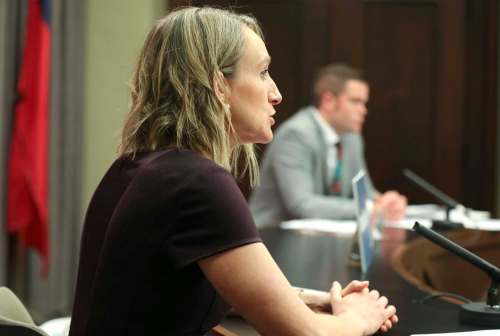
‘We have been through such a journey through the pandemic that this concept of transformation was very inspiring to me,’ says director Kelly Thornton (right), speaking to Em Siobhan McCourt, during a technical rehearsal for Orlando. (Mike Deal / Winnipeg Free Press)

“From the beginning, this process has been a lot more personal than many of the other productions I’ve worked with in the past,” Miron says. “There have been a lot of very touching and very personal stories that have been shared in the rehearsal hall that have really created an intimate, safe, supportive and understanding space.

“In general, we have that most of the time, but this is sort of at a new level I feel. It’s allowed us to take a few more risks and to allow us to really find ourselves in this world, in our characters, in this play, which you rarely find the time to do that.”

Woolf’s novel was turned into a film in 1992 starring Tilda Swinton in the title role. It’s one Thornton enjoyed but she’s avoided watching Vita & Virginia, a 2018 drama on Netflix with Gemma Arterton and Elizabeth Debicki portraying the romance between Sackville-West and Woolf.

“I think Virginia and Vita had very fascinating lives and the alchemy of the two of them coming together was really impactful for both of them,” Thornton says. “Vita really solidified Virginia as a writer… and Virginia really inspired Vita as well.”

Alan.Small@winnipegfreepress.com

Twitter: @AlanDSmall

Alan Small

Alan Small
Reporter

Alan Small has been a journalist at the Free Press for more than 22 years in a variety of roles, the latest being a reporter in the Arts and Life section.

Our newsroom depends on a growing audience of readers to power our journalism. If you are not a paid reader, please consider becoming a subscriber.

Our newsroom depends on its audience of readers to power our journalism. Thank you for your support.

Report Error Submit a Tip

More Stories

Lifelong friends will now be facing off in WHL

Mike Sawatzky 5 minute read Preview

Lifelong friends will now be facing off in WHL

Mike Sawatzky 5 minute read Thursday, Mar. 4, 2021

Trent Crane and William Irvine have been friends since before they can remember.

Through good times and bad, a tight bond was forged during their formative years in Morden. The boys went to school together, fought like siblings and were frequent hockey teammates.

They also played dozens of golf rounds together and were teammates on Manitoba's gold-medal winning baseball team at the 2016 Western Canadian peewee championship. They hung out constantly.

Their connection — Trent and William were born 29 days apart in the spring of 2003 — endures to this day.

Read
Thursday, Mar. 4, 2021

'Code red': UN scientists warn of worsening global warming

Seth Borenstein, The Associated Press 8 minute read Preview

'Code red': UN scientists warn of worsening global warming

Seth Borenstein, The Associated Press 8 minute read Tuesday, Aug. 10, 2021

BERLIN - Earth is getting so hot that temperatures in about a decade will probably blow past a level of warming that world leaders have sought to prevent, according to a report released Monday that the United Nations called a “code red for humanity.”

“It’s just guaranteed that it’s going to get worse,” said report co-author Linda Mearns, a senior climate scientist at the U.S. National Center for Atmospheric Research. “Nowhere to run, nowhere to hide.”

But scientists also eased back a bit on the likelihood of the absolute worst climate catastrophes.

The authoritative Intergovernmental Panel on Climate Change (IPCC) report, which calls climate change clearly human-caused and “unequivocal” and “an established fact,” makes more precise and warmer forecasts for the 21st century than it did last time it was issued in 2013.

Read
Tuesday, Aug. 10, 2021

Mom spearheads fight for rehab services

Zoe Pierce 5 minute read Preview

Mom spearheads fight for rehab services

Zoe Pierce 5 minute read 2:01 AM CDT

Four years ago, a car crash permanently changed Will Castor’s life.

The 28-year-old suffered a traumatic brain injury that required a long recovery as he worked to relearn skills many people take for granted, such as eating, speaking and getting out of bed.

A key part of that journey was First Steps Wellness Centre, a Winnipeg rehabilitation facility, where Will worked with therapists to regain independence and connect with others facing similar challenges.

But on June 5, financial constraints forced First Steps to close, leaving families without the specialized therapy they had come to rely on.

Read
2:01 AM CDT

Throne speech offers glimpse of PCs’ priorities

Shannon Sampert 5 minute read Preview

Throne speech offers glimpse of PCs’ priorities

Shannon Sampert 5 minute read Thursday, Nov. 22, 2018

Throne speeches are more than just pomp and circumstance and the opportunity for selfies between political rivals on the beautiful marble floors of the Manitoba legislature building on Broadway. They set the agenda for the legislative session and set the tone for the government as it moves into its new session. Looked at carefully, they also reveal the priorities of the government by what is said, and also what is not said.

But they are also highly symbolic. They are delivered by the lieutenant-governor of the province, who acts as the symbol of the head of state, the Queen, but they are written by speechwriters for the government of the day.

Political scientists have studied the throne speeches delivered at the federal level to understand the thematic commonalities and what they say about nationalism over the past 30 years. Janine Brodie of the University of Alberta, for example, determined that Canadian throne speeches delivered before the 2000s embraced a more neo-liberal tone that was tied to the global economy.

After 2000, an analysis by Tim Nieguth (Laurentian University) and Tracey Raney (Ryerson University) found that Conservative throne speeches tended to focus on neo-conservative themes — emphasizing the family, the military and threats to security — while Liberals’ speeches talked about health care and Indigenous issues.

Read
Thursday, Nov. 22, 2018

Count Binface vs. Nigel Farage

Gwynne Byer 5 minute read 2:00 AM CDT

At the time of writing there is still hope Count Binface can pull off a surprise byelection win and dethrone Nigel Farage, the leader of Reform UK, who has led the opinion polls in Britain for the past two years. The danger is that the Monster Raving Loony Party may also run, splitting the vote and letting Farage win.

The story so far:

Nigel Farage is what was known in wartime British slang as a ‘spiv’: a flashy, fast-talking petty criminal who always has something shoddy and borderline illegal to sell. Farage is not actually a criminal, my lawyers have instructed me to say, but he has led three political parties — UK Independence Party, Brexit Party, Reform UK — and they all smelled a bit off.

They were all anti-immigrant, ultra-nationalist and shyly racist, and they all used ‘populist’ tactics well before that style went global. Think of him as a Donald Trump who didn’t inherit great wealth but is a lot more coherent. In due course the rest of the world has caught up and, in Great Britain, Farage’s current political vehicle, Reform UK, has led opinion polls for two years straight.

If it works in Ontario, why not in Manitoba?

James Wilt 5 minute read Preview

If it works in Ontario, why not in Manitoba?

James Wilt 5 minute read 2:00 AM CDT

Grid-scale battery storage has fundamentally changed the global energy landscape — and Manitoba needs to get on board.

Battery systems store large amounts of excess electricity for when it’s most needed. While they can be charged from any generation source, they are especially beneficial for integrating wind and solar power, which vary with weather and time of day. Batteries allow electrical grids to meet the need for firm, dispatchable and affordable capacity using renewable energy, rather than relying on coal, nuclear and fossil gas. They also provide numerous other benefits, including reducing overloading of transmission infrastructure and helping to regulate the grid’s frequency and voltage.

Average costs for grid-scale batteries plummeted by more than half between 2023 and 2025 and installations have skyrocketed in China, the U.S., Australia and Europe. Texas now has 16,500 megawatts (MW) of battery storage, while California has 15,200 MW. Closer to home, Ontario recently awarded 640 MW of contracts to three battery storage projects in a competitive auction, with batteries beating out fossil gas-fired power plants on cost every time. One of these projects will be built near Dryden, only four hours east of Winnipeg.

Each battery system will provide eight hours of capacity but will cost considerably less than Ontario’s previous battery procurements, which provide only four hours of capacity. With this latest auction, Ontario has now secured 3,600 MW of battery storage capacity, including the operational Oneida (250 MW), Hagersville (300 MW) and Napanee (250 MW) projects. Almost all have significant Indigenous participation, with the latest procurements boasting 50 per cent First Nations ownership.

Read
2:00 AM CDT