Ditching clock culture
Run to feel good and connect with city, not to beat a time

Advertisement
Read this article for free:
or
Already have an account? Log in here »
To continue reading, please subscribe:

Digital Subscription
One year of digital access for only $205*
- Enjoy unlimited reading on winnipegfreepress.com
- Read the E-Edition, our digital replica newspaper
- Access News Break, our award-winning app
- Play interactive puzzles
*First annual payment billed as $205.00 + GST for one year. This annual subscription will automatically renew at $233.00 + GST every 52 weeks (10% off the regular annual price of $259.35). Offer available to new and qualified returning subscribers only. Cancel any time.
To continue reading, please subscribe:
Add Free Press access to your Brandon Sun subscription for only an additional
$1 for the first 4 weeks*
- Enjoy unlimited reading on winnipegfreepress.com
- Read the E-Edition, our digital replica newspaper
- Access News Break, our award-winning app
- Play interactive puzzles
*Your next Brandon Sun subscription payment will increase by $1.00 and you will be charged $17.95 plus GST for four weeks. After four weeks, your payment will increase to $24.95 plus GST every four weeks.
Read unlimited articles for free today:
or
Already have an account? Log in here »
Hey there, time traveller!
This article was published 28/09/2020 (2202 days ago), so information in it may no longer be current.
I can’t do it. This is hard. My legs feel so heavy. It’s too far.
Welcome to the mental script of many runners, at least once in a while.
A lot of people have a good idea of what running should look like. Keeping a consistent pace, trying to beat your time or going a certain distance. But that’s not the case for everyone.
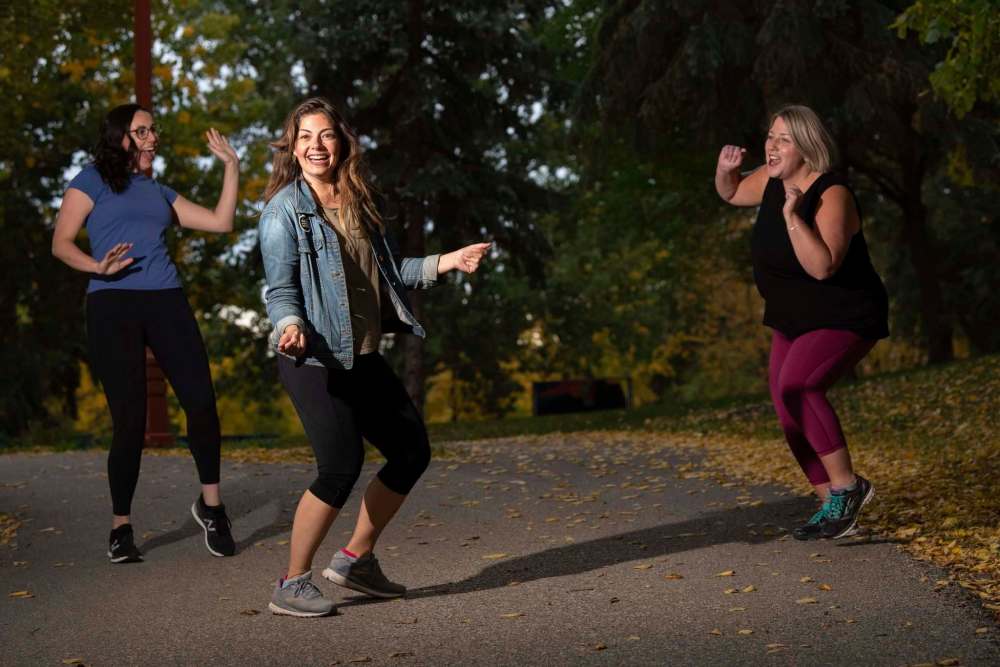
Running is more than exercise — it’s a way to unplug, get outside and separate your headspace from the rest of your daily routine. It leaves you feeling accomplished and energized for the rest of the day. For many, running is a way to get some alone time. For others, it can be a way to partner up with a friend or get involved with a running group.
Alternatively, the first time you run (and likely the second and third), it may be none of these things. As much as running can be an amazing stress reliever, it can also be very challenging, both mentally and physically. It’s tough and leaves you out of breath. It’s no wonder some people claim to hate it.
But it doesn’t have to be this way. More importantly, it shouldn’t be this way.
Lindsay Somers has always run for the enjoyment of it. However, after participating in the 2013 Manitoba Marathon with her mom, something struck a chord with her.
“Once (my mom) found out her run time and compared it to my aunt’s time — who’s a slightly competitive runner — it just completely diminished her entire achievement and experience in that moment,” Somers says. “It was disappointing to me that all that hard work that (my mom) put in was crushed.”
Somers says a lot of running culture is driven by the notion of feeling successful once you beat a certain time or run a particular distance.
She wanted to change that. She realized that a casual approach to running — where the numbers don’t matter — didn’t exist in Winnipeg. So, she created it.
Somers created her Learn to Run outdoor programs in 2017. Since then, she has encouraged hundreds of Winnipeggers to take their first steps and find joy in movement all year round. (Yes, that includes a Learn to Run program in the winter).
“I found a space for people to run because it feels good, not because you’re trying to beat a time,” Somers says. “The motivation isn’t to get faster. The motivation is to get out and move your body.”
The local lifestyle health coach co-ordinates her Learn to Run sessions — two runs a week for eight weeks — during the fall, winter and spring. Somers has her group meet at The Forks because of how easily they can access different neighbourhoods on foot.
“I love seeing the city through the lens of running. It’s a great way to connect to architecture, people and the seasons,” she says. “The city has wonderful active transportation trails and routes. It’s an untapped gift and resource that you don’t get to experience until you get out of your car or your own neighbourhood. It’s on foot that you really get to see it.”
When learning to run, Somers incorporates walk/run intervals to ease into things and starts the group on a three-kilometre loop in St. Boniface.
“There are four bridges in that loop. Anytime we go over a bridge, we dance-walk and pick up our pace,” she says. “They’re short little bits and we extend the distance over time. It’s a different connection to running when we’re not looking at numbers all the time,” she says.
Somers designed her Learn to Run program specifically for people who don’t typically see themselves as runners.
“The people that hated gym class are my target demographic,” she says. “The biggest achievement for me is when people believe in themselves.”
Leanne Lucas never considered herself a “runner” and was always intimidated by the idea of it.
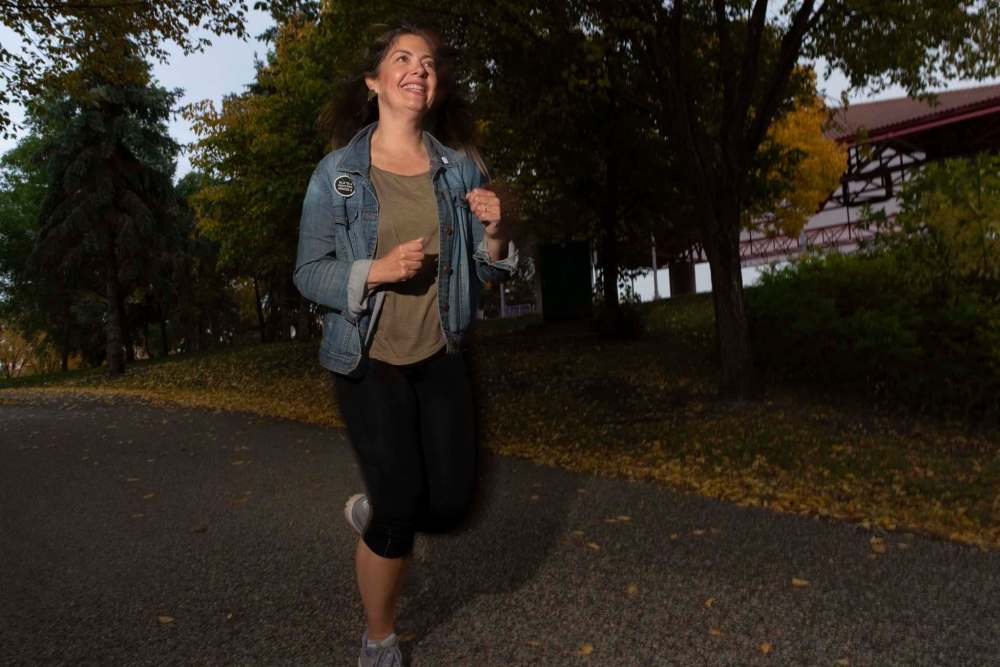
“I always thought runners were people who put on their shoes and just go run a marathon,” Lucas says. “Anytime I had tried running, it felt like it was something I wasn’t naturally good at and that was discouraging.”
But a post on Somers’ Instagram about her running program caught Lucas’ eye.
“It felt very refreshing how non-intimidating it was,” Lucas says. “(Somers) presented it in a way of ‘We don’t care about time or how you look. We’re just going to enjoy some time outside.’”
For Lucas, that sentiment resonated and the program’s ease-into-running approach spoke to her — so much so that she has completed almost all of Somers’ running programs since they first began more than three years ago.
Somers recently kicked off her fall 2020 run club and it couldn’t have come at a better time for Lucas.
“One of the biggest things I want to get out of this run club is a new sense of routine. With COVID, I feel like all routines flew out the window,” Lucas says. “When you’re working from home, you don’t know if it’s Monday, Sunday or Wednesday. Now, I’ve got Wednesday-evening and Sunday-morning runs to look forward to.”
The season change is an important aspect of Somers’ programs and it’s something Lucas has come to appreciate.
“It’s so nice to intentionally go outside twice a week and think, ‘Oh, this tree wasn’t yellow the last time I saw it,’” she says. “That is such a simple takeaway from being outside. It sounds crazy that I didn’t appreciate it as much until I was in there running through it.”
For Lucas, running isn’t about timing or pace.
“I don’t remember the last time I timed my run and I don’t care. It was something I started off doing but then when my time was garbage, I found it discouraging,” she says. “For me, I don’t need (the numbers) to feel like I had a great run.”
Running has its ups and downs — some days it may come easier and on others, it’s something your body is begging you not to do.
Sarah Wilton, a member of Somers’ run programs since 2017, has discovered that running and being outside has helped with her headspace.
“I’ve discovered through running that it’s really good for my mental health,” she says. “When I get out and move my body, it really clears my mind.”
Wilton says she doesn’t have a typical “runner’s body” and admits she had a tough time when she first started with Somers’ group.
“I’m fat and I’m OK calling myself that. I don’t look like a runner,” she says. “The first day was hard. I honestly thought I was going to die because I couldn’t run for more than 30 seconds. But Lindsay is so encouraging and I’ve been going back continually since.”
Wilton says she’s usually at the back of the pack when she’s out with the running club and that works for her.
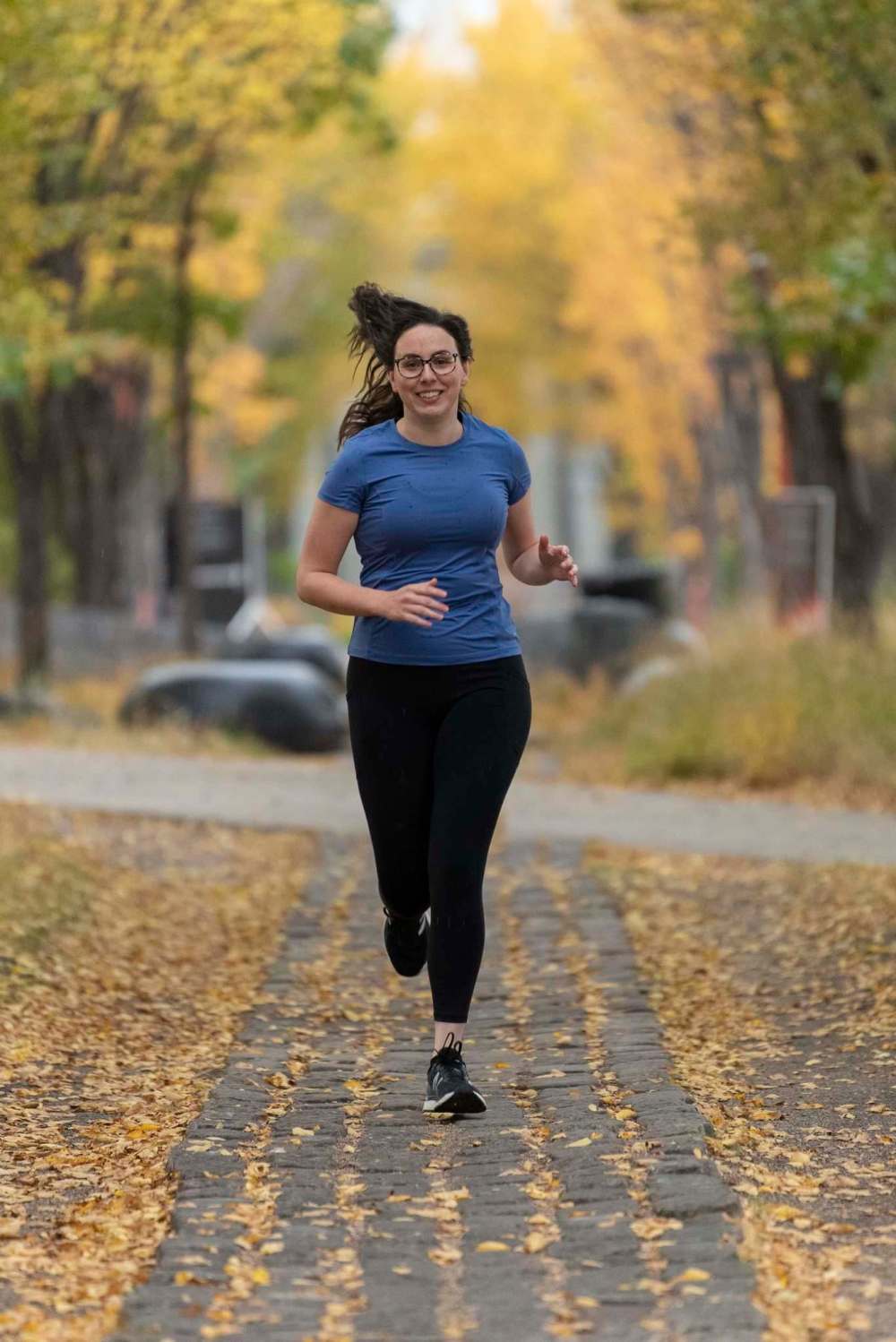
“I am 100 per cent OK with that, even though I’ve been running for over three years,” she says. “I don’t have any expectation that I’m going to be able to run five kilometres in 25 minutes. That’s not what we’re about.”
Through the Learn to Run program, Wilton has learned that her body is capable of more than she gave it credit for.
“My brother is a marathon runner and I’ve always admired him and his dedication. I always thought, ‘That’s never something I’m going to do,’” she says. “But running club has taught me to be comfortable stepping outside of my comfort zone.”
And joining Somers’ run club has benefited Wilton in more ways than one.
“It’s one of the best things that has ever happened to me,” Wilton says. “Not only have I picked up a new hobby, I’ve also met some of my best friends in my adult life. (Run club) has fundamentally changed my life.”
In addition to finding joy in movement and exploring our city, Somers’ club has built a strong community.
“I love having people come together and forging friendships. We have a big support network,” Somers says. “Our participants have talked through postpartum, losing a parent, having children. There’s even a couple who met at run club — their very first date was a run together.”

Running is a great way to get outside, feel better and form new relationships with other people. And starting doesn’t have to be hard — all it takes is a proper pair of running shoes and a willingness to move a little (or a lot), all at your own pace.
For Somers, she wants to ensure participants get the most out of her casual, relaxed approach.
“A way to be content in movement is to just enjoy the process of getting out and going for a run,” she says. “You show up, you do what you can do and you’ve won.”
sabrinacarnevale@gmail.com
@SabrinaCsays
Sabrina Carnevale is a freelance writer and communications specialist, and former reporter and broadcaster who is a health enthusiast. She writes a twice-monthly column focusing on wellness and fitness.
Our newsroom depends on a growing audience of readers to power our journalism. If you are not a paid reader, please consider becoming a subscriber.
Our newsroom depends on its audience of readers to power our journalism. Thank you for your support.
Sabrina Carnevale is a freelance writer and communications specialist, and former reporter and broadcaster who is a health enthusiast. She writes a twice-monthly column focusing on wellness and fitness.
Our newsroom depends on a growing audience of readers to power our journalism. If you are not a paid reader, please consider becoming a subscriber.
Our newsroom depends on its audience of readers to power our journalism. Thank you for your support.
Related Articles
Lacing up running shoes after quarter-century lapse eased lockdown loneliness for Winnipegger
Advertisement Advertise With Us
Advertisement Advertise With Us
History
Updated on Monday, September 28, 2020 8:15 AM CDT: Adds photos
Updated on Monday, September 28, 2020 8:42 AM CDT: Adds photo