Saskatchewan sculptor Joe Fafard dies at 76

Advertisement

Advertise with us

LUMSDEN, Sask. - A Saskatchewan artist whose sculptures of cows, horses and buffalo are on display outside corporate head offices and the National Gallery of Canada has died.

Read this article for free:


or

Already have an account? Log in here »

To continue reading, please subscribe:

Subscribe and receive a limited-edition Free Press branded hat or tote.

Digital Subscription

One year of digital access for only $205*

  • Enjoy unlimited reading on winnipegfreepress.com
  • Read the E-Edition, our digital replica newspaper
  • Access News Break, our award-winning app
  • Play interactive puzzles

*First annual payment billed as $205.00 + GST for one year. This annual subscription will automatically renew at $233.00 + GST every 52 weeks (10% off the regular annual price of $259.35). Offer available to new and qualified returning subscribers only. Cancel any time.

To continue reading, please subscribe:

Add Free Press access to your Brandon Sun subscription for only an additional

$1 for the first 4 weeks*

  • Enjoy unlimited reading on winnipegfreepress.com
  • Read the E-Edition, our digital replica newspaper
  • Access News Break, our award-winning app
  • Play interactive puzzles
Start now

*Your next Brandon Sun subscription payment will increase by $1.00 and you will be charged $17.95 plus GST for four weeks. After four weeks, your payment will increase to $24.95 plus GST every four weeks.

Hey there, time traveller!
This article was published 16/03/2019 (2765 days ago), so information in it may no longer be current.

LUMSDEN, Sask. – A Saskatchewan artist whose sculptures of cows, horses and buffalo are on display outside corporate head offices and the National Gallery of Canada has died.

Joe Fafard died peacefully Saturday at his home in Lumsden, Sask., a statement issued by his family said. Fafard suffered from stomach cancer and was 76.

Fafard’s “Running Horses,” 11 horses sculpted in steel, was placed on permanent display outside the National Gallery in 2011, although the original was replaced by a modified version due to Ottawa’s harsh weather.
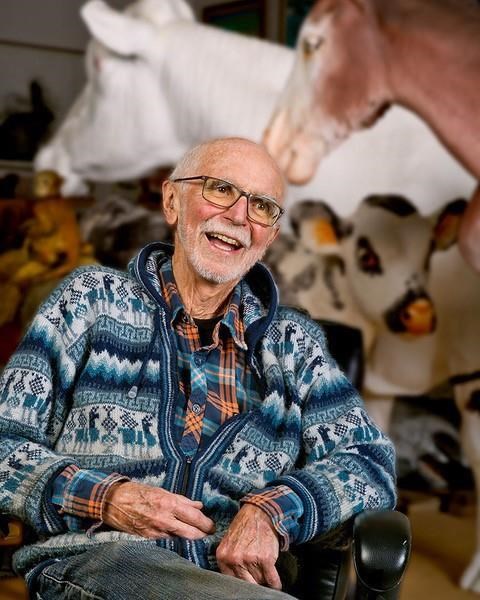
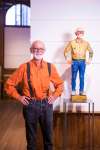
Joe Fafard is shown in this undated handout image. The Saskatchewan sculptor whose works of cows, horses and buffalo are on display outside corporate head offices and the National Gallery of Canada has died. Fafard died peacefully Saturday at his home in Lumsden, Sask., a statement issued by his family said. THE CANADIAN PRESS/HO *MANDATORY CREDIT *

“The Pasture,” seven hefty, bronzed cows sprawled on a grass square in downtown Toronto, was commissioned for the Toronto Dominion Centre.

Born in the tiny francophone community of Ste-Marthe, Sask., Fafard was one of 12 children raised on a family farm and espoused the idea that artists should be inspired by their local environment.

“Joe died the way he lived: simply, unpretentiously, in complete serenity, with a twinkle in his eye, but above all with the full love of his family and friends,” his spouse, Alyce Hamon, said in the statement.

Fafard’s early clay portraits showed people he knew from rural Saskatchewan. From there followed politicians such as Prime Minister Jean Chretien, actor Donald Sutherland, writer Farley Mowat and a portrait series of famous artists, from Van Gogh to Cezanne.

Cows, however, were one of the Order of Canada recipient’s better-known subjects and were popular with his fans.

Humorous yet respectful, his bovine sculptures reflected cows’ importance to humanity as a source of meat, milk and clothing.

”It seems to me that most of our body is made of cow material, if you think about the amount of milk we drink as kids, the cheese we eat, the ice cream, the steaks, the hamburgers,” he told The Canadian Press in 2008 when a retrospective of his works opened at the National Gallery.

”There was an old saying, ‘You are what you eat.'”

One piece on display at the 2008 retrospective, ”Groszmama,” depicted a 94-year-old woman seated in a wheelchair. Fafard at the time described the sense of dignity she had despite her difficulties.

”Maybe I wanted to speak about people’s trials more than their victories, maybe their failures as well,” he said.

Fafard studied at the University of Manitoba and Pennsylvania State University.

Saskatchewan Premier Scott Moe said Fafard’s work left an impression on many people in the province, noting some of the artist’s work is in his office.

“When one thinks of Saskatchewan visual artists, it’s hard to not think of Joe Fafard,” Moe said in tweet on Saturday.

The family says a ceremony celebrating the life of Joe Fafard will be held privately. A public ceremony will be announced at a later date.

Note to readers: This is a corrected story. An earlier version said Fafard attended the University of Winnipeg instead of the University of Manitoba

Report Error Submit a Tip

More Stories

Is this the season of secession?

David McLaughlin 5 minute read Preview

Is this the season of secession?

David McLaughlin 5 minute read 2:01 AM CDT

Canada has entered its season of secession. Like El Nino, the currents of grievance can blow hot and cold. Today, they are hot. But how hot for how long? The odds of Alberta and now Quebec separating from Canada are not high, but they are never zero.

After a year of waving the flag in a surge of national patriotism to confront Donald Trump’s attacks on Canada — economic and verbal — it is both jarring and frustrating for most Canadians to be reminded of the pervasive and persistent tensions that come with governing our federation.

When we need new national purpose to confront big economic sovereignty and security challenges from outside, that purpose is undermined and diminished by having to confront homegrown grievances.

We’ve seen and seen off two separation referendums in Quebec. Now we have a newly elected separatist party coming to power. In Alberta, voters will soon decide whether the independence road is one they want to travel.

Read
2:01 AM CDT

Jets trending in right direction after picking up points in first three games

Ken Wiebe 7 minute read Preview

Jets trending in right direction after picking up points in first three games

Ken Wiebe 7 minute read Yesterday at 4:24 PM CDT

Welcome to a small sample size season, when sweeping observations and hot takes can quickly become outdated and — occasionally — out of touch.

With that as a cautionary backdrop, the Winnipeg Jets are off to a 2-0-1 start that has them temporarily occupying top spot in the Central Division.

“We were optimistic that we’re a better team than we showed last year,” said Jets captain Adam Lowry. “We want to play fast. We want to compete hard, and we want to give ourselves a chance to win every night, so I think we’ve done that.”

As the Jets welcome the Colorado Avalanche on Wednesday to open a three-game homestand, they’ve gotten off to a fast start in a season that required one.

Read
Yesterday at 4:24 PM CDT

Yielding attraction

Joel Schlesinger 6 minute read Preview

Yielding attraction

Joel Schlesinger 6 minute read 2:01 AM CDT

Yield is a Rorschach test for investors. Where one see opportunity in high payouts from an investment, another sees high risk.

Consider bonds: yields are moving higher, which implies higher risk in the market, but to an investor considering buying a bond, higher yields represent higher income.

For most of the past 18 years, bond yields have been near historical lows and investors have sought alternatives.

“Canada’s population is aging, with a growing number of investors approaching or entering retirement and looking for more income,” says Pat Sommerville, co-chief executive officer of Hamilton ETFs in Toronto.

Read
2:01 AM CDT

Survey says city's downtown is struggling, but it's been here before

Ben Waldman 15 minute read Preview

Survey says city's downtown is struggling, but it's been here before

Ben Waldman 15 minute read Friday, Apr. 9, 2021

The convenience store cashier sees everything on his corner of Graham Avenue. His view is good: behind the register, he sits on a fading vinyl stool that pivots, and if he turns his head over his left shoulder, his eyes look right out toward the bus stop. If he’s lucky, the benches are full of university students or harried office workers, and the No. 18 is running a bit late.

If that’s the case, the shop door will swing open, and the cashier will be a very busy man, selling cans of Coca-Cola and energy drinks, packs of gum and cigarettes, a few lottery scratchers, a loaf of bread, a stick of deodorant, whatever anyone needs. For most of the day, the corner is somewhat quiet, but for a few short bursts — one in the morning, shortly after he opens up at 5:30 a.m., another at lunchtime, and another when people start to go home, around 3:30 p.m. — the intersection of Graham and Vaughan is a very loud place, and business is as steady as the pace on the sidewalk.

“After six o’clock, it always slows down,” says the cashier, who’s worked at the Graham Convenience Store for five years. For the last 12 months, it’s felt like after six o’clock.

Every person has a unique vantage point of how the pandemic has shifted the world, but the cashier, who didn’t want his name shared, has had a crystal-clear perspective on the way COVID-19 has changed Winnipeg’s downtown. All he’s had to do is turn his head, look through his window and watch the clock. He has anecdotal evidence, such as the quiet. But he also has empirical evidence, such as the relatively empty street corner and the number of customers as compared to his first four years at the store.

Read
Friday, Apr. 9, 2021

Naturalist offers personal reflections on the finite nature of life

Reviewed by Chris Smith 4 minute read Preview

Naturalist offers personal reflections on the finite nature of life

Reviewed by Chris Smith 4 minute read Saturday, Sep. 26, 2026

Canadian poet and naturalist Neil Griffin has written a historic and personal globe-spanning account of massive extinctions over centuries, caused by weather disruptions and by mankind. It’s a detailed, well-written account, sometimes with a touch of humour, but predominantly a frightening and depressing look at the losses and consequences.

Griffin opens by describing artifacts on his desk, “a pocket gallery of past and present ruin” — memento mori collected during his former life as a wildlife biologist and “cold reminders of what was and will not be again.”

The author combines geological and natural history with observations of his own, made during travels to destinations such as Canada’s boreal wetlands, the jungles of Belize, Kenya’s savannahs and the mountains of Rwanda — all places where he encountered endangered species.

Griffin takes readers through Earth’s five mass extinction events caused by upsets in the carbon capture cycle, planetary wobbles causing climate change, volcanic eruptions, meteors and how the “bad behaviour of Earth’s inhabitants” impact so many species. More than 99 per cent of Earth’s total plant, animal and fungal life is now extinct, and human beings will also be extinct someday, he writes, recognizing that extinction is a natural phenomenon, but that current extinction rates far exceed the norm.

Read
Saturday, Sep. 26, 2026

Subscribe

2 minute read Thursday, Jul. 23, 2026