Helping kids breathe easier
H1N1 outbreak a new challenge for his profession
Advertisement
Read this article for free:
or
Already have an account? Log in here »
To continue reading, please subscribe:
Digital Subscription
One year of digital access for only $1.44 a week*
- Enjoy unlimited reading on winnipegfreepress.com
- Read the E-Edition, our digital replica newspaper
- Access News Break, our award-winning app
- Play interactive puzzles
*Billed as $5.77 plus GST every four weeks. After 52 weeks, price increases to the regular rate of $19.95 plus GST every four weeks. Offer available to new and qualified returning subscribers only. Cancel any time.
To continue reading, please subscribe:
Add Free Press access to your Brandon Sun subscription for only an additional
$1 for the first 4 weeks*
- Enjoy unlimited reading on winnipegfreepress.com
- Read the E-Edition, our digital replica newspaper
- Access News Break, our award-winning app
- Play interactive puzzles
*Your next Brandon Sun subscription payment will increase by $1.00 and you will be charged $17.95 plus GST for four weeks. After four weeks, your payment will increase to $24.95 plus GST every four weeks.
Read unlimited articles for free today:
or
Already have an account? Log in here »
Hey there, time traveller!
This article was published 30/10/2009 (6206 days ago), so information in it may no longer be current.
Todd Mortimer has always found his job as a respiratory therapist challenging.
Now, with a second wave of the H1N1 pandemic upon us, Mortimer and his co-workers in the Health Science Centre pediatric intensive care unit (PICU) are girding themselves for what could be a tsunami of young patients.
On Thursday, there were three suspected and one confirmed case of H1N1 in the pediatric ICU. The children were all under the age of five.
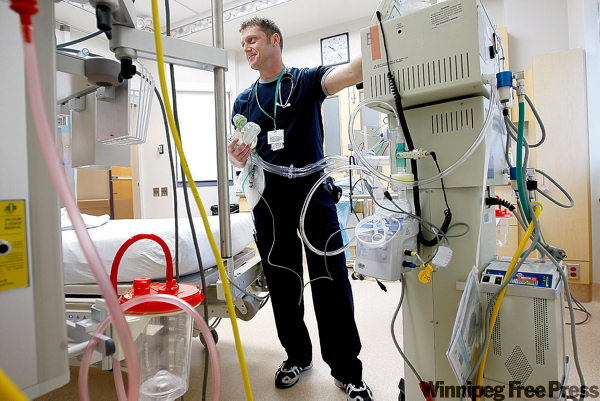
"It’s new and definitely catching our attention because of the newness and because the way it presents itself in different ways," says Mortimer, 42.
Most flus, he says, strike the very young, the elderly or those with underlying health problems. H1N1 hasn’t been following that pattern.
The eight-bed HSC PICU has been extended to 10 beds. There are plans to go to 14 beds. This is ground zero for the majority of children who will become seriously ill with the virus.
If need be, the hospital will set up more pediatric ICU beds throughout the hospital.
HSC saw between 30 and 40 per cent of the Canadian pediatric H1N1 cases in the first wave of the illness. There were seven pediatric deaths in Canada. Only one was in Winnipeg.
"We’re planning for different worst-case scenarios," Mortimer says. "The team here at PICU is an extraordinary team."
Mortimer got his H1N1 shot Monday, the first day it was offered in Manitoba.
The entire PICU, like so many wards in every hospital, is kept as sterile as possible. The compromised patients can’t be exposed to any outside threats.
HSC will get patients from across Manitoba, parts of Ontario and Nunavut. Confirmed cases are already showing up in the hospital’s emergency room.
A walk through the PICU is heartbreaking. Tiny children lie in beds, tubes and masks practically swallowing them. Some are burn victims. Others are the H1N1 cases.
Teams of professionals watch their every heartbeat and breath. These are the most vulnerable patients, the wee ones who need around-the-clock medical attention.
Respiratory therapists (RTs for short) help patients by managing their airways and their ventilators. They intubate patients or supply them with mask ventilation to help them breathe. It’s a fast-paced job that often begins in the emergency room. Cardiac and respiratory arrests require an RT.
Any time you hear a code called in a hospital, an RT is part of team racing to help a critically ill patient.
Mortimer or other RTs are also called upon when there’s a high-risk delivery at the Women’s Hospital. A premature baby will likely need help breathing. They’re ready for all cases of neonatal distress.
Still, theirs is usually an uncelebrated profession.
"RTs are really under the radar," he says. "Most people have never heard of us. But we’re there."
There are roughly 8,000 registered respiratory therapists in Canada. There are approximately 250 in Manitoba.
RTs have to be registered with the Manitoba Association of Registered Respiratory Therapists. Most have completed a three- or four-year program.
They graduate with a bachelor of medical rehabilitation — respiratory therapy degree.
Mortimer, who’s been at HSC for 19 years, has been teaching future respiratory therapists for the past 15 years. He also oversees some of the administrative functions of his department.
He earns approximately $77,000 a year.
His interest in health care began with his mother, a nurse.
"Some of these things just happen by chance," he says. "I was introduced to the program by some medical friends of my mother. It was never really a plan."
He has spent his entire career at HSC. An average day might see him teaching, giving an in-service to nurses and performing "hands-on, bedside care."
There are meetings to attend, many of them related to H1N1. It’s not all flashing lights and beeping monitors and rushing adrenalin.
The married father of two pauses when he’s asked how difficult it is when a patient dies.
"I get that (question) a lot," he says. "’How do you work with kids?’ We infrequently have poor outcomes," he says, earnestly.
"It’s infrequent. I know we’re doing a good job here. We have state-of-the-art technology. If a kid gets sick I want to be involved."
Part of his job is to talk to parents.
"We have to do that every day. My position is I give them the best and most accurate information."

There’s a sense that a clock is ticking in this PICU and in every emergency room across the country. Truly, no one knows what the pandemic will bring. Todd Mortimer knows this:
"We have a terrific team and we’ve been preparing for this. We do our jobs well. We’re been planning for whatever is coming."
lindor.reynolds@freepress.mb.ca