

Touchstones we too often take for granted
Advertisement
Read this article for free:
or
Already have an account? Log in here »
To continue reading, please subscribe:
Digital Subscription
One year of digital access for only $1.44 a week*
- Enjoy unlimited reading on winnipegfreepress.com
- Read the E-Edition, our digital replica newspaper
- Access News Break, our award-winning app
- Play interactive puzzles
*Billed as $5.77 plus GST every four weeks. After 52 weeks, price increases to the regular rate of $19.95 plus GST every four weeks. Offer available to new and qualified returning subscribers only. Cancel any time.
To continue reading, please subscribe:
Add Free Press access to your Brandon Sun subscription for only an additional
$1 for the first 4 weeks*
- Enjoy unlimited reading on winnipegfreepress.com
- Read the E-Edition, our digital replica newspaper
- Access News Break, our award-winning app
- Play interactive puzzles
*Your next Brandon Sun subscription payment will increase by $1.00 and you will be charged $17.95 plus GST for four weeks. After four weeks, your payment will increase to $24.95 plus GST every four weeks.
Read unlimited articles for free today:
or
Already have an account? Log in here »
“For rent: one-storey, one-bedroom former family home and summer cabin with brookside frontage, currently vacant…”
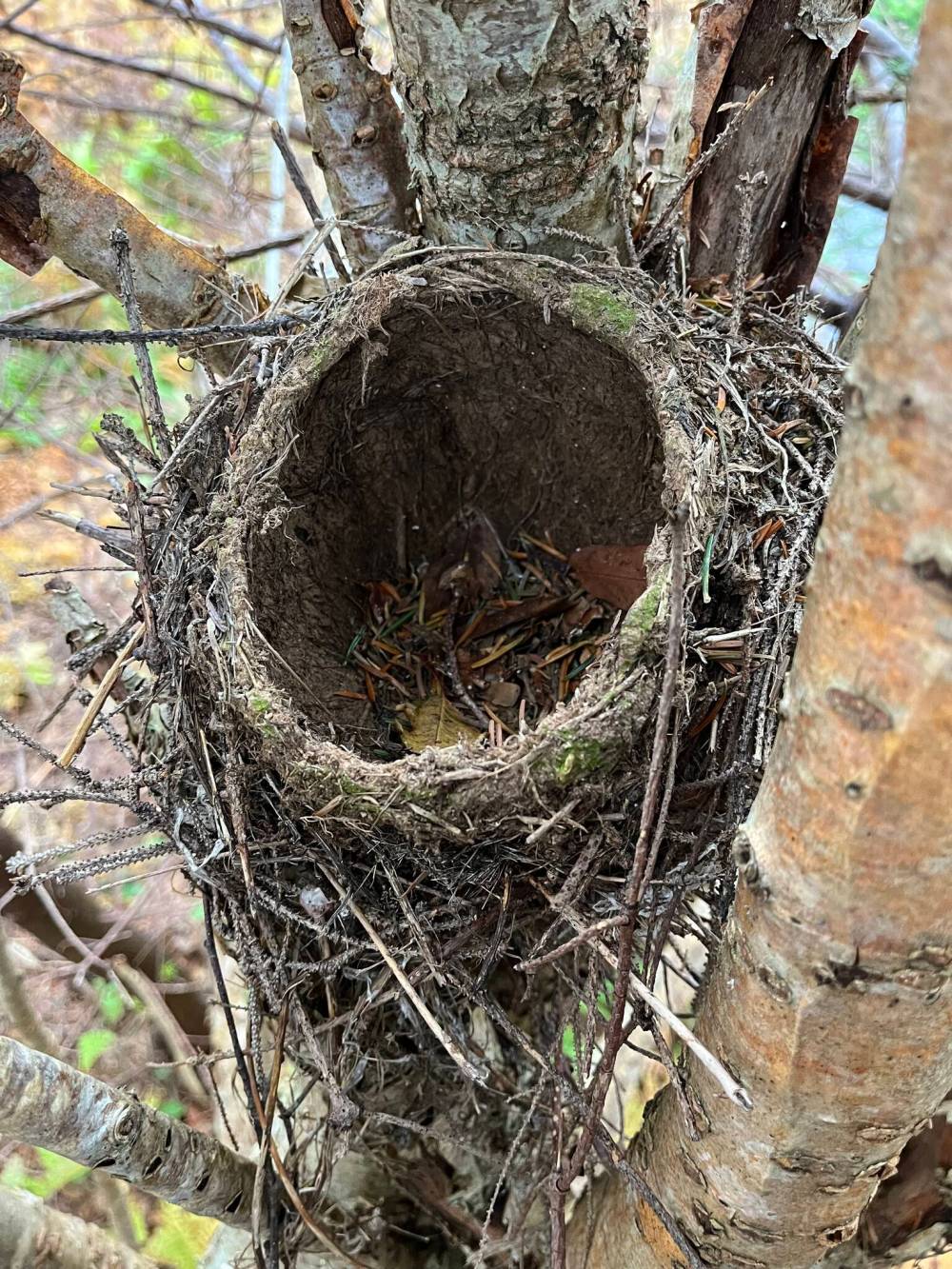
It’s actually a birds’ nest, set in the crotch of a sturdy dogwood tree at about chest height, sitting just above a small, trout-filled reservoir. A location clearly more dependent on summer camouflage than on altitude for nestling security.
It looks abandoned now: there’s a dapple of fir needles in the deepest curve of the nest’s belly, some green, others already orange with age, and a single dried birch leaf. It’s a small marvel of construction: first, a sturdy outer ring of woven overlapping branches, then an inner layer of moss and mud. Some of the moss has stayed alive in an oft-interrupted ring around the top. It’s an almost-perfectly round bowl of a thing, careful precision sprung fully from disorder.
Russell Wangersky photo
An abandoned nest above a small brook in Adam’s Cove, Nfld.
Will its builders — probably robins, but maybe other members of the thrush family — return to their summer home? It’s unlikely. Perhaps they don’t even view it as a home, just as a nesting way station.
Home.
What a familiar and unusual concept it is.
It’s something that can go missing when you’re spread too thin — too thin geographically, especially when you’re spending months in other people’s houses, far from the touchstones you usually take for granted.
At first, as days on the road dragged into weeks, the only way I could find to describe it was that I missed my spices and knives — which I did, as we moved from house to house for two months, waiting for house reconstruction to end. (Spoiler alert — it hasn’t.) But it was actually much more than that — I missed not only the knives and spices themselves, but the easy simplicity of having them right there, in familiar reach. And the easy simplicity of everything else. Knowing where and what everything is, being able to reach out and lay hands on what you need with hardly a glance, your hands mostly knowing already where things are.
Knowing the rest of the house, too — being able to traverse the stairs in the dark. Knowing the midnight ticks of old floors and occasional clanks of the big hot-water radiators. Knowing how to move around an earlier house in the pitch dark of a single-lane rural road with streetlights only at a discrete distance.
You don’t even have to count steps on the stairs, because your feet already know the way and the measure, and your hand rises to touch the bathroom door frame just as you reach it, a wonder of a reflex that needs no analysis, only the acceptance that our senses collect and store more information than we might ever bother to consider or deliberately use.
It is what people do, our own nest-building of a sort, making entries in the unseen catalogue of the familiar, and though I sometimes envy the entrenched ease of those who set down deep roots in one place and never move, I also realize that they may not recognize the benefits they have accrued, and instead take it all for granted.
It is the Joni Mitchell corollary: not knowing what you’ve got till it’s gone. And perhaps not even knowing what you’ve got until it is too late to truly appreciate it.
There is a sweet beauty to even the saddest and most personal of songs.
Russell Wangersky photo
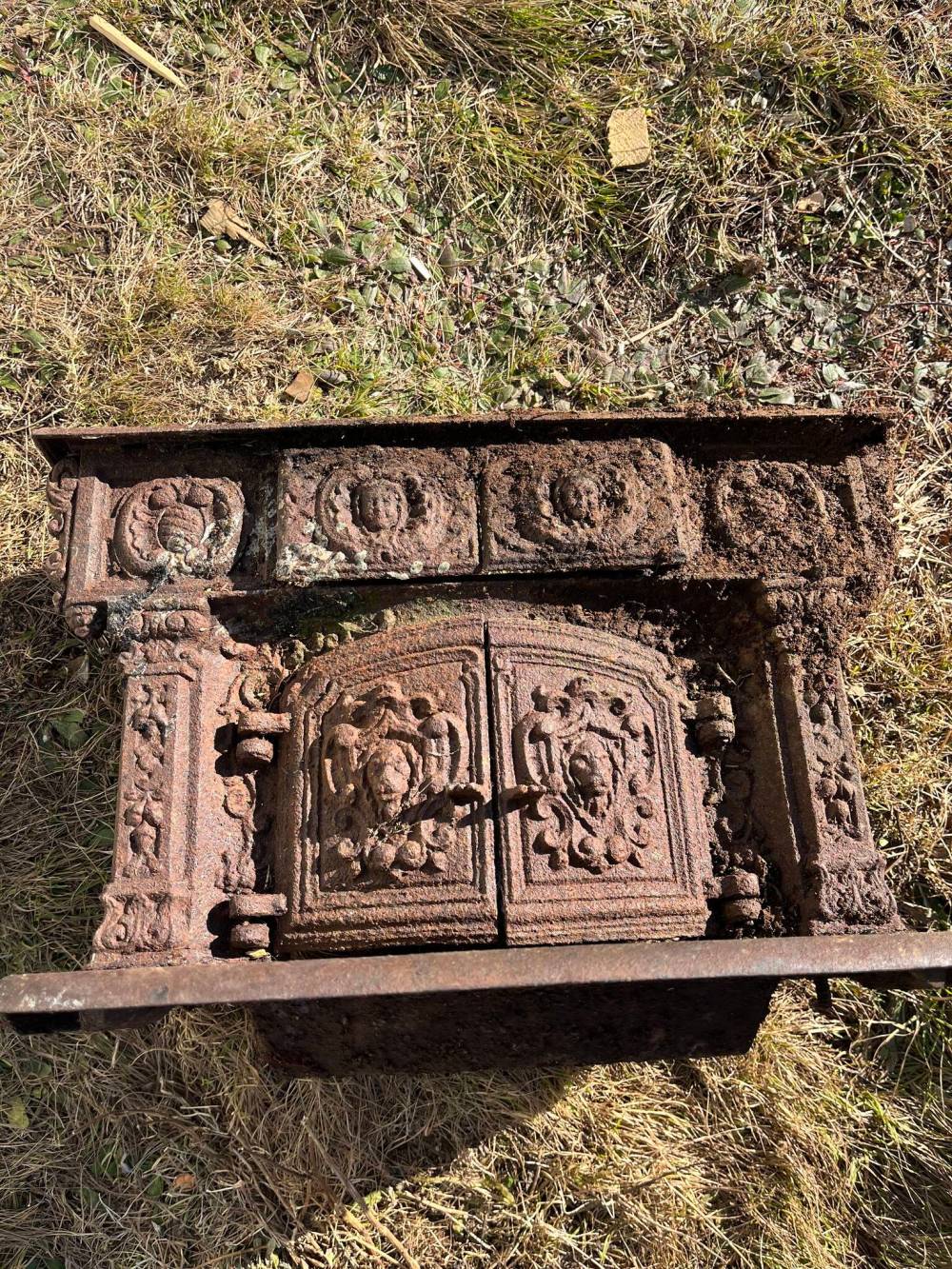
The front of a Victorian parlor stove, found in a peat bank in Adam’s Cove.
The appreciation of loss, the knowing, careful index of what is now definitely past, the bittersweet calculus of present versus history: it all plays out for you if you know where to look, or, more to the point, when your eyes are forced by circumstance to focus on it.
A lot of the sharp bright corners of humanity live in there.

Just above the tree with the nest, we found the cast-iron face-front of an ornate Victorian parlour stove sticking out of the soft sloping bank: with its sharply-defined faces and features, its hinged doors, it’s clear the stove has a story. And though we rescued it from the bank, and though we’ll clean it up gently and blacken it with stove-black and find it a place to live, we’ll never know the story of how it got there.
For us, that stove-front will always only be the bare facts of its discovery and subsequent placement, along with the story that we will inevitably consciously or subconsciously invent to fill in the gaps. But the part of the story that brought stove to the soft soil bank, and the longer tale that was its lifetime bringing warmth either to our former living room or front bedroom (the only two rooms that, before the building burned, had chimney thimbles the right size for its piping) have passed into the catalogue of the unknowable.
The people who implicitly knew the answers, the people who also lived in our house as a home, have undergone their own migration.
The nest is empty: those birds have flown.
Russell Wangersky is a writer and columnist who splits his time between Winnipeg and Adam’s Cove, N.L.