

European in all the wrong ways
Advertisement
Read this article for free:
or
Already have an account? Log in here »
To continue reading, please subscribe:
Digital Subscription
One year of digital access for only $1.44 a week*
- Enjoy unlimited reading on winnipegfreepress.com
- Read the E-Edition, our digital replica newspaper
- Access News Break, our award-winning app
- Play interactive puzzles
*Billed as $5.77 plus GST every four weeks. After 52 weeks, price increases to the regular rate of $19.95 plus GST every four weeks. Offer available to new and qualified returning subscribers only. Cancel any time.
To continue reading, please subscribe:
Add Free Press access to your Brandon Sun subscription for only an additional
$1 for the first 4 weeks*
- Enjoy unlimited reading on winnipegfreepress.com
- Read the E-Edition, our digital replica newspaper
- Access News Break, our award-winning app
- Play interactive puzzles
*Your next Brandon Sun subscription payment will increase by $1.00 and you will be charged $17.95 plus GST for four weeks. After four weeks, your payment will increase to $24.95 plus GST every four weeks.
Read unlimited articles for free today:
or
Already have an account? Log in here »
It’s no secret that Prime Minister Mark Carney is an incorrigible Europhile. He went to university there. Supports their sports teams. His favourite writers? All European. Until recently, he even held a few of their passports.
Cultural affinities aside, it’s clear his political vision for Canada is heavily influenced by his relationships with European leaders.
Now, despite no one knowing what it would mean, and with no mandate for it, Carney has been determined to make Canada the first associate member of the European Union. Part of his pitch includes the assertion that Canada is the most European non-European country. (Argentineans would tango in fury at such a comment.)
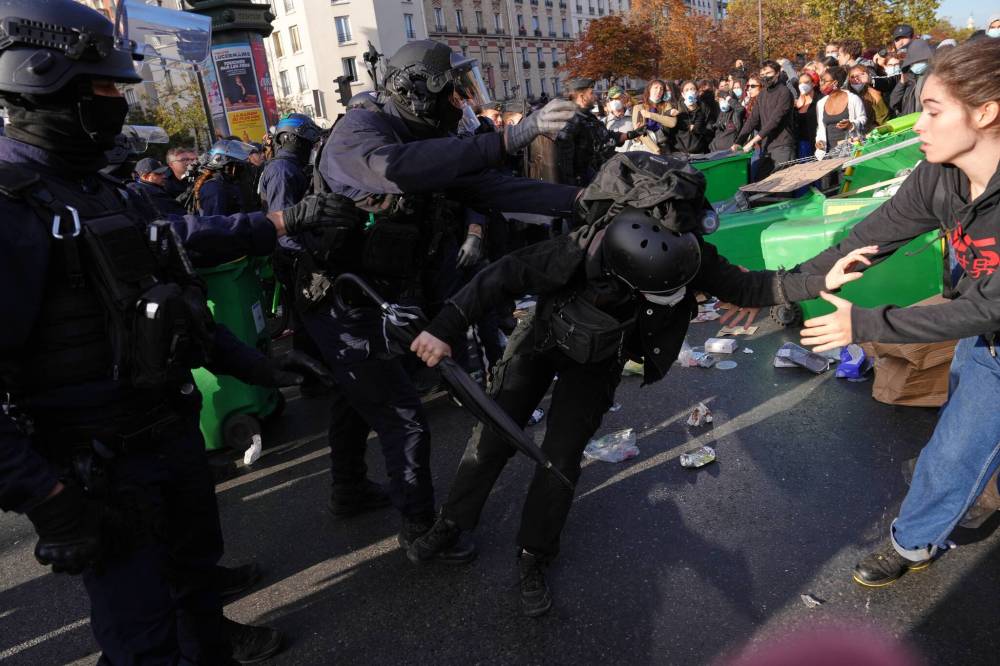
AURELIEN MORISSARD / THE ASSOCIATED PRESS
Riot police face high school students as they gather before a demonstration against under-resourced schools in Paris on Oct. 6.
Clearly, if it’s European, Carney wants it for Canada.
Many Canadians might find this desire relatable. Who hasn’t, landing back in the Great White North after a trip abroad, longed for the European social acceptance of a wine-filled lunch?
Unfortunately, the overwhelming evidence isn’t that Carney is seeking to make Lethbridge more like Lyon in all the ways many Canadians wish, but instead, looks to Europe, sees their cities in flames, and believes Canada, too, could benefit from a little culture.
Flippancy aside, an examination of the policy decisions of this government does make one wonder if the federal government is trying to make young Canadians act a little more European.
Unrest has gripped Europe and young Europeans are driving these protests, armed with a laundry list of grievances.
In Spain, demonstrations broke out against a lack of affordable housing. Barcelona and Madrid were ranked 20th and 16th, respectively, among least affordable major cities in the world, based on average salaries and home prices.
However, less affordable were Toronto and Vancouver, coming in at 12th and fifth place, respectively.
While young Spaniards, fed up with high rents and an inability to get on the housing ladder, took to the streets when the eviction of an 87-year-old disabled women made headlines, in Canada, streets remained calm when the Carney government chose to relax its ban on foreign buyers of residential real estate.
European riots reached their apogee in Paris, where demonstrations began as a protest against a perceived lack of investment into the French education system.
Despite the images coming out of France, the federal government seems confident in the passivity of our youth and, despite 600 educational programs being axed since 2025, moved forward with cuts to student grants. In the most recent federal budget, no new measures were made available to students or academic staff.
Defence spending, too, has become a topic of great debate amidst European unrest. While both Italy and Canada have publicly made commitments to spend five per cent of GDP on military expenditures by 2035, only the youth in Italy publicly expressed their preference that these new expenditures instead go towards housing and education.
Perhaps the biggest concern for all European youth is the chronic perception that they have no future. Unemployment and underemployment remain high. In the EU, the rate of young people considered NEET, not in employment, education or training, sat at a whopping 11 per cent.
It should come as no surprise that, devoid of hope, many took to the streets.
In Canada, however, the rate of young NEETs sits even higher, at 11.7 per cent.
Despite the hundreds of thousands of Canada’s youth out of work, Ottawa moved forward with plans to allow employers to bypass young Canadians even more completely, by promising to create 660,000 new permanent residents in 2027 and announcing measures to allow employers to more easily seek out foreign workers. Indeed, of all the other demands made by European youth, their Canadian counterparts would be right to have similar grievances. From climate change to growing debt burdens, to online surveillance and censorship, in most cases, Canada’s youth have been let down on what matters most to them at even greater magnitudes.

So, while this government takes lessons from its European homologues, why haven’t young Canadians?
Perhaps the decline of pubs, bowling alleys and third spaces in general, has ensured young Canadians stay sufficiently atomized, forcing them to channel their anger online. Is it any coincidence that the only city in Canada that consistently sees youth protest, Montreal, is also the only city that lets young adults share an $11 bottle of wine in the park?
Or perhaps the most rejected generation, following months of job applications, matchless nights on dating apps and getting ghosted by hiring managers, is too dejected and has finally checked out.
We don’t need to ask why the youth in Europe are rioting. Instead, as federal Europhiles import policies and create the same conditions that led to European unrest, why aren’t young Canadians?
Danny Parys is a strategy and governance consultant and a fellow at Social Capital Partners. He holds a degree in economics from the University of Manitoba and an MBA from HEC Montreal.