

New national security plan incomplete
Advertisement
Read this article for free:
or
Already have an account? Log in here »
To continue reading, please subscribe:
Digital Subscription
One year of digital access for only $1.44 a week*
- Enjoy unlimited reading on winnipegfreepress.com
- Read the E-Edition, our digital replica newspaper
- Access News Break, our award-winning app
- Play interactive puzzles
*Billed as $5.77 plus GST every four weeks. After 52 weeks, price increases to the regular rate of $19.95 plus GST every four weeks. Offer available to new and qualified returning subscribers only. Cancel any time.
To continue reading, please subscribe:
Add Free Press access to your Brandon Sun subscription for only an additional
$1 for the first 4 weeks*
- Enjoy unlimited reading on winnipegfreepress.com
- Read the E-Edition, our digital replica newspaper
- Access News Break, our award-winning app
- Play interactive puzzles
*Your next Brandon Sun subscription payment will increase by $1.00 and you will be charged $17.95 plus GST for four weeks. After four weeks, your payment will increase to $24.95 plus GST every four weeks.
Read unlimited articles for free today:
or
Already have an account? Log in here »
It finally arrived. More than two decades after Canada’s lone national security strategy was published in 2004, Ottawa released an update on Oct. 29. Prime Minister Mark Carney touted the revised framework as a “whole-of-government approach” to cope with a more fractious world.
Yet at just 13 pages, The Plan for a Stronger Canada is surprisingly thrifty. The strategy provides only a skeleton to be filled in later.
Eight key sectors are identified where Canada must bolster sovereign capabilities to enhance national resilience and strategic autonomy for purposes “up to and including war.” These encompass emerging technologies — AI, quantum computing, space-based systems — critical minerals, defence, energy, transportation, biotech, food security and payment networks.
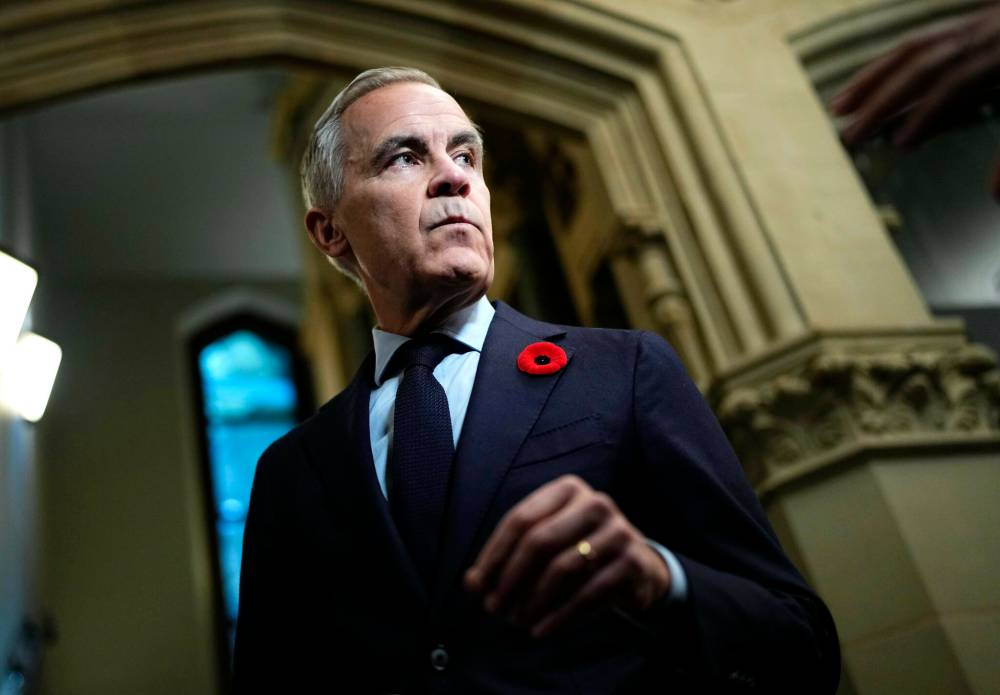
Justin Tang / The Canadian Press Files
Prime Minister Mark Carney touts the revised national security strategy as a new approach to a fractious global climate.
Five more policies are said to be coming down the pipeline as well, covering economic security, foreign engagement, defence, public safety and intelligence. The government promises these are where its concrete actions will be unveiled.
The new national security plan is thus “best understood as a statement of strategic intent,” Andrea Charron, the director of the University of Manitoba’s Centre for Defence and Security Studies, posted on LinkedIn. “It signals where Canada believes it must go, while leaving unanswered the harder question of how it intends to get there.”
Still, producing just the strategy itself has value: it confirms Ottawa grasps the world has changed in unsettling ways. And, that Canada must change with it.
“This is very much a ‘Canada going it alone’ document,” according to Jessica David, a former national security and intelligence official.
She applauded Ottawa’s recognition that the global order is tipping into anarchic competition between states.
Yet at the core of the plan’s ambitions are digital platforms. These are the same systems that the federal government’s own AI strategy acknowledges Canada holds little sway over.
“Autonomy built on digital systems Canada doesn’t own or control isn’t autonomy at all and the framework’s success will depend on whether Ottawa is willing to define digital sovereignty and what counts as a Canadian company, with real teeth,” cautions Matthew da Mota, research director at the Canadian Shield Institute think tank.
As if to underscore its seriousness, parallel to releasing the strategy, Ottawa boldly invested $1.6 billion in Cohere, Canada’s crown-jewel AI firm. The giant equity stake purchase is conditioned on the Toronto-based company — one of only a handful worldwide producing frontier AI models — staying headquartered in Canada.
The new plan also is undeniably vague about the global-threat landscape. “Only in Canada can you write a national security strategy without mentioning the specific malign actors that seek to threaten Canadian security and interests,” a trio of defence experts from the Macdonald-Laurier Institute wrote in conservative outlet The Hub.
“There is no mention of the Russian threat to the east, of the Chinese threat to the west. No mention of terrorism, of nuclear weapons, of failed states generating tsunamis of refugees,” echoed Ben Rowswell, a former federal official who helped develop the 2004 security strategy.
The same goes for India, Pakistan and Rwanda — nations, among others, that Canadian intelligence officials and civil society groups accuse of engaging in transnational repression and disinformation campaigns on Canadian soil.
This reflects the Carney government’s embrace of so-called “variable geometry.” To lessen Canada’s dependence on America, Ottawa has begun pursuing flexible economic and security partnerships with all comers based on mutual interests — not necessarily shared principles. Even openly authoritarian states are welcome.
It’s a sharp break from Carney’s predecessor.
“While expanding trade and building new partnerships is essential, this strategy suggests that Canada’s commitments to its values stops at its border,” Roland Paris, a former foreign policy advisor to prime minister Justin Trudeau, told The Globe and Mail.

Plus, lurking on the horizon is the question of how to pay for it all.
The plan reiterates Ottawa’s NATO pledge to spend five percent of GDP on defence by 2035. That alone may eclipse $150 billion annually. The Defence Industrial Strategy released in February contains another half a trillion dollars in investment pledges. Together, these address only a portion of the framework’s priorities.
The government is clearly banking on positive economic spinoffs from military modernization. However, amid a rapidly aging population and severe housing shortages, painful tradeoffs lie ahead. Climate-change fallout will also only get worse. Some combination of higher taxes, social program cuts and deeper deficit spending is inevitable.
A new national security for Canada was long overdue. Although, if anything the hard work has just begun. The best laid plans won’t amount to much if the public isn’t brought on board.
Kyle Volpi Hiebert is a Montreal-based political risk analyst focused on globalization, conflict and emerging technologies.