

Sustainability, profitability go hand-in-hand

Advertisement
Read this article for free:
or
Already have an account? Log in here »
To continue reading, please subscribe:
Digital Subscription
One year of digital access for only $1.44 a week*
- Enjoy unlimited reading on winnipegfreepress.com
- Read the E-Edition, our digital replica newspaper
- Access News Break, our award-winning app
- Play interactive puzzles
*Billed as $5.77 plus GST every four weeks. After 52 weeks, price increases to the regular rate of $19.95 plus GST every four weeks. Offer available to new and qualified returning subscribers only. Cancel any time.
To continue reading, please subscribe:
Add Free Press access to your Brandon Sun subscription for only an additional
$1 for the first 4 weeks*
- Enjoy unlimited reading on winnipegfreepress.com
- Read the E-Edition, our digital replica newspaper
- Access News Break, our award-winning app
- Play interactive puzzles
*Your next Brandon Sun subscription payment will increase by $1.00 and you will be charged $17.95 plus GST for four weeks. After four weeks, your payment will increase to $24.95 plus GST every four weeks.
Read unlimited articles for free today:
or
Already have an account? Log in here »
Canadian farm groups had high praise for some features of the Nov. 6 federal budget, but what resonated the loudest with the farming community is what it doesn’t say.
Out with all that talk about greenhouse gases, emissions reductions, carbon taxes and sustainability — which seemed to dominate federal agricultural policy under prime minister Justin Trudeau’s Liberals. In with Prime Minister Mark Carney’s banker-speak, focused on productivity and economic growth.
Words matter. The language we choose frames the conversations we have — sometimes boxing us in. The words used by the Trudeau government in a bid to establish Canada as a leader in containing global warming had the effect of putting farmers on the defensive. Once that happens, reasonable discourse gives way to polarized debate.
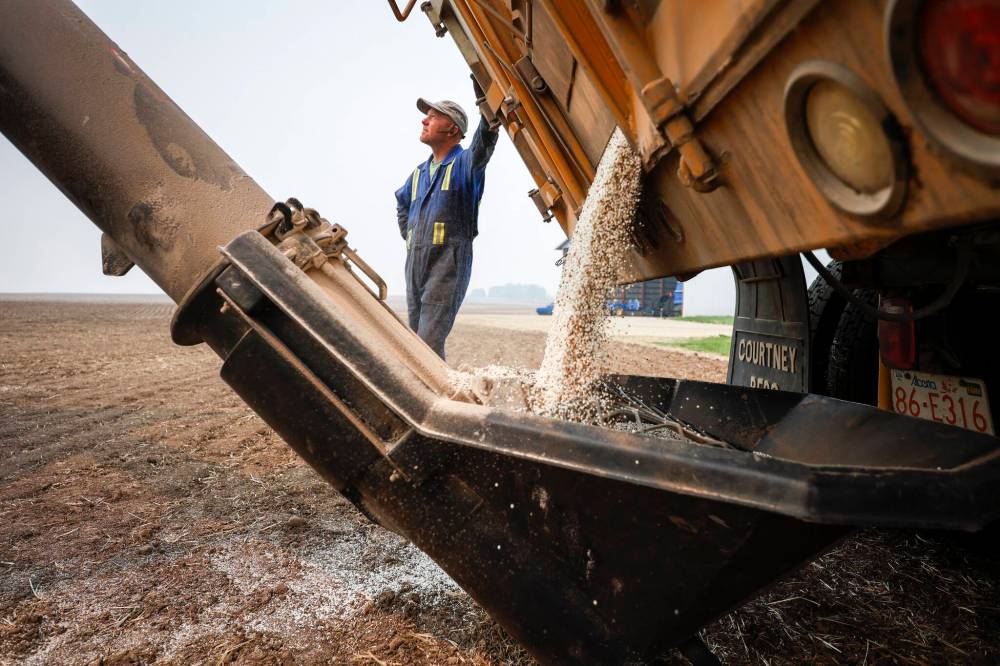
JEFF MCINTOSH / THE CANADIAN PRESS FILES
Philip Reid loads fertilizer into a seeding rig as he prepares to plant a canola crop on his family’s farm near Cremona, Alta., in 2023.
Sustainability and profitability aren’t mutually exclusive. Reducing emissions from agricultural operations could result in net gains in both profitability and productivity if they result from more efficient use of resources.
But when the federal department issued an October 2022 policy discussion paper titled “Reducing emissions arising from the application of fertilizer in Canada’s agriculture sector,” critics zeroed in on the stated target of reducing emissions from synthetic fertilizer use by 30 per cent by 2030.
The paper noted synthetic fertilizer use had risen 71 per cent between 2005 and 2019, which correlated with a 54 per cent increase in N2O emissions. It failed to acknowledge the increased fertilizer use was correlated with sharp improvements in productivity, which means farmers are using fewer resources per bushel grown.
Farm lobbyists were incensed the government set an arbitrary 30 per cent reduction target without considering the effect that might have on farmers’ yields.
The government flatly denied any intent to make the target mandatory, emphasizing emissions reductions could be achieved through more efficient fertilizer management and promising to invest significant dollars into helping farmers adopt better practices.
But that didn’t stop the news releases and analysis of how far the sky would fall if the target did become mandatory.
Industry and farmers spent a lot of time and energy arguing with the government over manufactured threats when they were chasing the same goal, just from different angles.
It’s no secret a high proportion of the fertilizer farmers apply never reaches its intended target. Reducing fertilizer losses — which correlates with lower emissions — is the whole focus behind what is known as the industry’s 4R Nutrient Strategy — applying fertilizers at the right time, in the right place, using the right method and the right product. It could save farmers money, maintain productivity and help the environment, too.
The Carney government’s focus on economic growth appears to have pushed climate change mitigation and adaptation to the back burner in favour of more palatable, albeit less ambitious initiatives.
Farmers will benefit from the ability to fully depreciate new equipment or new barns in the year of purchase. Other budget promises include expanding provisions to facilitate intergenerational farm transfers to extended family and granting permanent residency to more temporary foreign workers.
They may also benefit from more market diversification. However, critical vulnerabilities in export transportation infrastructure render that effort moot if farmers can’t get their product to new markets.
The budget also did little to cushion the soaring cost of fertilizer and fuel or address the financial strain many farmers are feeling. After all, the ability to depreciate new farm equipment only matters if a farmer can afford to invest in the first place.

Few are even talking about the fact fertilizer and fuel are derived from non-renewable resources. It’s fair to question whether governments should be compensating farmers as if higher costs are a short-term anomaly or preparing them for a different future.
Climate change is happening, incrementally through annual increases in global temperature and violently through the extreme weather now playing out across the globe. Farmers and our food supply are on the front lines.
It bears repeating over the long term, profitability and sustainability go hand-in-hand.
We can avoid talking about it or we can find language that seeks a common ground. But we ignore the reality at our peril.
Laura Rance-Unger is editor emeritus for Glacier FarmMedia. She can be reached at lrance@farmmedia.com
Laura Rance is editorial director at Farm Business Communications.
Our newsroom depends on a growing audience of readers to power our journalism. If you are not a paid reader, please consider becoming a subscriber.
Our newsroom depends on its audience of readers to power our journalism. Thank you for your support.
Advertisement Advertise With Us
Advertisement Advertise With Us