

Carney must better define sovereignty
Advertisement
Read this article for free:
or
Already have an account? Log in here »
To continue reading, please subscribe:
Digital Subscription
One year of digital access for only $1.44 a week*
- Enjoy unlimited reading on winnipegfreepress.com
- Read the E-Edition, our digital replica newspaper
- Access News Break, our award-winning app
- Play interactive puzzles
*Billed as $5.77 plus GST every four weeks. After 52 weeks, price increases to the regular rate of $19.95 plus GST every four weeks. Offer available to new and qualified returning subscribers only. Cancel any time.
To continue reading, please subscribe:
Add Free Press access to your Brandon Sun subscription for only an additional
$1 for the first 4 weeks*
- Enjoy unlimited reading on winnipegfreepress.com
- Read the E-Edition, our digital replica newspaper
- Access News Break, our award-winning app
- Play interactive puzzles
*Your next Brandon Sun subscription payment will increase by $1.00 and you will be charged $17.95 plus GST for four weeks. After four weeks, your payment will increase to $24.95 plus GST every four weeks.
Read unlimited articles for free today:
or
Already have an account? Log in here »
It’s been roughly 20 years since the Canadian government released its last national security statement.
So it was long overdue to enunciate an updated and revised Plan for a Stronger Canada. “This is the plan for a sovereign, resilient and prosperous Canada,” according to Prime Minister Mark Carney.
We are obviously living in very turbulent international times in which authoritarian states are acting out, when Russia and China have shown a propensity toward aggression and contesting territorial integrity.
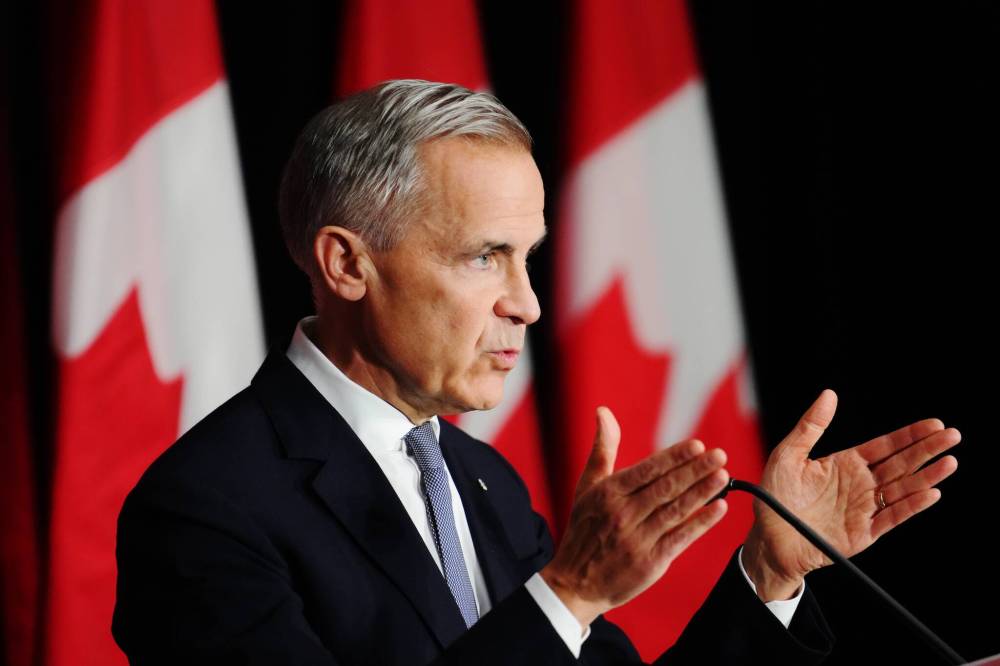
SEAN KILPATRICK / THE CANADIAN PRESS FILES
Prime Minister Mark Carney makes a live address on Canada’s plan to build a stronger economy on Oct. 22.
The new security strategy concisely sets out the seminal challenges: “The long-held belief that the combination of our geography, interconnectedness and a rules-based international order could substitute for Canadian sovereign capacity to protect ourselves is no longer tenable.”
The strategy contains a brief section on key policy objectives: strengthening and protecting Canadian sovereignty, bolstering the Canadian economy (through national interest projects) and adopting a “co-operative, clear-eyed” approach to managing relations with the United States.
“We will work to maintain a relationship with the United States based on mutual respect, national sovereignty and shared responsibility for the security of North America,” it says plainly.
While the new plan doesn’t say it explicitly, it is clear that the evolving threat environment is inextricably linked to U.S. President Donald Trump. He has single-handedly sought to undermine the long-standing liberal international order, opted for nativism and protectionism over internationalism and open markets and turned interconnectedness and integrated supply chains into a serious Canadian economic vulnerability.
To ensure that Canada is in a position to control its own destiny (and adapt to unexpected events), the strategy relies heavily on Canadian natural resources, energy, critical minerals and advanced technology (like AI).
Added to this list are other “strategic capabilities”: transportation, food security, payment systems and investments and pharmaceuticals and biotech. As the plan clearly emphasizes: “We can achieve greater strategic autonomy through a secure and growing economy, a disciplined foreign policy, a stronger and more agile armed forces, reinforced national defence and better intelligence functions.”
This all raises a series of salient questions: will this new national security strategy still be relevant given a hobbled and lame-duck Trump presidency? How do you get Canadians and corporate Canada to buy into this plan? And, most important, where is all the money going to come from to underpin these various national security objectives?
I was disappointed to see that Latin America and the Caribbean were mentioned once (“to combat illegal drugs and the spread of organized crime”), and largely as an afterthought. This Liberal government may not know it, but the people of the Americas are Canada’s neighbours and friends, eager to do business with us, anxious to hear what Canada has to say in the OAS and the Summits of the Americas and desperate to sit down with a country that is not the United States. But it’s obvious that Europe, the Indo-Pacific and the Middle East are now taking up all the oxygen in the foreign policy room.
Curiously, the reference to a “disciplined foreign policy” stood out to me. What exactly does it mean? From what I’ve seen thus far from Carney, it means prioritizing economic interests over the incorporation of Canadian values and principles in the conduct of our foreign policy.
This is not “values-based realism”; it’s rolling out the red carpet for just about every country in the world — irrespective of their record on protecting fundamental human rights.
I have to say that I lost count of how many times the word “sovereignty” appeared in the 14-page document — and without once even defining what the term actually means in today’s complex world.
It seems to me that Carney defines Canadian sovereignty as diminishing human rights concerns and capitulating to the Chinese so as to advance a “strategic partnership.” Ditto for selling Candu nuclear technology and weapons systems to an increasingly autocratic state like Turkey.

Perhaps sovereignty means giving in to a country like the UAE (which is enabling mass atrocities in Sudan today) on military exports and an extradition treaty in exchange for untold billions of foreign investment? If you ask me, these are all examples of a Canada clearly compromising its national sovereignty.
More to the point: diversifying our trade with other countries in Europe and the Middle East (which I see as good symbolic politics) is all well and good. But Canada is a North American country. Our best ally, defence partner and customer is the United States — and it will always be so. All you have to do is talk with small and medium-sized Canadian companies that know precisely who pads their bottom lines (hint: it’s not the Europeans).
My worry is that Carney’s new national security plan will end up like many others before his — to wit, collecting dust after a year or two. Yes, of course, fortify Canada’s economic security, our military and our intelligence services, husband our natural resources and diversify our trading partners.
But don’t forget that Trump is on his way out and our future prosperity is closely tied to the Americas.
Peter McKenna is professor of political science at the University of Prince Edward Island in Charlottetown.