

Federal pledge requires careful implementation
Advertisement
Read this article for free:
or
Already have an account? Log in here »
To continue reading, please subscribe:
Digital Subscription
One year of digital access for only $1.44 a week*
- Enjoy unlimited reading on winnipegfreepress.com
- Read the E-Edition, our digital replica newspaper
- Access News Break, our award-winning app
- Play interactive puzzles
*Billed as $5.77 plus GST every four weeks. After 52 weeks, price increases to the regular rate of $19.95 plus GST every four weeks. Offer available to new and qualified returning subscribers only. Cancel any time.
To continue reading, please subscribe:
Add Free Press access to your Brandon Sun subscription for only an additional
$1 for the first 4 weeks*
- Enjoy unlimited reading on winnipegfreepress.com
- Read the E-Edition, our digital replica newspaper
- Access News Break, our award-winning app
- Play interactive puzzles
*Your next Brandon Sun subscription payment will increase by $1.00 and you will be charged $17.95 plus GST for four weeks. After four weeks, your payment will increase to $24.95 plus GST every four weeks.
Read unlimited articles for free today:
or
Already have an account? Log in here »
Manitoba has never seen an investment quite like the one announced last week to address homelessness, addictions and mental health. The $1-billion commitment made by Prime Minister Mark Carney on Friday represents an extraordinary opportunity to make meaningful progress on some of the most troubling social challenges facing Winnipeg and the province.
It’s also a welcome recognition that these problems cannot be solved with short-term fixes, fragmented programs or governments passing responsibility from one level to another.
For too long, Manitoba’s response to homelessness and addictions has been underfunded, poorly co-ordinated and inadequate to the scale of the crisis. People struggling with severe mental-health and addiction problems have too often cycled among emergency rooms, shelters, correctional facilities and the streets without receiving the sustained care and housing they need.
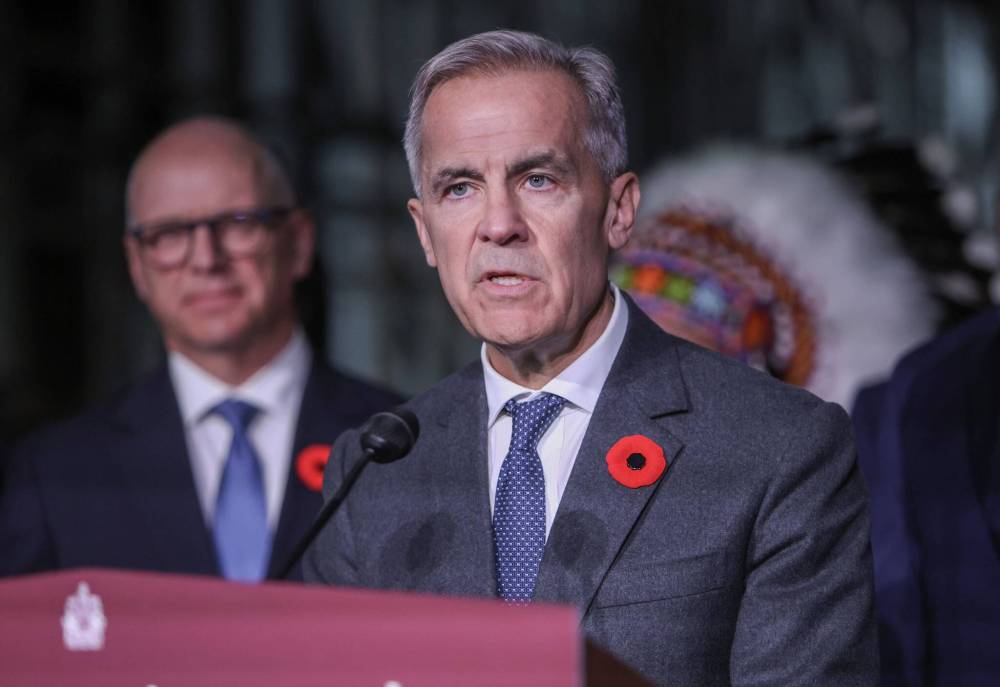
Ruth Bonneville / Free Press Files
Prime Minister Mark Carney speaks in Winnipeg on Friday.
Friday’s announcement offers a chance to change that.
The federal government is committing up to $800 million toward more than 2,000 supportive and transitional housing units, along with $200 million for a new mental-health and addictions centre in Winnipeg. The centre, which could open as early as 2029, is intended to combine acute and outpatient medical care and coordinated support services.
That is a significant investment by any measure and one Manitoba desperately needs.
Just as encouraging is the broad partnership behind it. Carney stood alongside Premier Wab Kinew, Mayor Scott Gillingham, Indigenous leaders and community organizations to announce the initiative. The private sector, including Winnipeg Jets owners Mark Chipman and David Thomson, also played an important role in advancing the project.
The city will provide land, the province will fund ongoing services and First Nations will be critical partners.
This kind of collaboration is essential. Homelessness, mental illness and addiction do not respect jurisdictional boundaries. Neither should the response.
Governments, Indigenous communities, businesses and frontline organizations all have important roles to play. Having them working toward a common goal, with substantial resources behind them, is a welcome departure from the fragmented approaches of the past.
But an announcement of this magnitude is only the beginning. There are still important questions that need answers before Manitobans can judge how successful this initiative will ultimately be.
Where will the new treatment centre be located? Where will the transitional and supportive housing units be built? How will they be distributed throughout Winnipeg and the province? And perhaps most importantly, what specific wraparound services will be available to residents?

There is also a legitimate concern about what happens after people leave transitional housing. Manitoba has a significant shortage of permanent affordable and subsidized housing. If people stabilize their lives but cannot find somewhere permanent to live, transitional housing risks becoming another holding pattern rather than a pathway out of homelessness.
As housing advocates have said, there is little point in moving people through transitional accommodation if there is nowhere for them to go next. The province must ensure there is a sufficient supply of permanent housing to support the initiative. Some of the new units may need to be permanent homes themselves.
These are not reasons to diminish Friday’s announcement. They are reasons to get the implementation right.
Carney has committed an unprecedented amount of federal money to a problem that has been allowed to grow for years. Kinew’s government now has an enormous responsibility to turn that commitment into effective treatment, meaningful support and stable housing.
Ending homelessness is an ambitious goal and there are no guarantees that even $1 billion will accomplish it. But Manitoba has never had this kind of opportunity before. If implemented effectively, it has the makings of real, transformative change.