

Closing book on weather-damaged harvest

Advertisement
Read this article for free:
or
Already have an account? Log in here »
To continue reading, please subscribe:
Digital Subscription
One year of digital access for only $1.44 a week*
- Enjoy unlimited reading on winnipegfreepress.com
- Read the E-Edition, our digital replica newspaper
- Access News Break, our award-winning app
- Play interactive puzzles
*Billed as $5.77 plus GST every four weeks. After 52 weeks, price increases to the regular rate of $19.95 plus GST every four weeks. Offer available to new and qualified returning subscribers only. Cancel any time.
To continue reading, please subscribe:
Add Free Press access to your Brandon Sun subscription for only an additional
$1 for the first 4 weeks*
- Enjoy unlimited reading on winnipegfreepress.com
- Read the E-Edition, our digital replica newspaper
- Access News Break, our award-winning app
- Play interactive puzzles
*Your next Brandon Sun subscription payment will increase by $1.00 and you will be charged $17.95 plus GST for four weeks. After four weeks, your payment will increase to $24.95 plus GST every four weeks.
Read unlimited articles for free today:
or
Already have an account? Log in here »
Farmers trying to close the book on this year’s harvest are left with a few loose ends that already promise to make next year’s story interesting.
Fighting weeds, insects and disease goes with the territory when growing annual crops. But unpredictable growing conditions and weather combined with new players joining the crop-threat team make the plot line twisty.
It was uncommonly common to see fields this past summer where it was hard to tell what crop was growing beneath the weeds, if there was a crop on that field at all.
DARRYL DYCK / THE CANADIAN PRESS FILES
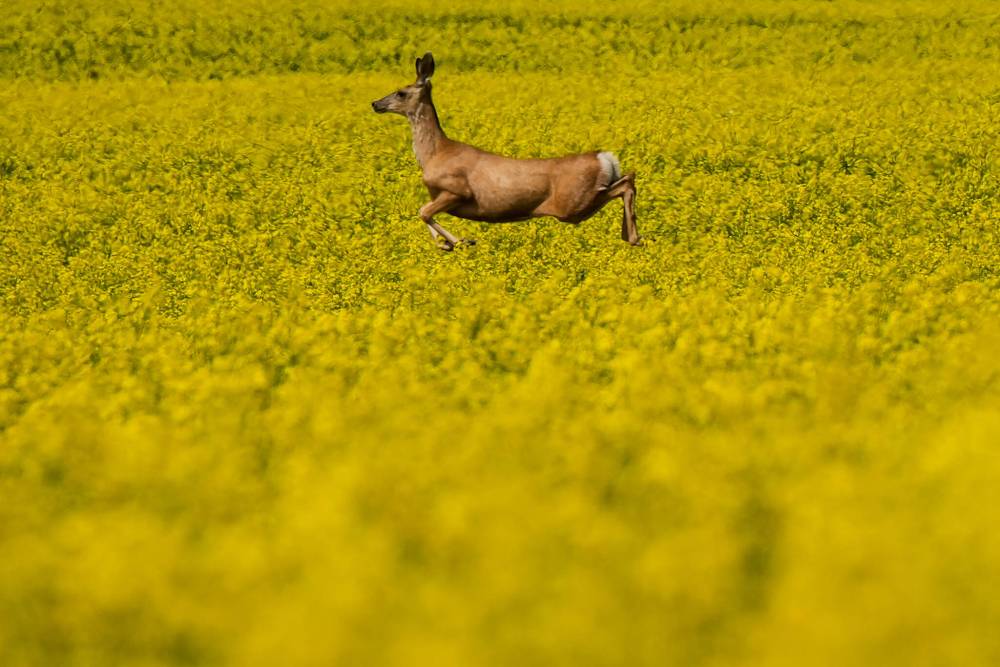
A deer bounds through a canola field this summer. Plans are already being formed to face the challenges of the next growing season.
The cold weather, heavy rains and flooding early in the growing season made it impossible for farmers in many areas to follow their usual approach to seeding and weed control. Fields in the most heavily deluged areas remained unworkable until late summer, if farmers could even reach them due to washed-out roads and bridges.
Uncontrolled weeds have now gone to seed and replenished the dreaded “weed seed bank,” undoing multi-year efforts to reduce the below-surface inventory of weeds waiting to germinate.
One of the core principles of integrated pest management is to reduce weed pressure by depleting the seed bank using strategies such as crop rotations, harvest management, herbicides and reduced tillage.
Cutting tillage to reduce weeds seems counterintuitive, but less soil disturbance correlates with higher levels of soil biological activity. Those voracious little bugs like to feast on ungerminated seeds.
It all works great — in theory. But in real-world conditions, theory sometimes takes a back seat to getting the job done.
Extension advisers are also warning farmers to be on the lookout for a relatively new canola pest early in the next growing season.
The cabbage seed pod weevil has been gaining traction on the Prairies since it was first detected earlier this decade.
The insect hides over winter beneath plant residues and emerges to lay its eggs as the canola pods form after flowering. The hatching larvae feed on the developing seeds causing yield losses.
Farmers have a tight window for insecticide applications because once the pods have formed, the eggs are sheltered from any insecticides they apply. And because the insecticides registered for controlling the pest are broad spectrum, they wipe out the pollinators too.
Provincial entomologist John Gavloski says canola will produce seed without pollinators, but with their help, yields increase on average of 10 to 15 per cent. To minimize the risk of collateral damage, farmers are advised to check their canola fields as they begin to flower, spray only if a weevil infestation exceeds economic thresholds and to spray later in the day when the pollinators are less active.
On the disease front, the standout story this year is a sharp increase in the number of wheat fields infected with fusarium head blight, a cereal disease that cuts yields but also produces mycotoxins in the grain that are harmful to humans and livestock.
A midsummer disease survey showed 52 per cent of the fields sampled were infected, the highest levels in a decade.
Grain delivered into the handling system is monitored for fusarium-damaged kernels to avoid them getting into processing for food or livestock feed.
Yields for this year’s wheat crop were already disappointing. Hot, dry weather during flowering in early summer is partly to blame. It was then followed by hot, humid weather that encouraged diseases like fusarium to take hold. Then a wet, mucky autumn delayed harvest, causing the wheat kernels to sprout while they awaited harvest.

Sprouting and fusarium are two of the many factors that cause wheat to be downgraded, which drastically reduces its value. Fusarium spores can linger on crop residues to infect next year’s crop — if conditions are right.
Farmers can use fungicides registered to control fusarium and other fungal diseases, but timing must be precise to get control and the weather doesn’t always co-operate.
As they enter what is expected to be a mild El Niño winter with their fields well-endowed with moisture, all producers can do is plan for the next growing season, knowing there are costly pests lurking in the shadows of this one making plans of their own.
Eyes wide open.
Laura Rance-Unger is editor emeritus for Glacier FarmMedia. She can be reached at lrance@farmmedia.com
Laura Rance is editorial director at Farm Business Communications.
Our newsroom depends on a growing audience of readers to power our journalism. If you are not a paid reader, please consider becoming a subscriber.
Our newsroom depends on its audience of readers to power our journalism. Thank you for your support.
Advertisement Advertise With Us
Advertisement Advertise With Us