

The volatile U.S. midterms
Advertisement
Read this article for free:
or
Already have an account? Log in here »
To continue reading, please subscribe:
Digital Subscription
One year of digital access for only $1.44 a week*
- Enjoy unlimited reading on winnipegfreepress.com
- Read the E-Edition, our digital replica newspaper
- Access News Break, our award-winning app
- Play interactive puzzles
*Billed as $5.77 plus GST every four weeks. After 52 weeks, price increases to the regular rate of $19.95 plus GST every four weeks. Offer available to new and qualified returning subscribers only. Cancel any time.
To continue reading, please subscribe:
Add Free Press access to your Brandon Sun subscription for only an additional
$1 for the first 4 weeks*
- Enjoy unlimited reading on winnipegfreepress.com
- Read the E-Edition, our digital replica newspaper
- Access News Break, our award-winning app
- Play interactive puzzles
*Your next Brandon Sun subscription payment will increase by $1.00 and you will be charged $17.95 plus GST for four weeks. After four weeks, your payment will increase to $24.95 plus GST every four weeks.
Read unlimited articles for free today:
or
Already have an account? Log in here »
The last time the Democratic Party had 218 or more seats — the number required to control the U.S. House of Representatives — was from 2021 to 2023, following the election of Democrat Joe Biden as president. During that same period, the Democrats also had the edge in the Senate. Despite a 50-50 split with the Republicans, Democrats were able to control the Senate with the help of Vice-President Kamala Harris, who cast the key vote in a tie. From 2023 to 2025, the Democrats had a slim 51 to 49 Senate majority.
If history repeats itself and the latest polls are fairly accurate, on Tuesday, Nov. 3, the Democratic Party will take back the House and (probably) the Senate from the Republicans, who have controlled both legislative bodies since the 2024 election. In the House, the Democrats have to gain at least three more seats. In the Senate, they have to win four more, which is entirely doable, though they almost certainly have to win a seat in Texas, Ohio, Kansas or Alaska, each of which currently has two Republican senators.
The prospect of a Democratic victory has President Donald Trump in a tizzy. For the past two years, he has abused his executive power to impose illegal tariffs on Canada and other countries; started a war with Iran; cozied up to Russian president Vladimir Putin and turned his back on Ukrainian president Volodymyr Zelenskyy; and increased the national debt through questionable tax cuts — to list only a few of his more egregious actions. He has been able to get away with this mainly because Republicans in the Senate and the House refuse to even question his decisions.
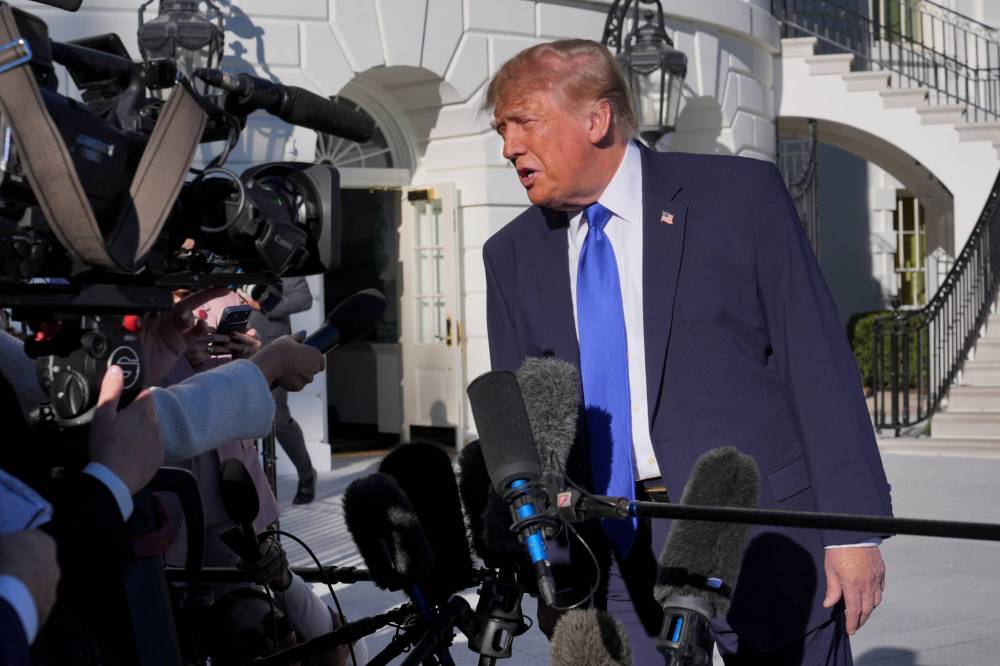
Scott Applewhite / The Associated Press
U.S. President Donald Trump speaks to reporters before boarding Marine One on the South Lawn of the White House in Washington, D.C.
With the Democrats in charge, Trump’s brazen actions won’t be completely halted, but he will face significant legislative challenges and obstacles not easily dismissed. His controversial appointees, such as Attorney General Todd Blanche, who perceives himself as Trump’s private lawyer rather than the legal representative of the people, won’t get a free pass in committee hearings.
Trump’s desperation has been clearly evident. First, by the increasing number of rallies he has arranged in deep red Republican states such as Texas, where most polls have Democrat James Talarico leading Texas Attorney General Ken Paxton in a critical senate race. The last time Texas elected a Democratic Party senator was in 1988.
Second, via his reckless and relentless conspiratorial claims about so-called election rigging — truly a pathetic attempt to attack the integrity of the American election system.
The most controversial of these is the lawsuit launched by Blanche, on Trump’s orders, to nullify the Alaska Senate election if the Republican incumbent Dan S. Sullivan loses. Why? Because among the three other individuals running — including Democrat Mary Peltola — there is an independent candidate named Dan J. Sullivan. Trump and Blanche believe that most Alaska voters (primarily Republican ones) are not discerning enough to know which “Dan Sullivan” they are voting for. According to a recent New York Times investigation, Dan J. Sullivan was recruited to run by Peltola’s campaign organization. If true, this is definitely a “dirty trick,” but not an unprecedented one; Republicans have also employed this deceptive tactic in other elections. Alaska officials have requested that a federal judge dismiss the lawsuit and, according to several legal experts and constitutional scholars, that is likely to happen.
Trump is probably in for a rueful awakening. Since the latter part of the 19th century, the president’s party nearly always loses seats in the House and the Senate in midterm elections. And, it can be ugly.

In 1894, Democrat Grover Cleveland, the only other president who, like Trump, had non-consecutive terms (from 1885 to 1889 and 1893 to 1897), was dealing with an economic depression and a bitter railway strike. That year, his party lost five seats in the Senate and 116 seats in the House, still the worst defeat for a president in a midterm election. Within two years, the Republicans recaptured the presidency and held it for the next 16 years. In that period, they also controlled the Senate and the House from 1897 to 1911.
A century later, in 1994, in the first midterm election after Democrat Bill Clinton had become president, his failure to reform the health-care system as he had promised, among other factors, made him and his party unpopular enough for the Republicans to gain control of both the House — the Democrats lost 53 seats — and the Senate for the first time in 42 years.
Similarly, in 2010, two years after Barack Obama won the presidency, the Democrats kept control of the Senate but lost 63 seats in the House. The Republican faction, the Tea Party, the forerunner of the MAGA movement, had some success and Obama’s economic and health policies came under attack, leading to Republican electoral victories.
The Republicans may not experience the 2010 “shellacking,” as Obama called it at the time, the Democrats then suffered, but modest and decisive Democratic wins seem likely. Trump personally may not be on the ballot. Yet, as the barrage of political ads running constantly on Winnipeg-area TV channels show, his continued authoritarian-style presidency and his controversial policies, which are contributing to the affordability crisis Americans are now experiencing, are the main issues in these midterm elections.
Now & Then is a column in which historian Allan Levine puts the events of today in a historical context. His most recent book is The Dollar-A-Year Men: How the Best Business Brains in Canada Helped to Win the Second World War.