

Moving past the Indian Act will take time and trust

Advertisement
Read this article for free:
or
Already have an account? Log in here »
To continue reading, please subscribe:
Digital Subscription
One year of digital access for only $1.44 a week*
- Enjoy unlimited reading on winnipegfreepress.com
- Read the E-Edition, our digital replica newspaper
- Access News Break, our award-winning app
- Play interactive puzzles
*Billed as $5.77 plus GST every four weeks. After 52 weeks, price increases to the regular rate of $19.95 plus GST every four weeks. Offer available to new and qualified returning subscribers only. Cancel any time.
To continue reading, please subscribe:
Add Free Press access to your Brandon Sun subscription for only an additional
$1 for the first 4 weeks*
- Enjoy unlimited reading on winnipegfreepress.com
- Read the E-Edition, our digital replica newspaper
- Access News Break, our award-winning app
- Play interactive puzzles
*Your next Brandon Sun subscription payment will increase by $1.00 and you will be charged $17.95 plus GST for four weeks. After four weeks, your payment will increase to $24.95 plus GST every four weeks.
Read unlimited articles for free today:
or
Already have an account? Log in here »
If I had a dime for every time a politician has called for the “abolishment”of the Indian Act, I’d be a rich man.
OK, maybe I’d have enough coins to jingle loudly in my pocket.
My point: a Canadian leader calling for the end of the race-based law passed in 1867 that is designed to give the federal government broad and brutal control over First Nations governments, membership, and reserve land is nothing new.
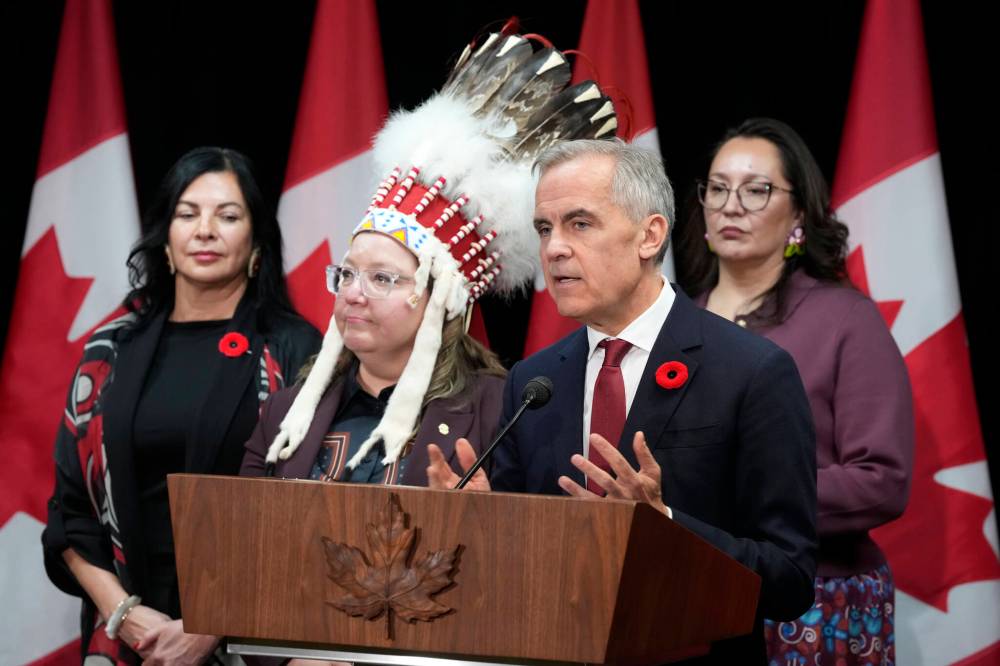
ADRIAN WYLD / THE CANADIAN PRESS FILES
Minister of Northern and Arctic Affairs Rebecca Chartrand, left to right, AFN National Chief Cindy Woodhouse Nepinak and Indigenous Services Minister Mandy Gull-Masty look on as Prime Minister Mark Carney speaks with media following the First Nations and First Ministers’ meeting in Ottawa on Monday.
Premier Wab Kinew became the latest to advocate for this, during the First Nations-first ministers meeting in Ottawa this week.
“I think it’s time to abolish the Indian Act,” Kinew told media after showing his Indian status card. “And it needs to be done with First Nations people and First Nations governments.”
In response, Prime Minister Mark Carney said the federal government is “very open to” Kinew’s suggestion but needs to “review” the law while working with First Nations leaders to determine whether it should be repealed, modified or replaced.
Carney later told media his government’s review of the Indian Act has “no timeline” and “no predetermined outcome.”
Anyone who studies history knows what happens every time a politician promises to change the Indian Act.
As First Nations leaders have pointed out for decades: there is no legal mechanism in the country that recognizes the unique relationship Indigenous peoples share with the Crown, protects reserve land, and ensures certain treaty obligations — health, housing and education — are fulfilled.
Modern and historic treaties do this, of course, but the recognition of these agreements isn’t clear in Canadian law, not all First Nations share in treaties with the Crown, and Canadian legal interpretations of these agreements never match First Nations’ understandings of them.
Abolishing the Indian Act, therefore, is not something that should be done hastily but via careful and thorough consultation, with the goal to forge a legal relationship centred around Indigenous and treaty rights.
This means decades of debate, discussion and deliberations and a whole lot of creativity.
Until then, the majority of First Nations leaders have said many times they would rather deal within the parameters of the problematic Indian Act then with nothing at all.
If anything, Kinew gets credit for encouraging a path of creativity.
“You can have self-determination,” Kinew said, “And you can have strong Indigenous nationhood, while at the same time not having the paternalism and the barriers that come with the Indian Act… You have nothing to lose but your chains.”
This may be true — and certainly it’s an optimistic vision — but what if those who placed the chains give no reason to trust they will do anything different?
While I’m not calling Kinew naive, I am saying the Carney government has given Indigenous Peoples no reason to believe he is not committed to a path of paternalism.
For instance: lost in all of the attention paid to the Indian Act were five major announcements Carney made after the meeting — the first time First Nations leaders, the federal government and premiers met in decades.
The first was the federal promise to co-develop with the Assembly of First Nations a First Nations sovereign wealth fund and broaden the lending authority of the First Nations Finance Authority to “give First Nations peoples a direct stake in major projects.”
The second was the federal allocation of $260 million over four years for a workforce readiness fund to support First Nations worker participation “with job opportunities created by major projects.”
The third was Carney’s announcement of $2.5 billion over five years for emergency preparedness to “equip First Nations communities to conduct evacuations, provide emergency assistance, and rebuild homes and critical infrastructure following disasters.”
The fourth was a commitment of $630 million over four years and $250 million in ongoing annual funding to expand on-reserve Indigenous policing and $140 million over four years for “fund crime prevention” and “culturally sensitive community safety initiatives.”
The fifth was for another First Nations-first ministers meeting in the future.

With the exception of the nebulous fifth promise, the first four commitments are all moves to ensure (or, worse, mitigate) First Nations participation in Carney’s aggressive resource development agenda and undermine resistance to his government’s proposed Bill c-39, which controversially seeks to speed up Indigenous consent on pipelines, mines, and other resource projects to never-before-seen deadlines.
By the end of Monday, Carney had received commitments from the AFN to lead a process for more First Nations involvement in resource projects, First Nations workers to work on them, and First Nations-operated police, firefighters, and emergency management structures to take the lead when anti-development protests emerge, citizens need to be evacuated, or on-reserve infrastructure — such as a highway necessary to deliver resources or a pipeline — needs repair.
Know what that sounds like?
The jingles of an awful lot of chains.
niigaan.sinclair@winnipegfreepress.com
Niigaan Sinclair is Anishinaabe and is a columnist at the Winnipeg Free Press.
Our newsroom depends on a growing audience of readers to power our journalism. If you are not a paid reader, please consider becoming a subscriber.
Our newsroom depends on its audience of readers to power our journalism. Thank you for your support.
Advertisement Advertise With Us
Advertisement Advertise With Us