

Remembering Canada’s first national internment
Advertisement
Read this article for free:
or
Already have an account? Log in here »
To continue reading, please subscribe:
Digital Subscription
One year of digital access for only $1.44 a week*
- Enjoy unlimited reading on winnipegfreepress.com
- Read the E-Edition, our digital replica newspaper
- Access News Break, our award-winning app
- Play interactive puzzles
*Billed as $5.77 plus GST every four weeks. After 52 weeks, price increases to the regular rate of $19.95 plus GST every four weeks. Offer available to new and qualified returning subscribers only. Cancel any time.
To continue reading, please subscribe:
Add Free Press access to your Brandon Sun subscription for only an additional
$1 for the first 4 weeks*
- Enjoy unlimited reading on winnipegfreepress.com
- Read the E-Edition, our digital replica newspaper
- Access News Break, our award-winning app
- Play interactive puzzles
*Your next Brandon Sun subscription payment will increase by $1.00 and you will be charged $17.95 plus GST for four weeks. After four weeks, your payment will increase to $24.95 plus GST every four weeks.
Read unlimited articles for free today:
or
Already have an account? Log in here »
Canada’s first national internment operation, from 1914 to 1920, is a part of Canadian history that is at times forgotten. Oct. 28 marks the anniversary of the Canadian government passing an order-in-council (essentially an executive decree) in 1914, under the War Measures Act. The order legally authorized the arrest and internment of Canadian civilians as enemy aliens during the First World War, and thousands of Canadians were sent to internment camps across the country.
The war of 1914-18 created difficulty for new Canadians hoping to become naturalized citizens. Many new immigrants to Canada came from regions of Europe that was under the rule of the Austro-Hungarian Empire at the start of the First World War.
The Canadian government, under Prime Minister Sir Robert Borden introduced internment camps throughout Canada, fearing that many eastern European immigrants would have some form of affiliation with the Austro-Hungarian Empire.
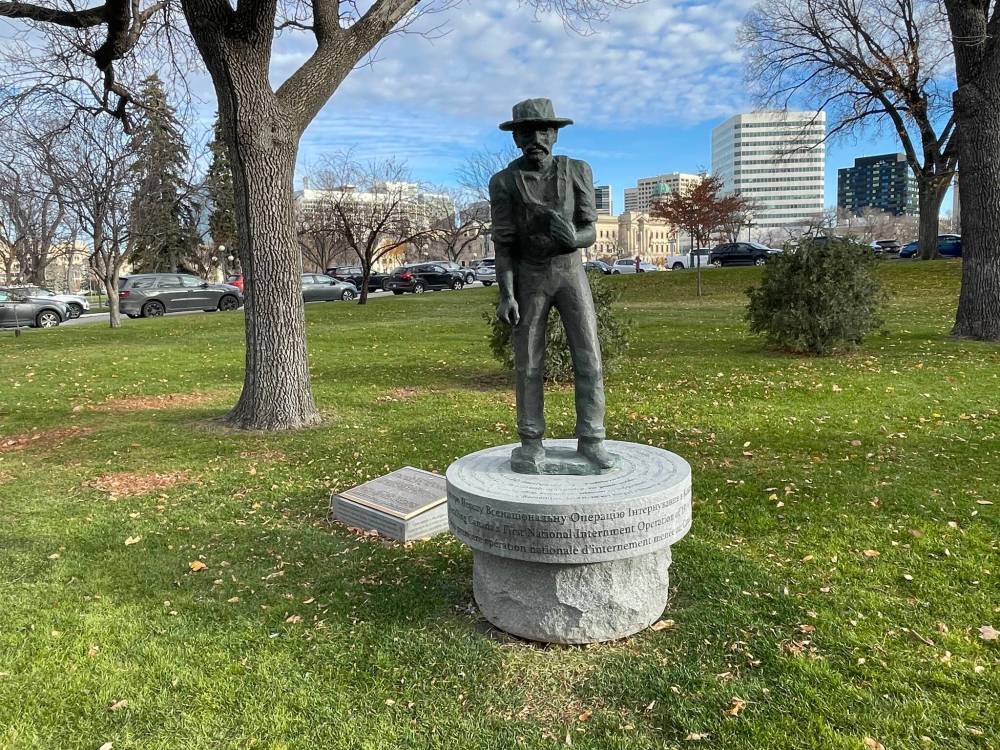
John Kendle / Free Press
The Winnipeg Receiving Station monument was erected in October 2015 on the Manitoba legislative grounds.
Even though there was never any evidence of disloyalty, people were imprisoned needlessly and forced to do heavy labour in 24 internment camps throughout Canada’s frontier hinterland. There were two identified internment camps in Manitoba, one in Brandon and the other in Winnipeg.
Between 1914 and 1920, Canada unjustly imprisoned 8,579 innocent men, women, and children. Many of them were Ukrainians, Croatians, Slovenians, Serbs, Hungarians, Czechs, Italians, Poles, Bulgarians, Romanians, Slovaks, and others.
These new Canadians were promised freedom and free land and yet suddenly found themselves as “enemy aliens” placed in camps, their valuables and property confiscated, forced to do heavy labour, including clearing forests, building roads and developing infrastructure. Women and children were held in Vernon, B.C. and Spirit Lake, Que., while the men were spread across the other 22 locations forced to do heavy labour.
This was an odd period of Canadian history. On one hand many new Canadians volunteered for service with the Canadian forces, while thousands of innocent Europeans were civilian internees.

To raise consciousness and awareness of the first national internment operation, the Canadian government recognized this tragic era in 2005, with the passage of The Internment of Persons of Ukrainian Origin Recognition Act. With this recognition, Manitobans of Ukrainian descent requested a statue to be placed in honour of the 5,000 or more Ukrainians, plus other Europeans who were interned during that dark period of time. The Winnipeg Receiving Station monument was erected in October 2015 on the Manitoba legislative grounds, with text in 16 languages, representing the ethnocultural communities affected.
There is a plaque adjacent to the statue, with the following inscription, in three languages (English, French and Ukrainian): “Thousands of Ukrainian Canadians and other eastern Europeans were unjustly imprisoned as ‘enemy aliens’ during Canada’s first national internment operation of 1914-1920. This plaque is in memory of those held in the Winnipeg Receiving Station between 1 September 1914 and 29 July 1916.”
The internment issue of the First World War, and Canada’s mistrust of immigrants, led to the same injustice happening again to Japanese Canadians during the Second World War .
Acknowledging forgotten segments of Canadian history — even 112 years later — is an educational exercise. Communities throughout Canada should continue being vigilant by commemorating historical milestones so that Canadians will not forget dark periods in Canada’s history. Accordingly, Oct. 28 has been officially recognized by Ukrainian Canadian Congress as National Internment Commemoration Day in Canada, acknowledging this largely forgotten chapter of Canadian history.
Peter John Manastyrsky writes articles about historical, political and contemporary issues. He resides in Niverville, Man.