

‘This is about inclusion for me’
World Indigenous Business Forum comes home to Winnipeg for first time, ponders questions for future prosperity
Advertisement
Read this article for free:
or
Already have an account? Log in here »
To continue reading, please subscribe:
Digital Subscription
One year of digital access for only $1.44 a week*
- Enjoy unlimited reading on winnipegfreepress.com
- Read the E-Edition, our digital replica newspaper
- Access News Break, our award-winning app
- Play interactive puzzles
*Billed as $5.77 plus GST every four weeks. After 52 weeks, price increases to the regular rate of $19.95 plus GST every four weeks. Offer available to new and qualified returning subscribers only. Cancel any time.
To continue reading, please subscribe:
Add Free Press access to your Brandon Sun subscription for only an additional
$1 for the first 4 weeks*
- Enjoy unlimited reading on winnipegfreepress.com
- Read the E-Edition, our digital replica newspaper
- Access News Break, our award-winning app
- Play interactive puzzles
*Your next Brandon Sun subscription payment will increase by $1.00 and you will be charged $17.95 plus GST for four weeks. After four weeks, your payment will increase to $24.95 plus GST every four weeks.
Read unlimited articles for free today:
or
Already have an account? Log in here »
When Nicola Shirley-Phillips imagines what the Indigenous economy in her country might look like 100 years from now, she doesn’t mention social media or artificial intelligence. Instead, she envisions a holistic way of life where people work alongside each other in a way that cares for the planet.
“I see community (and) I see us being more respectful of all the energies around us — our water energy, our climate (and) the soil,” she said. “In all of that, there are opportunities for us to create businesses and opportunities to provide our services.”
Shirley-Phillips, a serial entrepreneur, organic farmer and community economic development specialist from Jamaica, shared her vision Tuesday morning during a panel discussion focused on Indigenous women and prosperity.
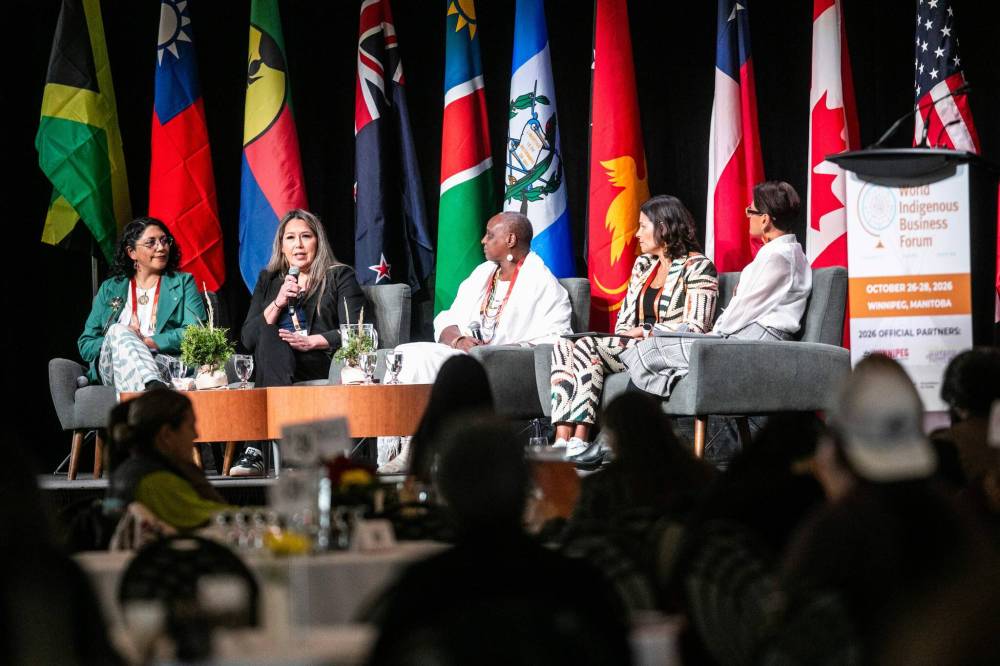
MIKAELA MACKENZIE / FREE PRESS
From left: Alejandra Jelvez Oyarzun, Michelle Cameron, Nicola Shirley-Phillips, Kristal Kinsela and moderator Rachel Petero during a panel discussion the RBC Convention Centre on Tuesday.
The discussion was one of the first items on the schedule during the first full day of the World Indigenous Business Forum at the RBC Convention Centre in Winnipeg.
Alejandra Jelvez Oyarzun’s vision for the Indigenous economy in 2126 aligns with Shirley-Phillips’.
“I envision a future where we (have) … ventures that generate the holistic prosperity needed to live with dignity,” said the entrepreneur, who serves as strategic manager at Cerveza Cumbres del Ranco, a craft brewery in Chile.
“I envision a future where we will have quality time — time for ourselves, for our children, for our community and for honouring our ancestors.”
Kristal Kinsela, a leadership coach and consultant from Australia, has her descendants in mind when she thinks about her country a century from now.
“The vision that I have for my grandchildren’s grandchildren is one where health is the real wealth,” she said. “We’ve got to pay more attention to health. We are no good for anybody if we don’t pour into ourselves and look after our health and well-being.”
If Michelle Cameron’s dreams for 100 years from now come to fruition, there will be many more Indigenous-owned businesses than there are today.
“Today, we only make up 1.7 per cent of the total businesses in Canada,” said Cameron, founder and chief executive at Dreamcatcher Promotions, a promotional products company in Winnipeg. “There should be an Indigenous business in every trade and industry in Canada. There’s absolutely no reason why there isn’t.”
Sharing ideas like that is part of why the World Indigenous Business Forum exists.
The three-day conference has brought together a sold-out crowd of 1,000 Indigenous entrepreneurs, leaders, innovators and allies from more than 20 counties to share knowledge, build relationships and explore opportunities for economic growth and collaboration.
Although it was started by a Winnipegger, the conference has never been held in Manitoba. Rosa Walker launched the conference in 2010 in New York City and has held the event in places such as Namibia, Guatemala and New Zealand. This year’s conference marks the third time a Canadian city has hosted.
“It’s incredible,” Walker said of the event being in her hometown. “I’m so proud of what Winnipeg was able to show (Monday) night at the welcome reception. The culture, the community, the diversity — all of that. It was just beautiful.”
Indigenous Leadership Development Institute, Inc., Walker’s non-profit company, is hosting the conference in collaboration with Winnipeg Economic Development & Tourism.
“Our theme is always to connect, share and inspire,” Walker said.
“What we’ve learned is that people really want to engage in person. They want to be able to hear from other Indigenous people (about) their successes and challenges so that they can develop their own businesses, develop their own community development and learn what works.”
Andres Antivil Alvarez is one of 60 attendees from Chile, where he is president of the Indigenous Enterprises Foundation. He said he’s interested in learning how Indigenous peoples from other parts of the world work toward economic inclusion.
“In Chile, we have a huge racism (toward) the Indigenous culture,” said Alvarez, who has ancestral Mapuche roots. “Chilean society doesn’t know too much about us, so they deny us as a nation. First, we need to educate that we are here, we have rights and we have commerce, too. We want to be part of the economic activity.
“This is about inclusion for me,” he added. “That is my inspiration to be here.”
Rachel Petero, a Maori leader from New Zealand, described attending the conference as an investment in her vision of seeing Indigenous women thriving. She’s the founder of Indigenous Women in Industry, a series of international gatherings designed to create economic, social and cultural opportunities for Indigenous women around the world.

“Since 2017, a lot of my business has come from WIBF because of the connections that I’ve made,” Petero said. “So I value WIBF and I value what it brings for our communities.”
The World Indigenous Business Forum continues today. The event is sold out, but the public is invited to visit the conference’s artisan village, which features Indigenous artisans from around the world showcasing and selling their handmade products.
The artisan village is open from 8:00 a.m. to 4:30 p.m. on the third floor of the convention centre’s south building.
Next year’s conference is scheduled to be held in Santiago, Chile.
aaron.epp@winnipegfreepress.com