

Lula’s historic Brazilian election victory
Advertisement
Read this article for free:
or
Already have an account? Log in here »
To continue reading, please subscribe:
Digital Subscription
One year of digital access for only $1.44 a week*
- Enjoy unlimited reading on winnipegfreepress.com
- Read the E-Edition, our digital replica newspaper
- Access News Break, our award-winning app
- Play interactive puzzles
*Billed as $5.77 plus GST every four weeks. After 52 weeks, price increases to the regular rate of $19.95 plus GST every four weeks. Offer available to new and qualified returning subscribers only. Cancel any time.
To continue reading, please subscribe:
Add Free Press access to your Brandon Sun subscription for only an additional
$1 for the first 4 weeks*
- Enjoy unlimited reading on winnipegfreepress.com
- Read the E-Edition, our digital replica newspaper
- Access News Break, our award-winning app
- Play interactive puzzles
*Your next Brandon Sun subscription payment will increase by $1.00 and you will be charged $17.95 plus GST for four weeks. After four weeks, your payment will increase to $24.95 plus GST every four weeks.
Read unlimited articles for free today:
or
Already have an account? Log in here »
This was supposed to go down as one of the closest presidential elections in Brazilian history — until it wasn’t. In the end, 80-year-old leftist President Luiz Inácio (Lula) da Silva of the Workers Party bested (by some four million votes) Flávio Bolsonaro, the hard-right Liberal Party leader and senator, by a lopsided 3.5 per cent of the popular vote.
Speaking of Brazilian history, it rarely happens that the second-place finisher in the first round ends up winning the second, run-off contest in such a decisive manner. More significant, Lula has now won an unprecedented (non-consecutive) fourth term as an elected Brazilian president.
While Bolsonaro has waffled on making a concession speech (like his father in 2022), the writing on the wall shows clearly that he lost badly. He has evidently taken issue with a ruling by a justice of the Supreme Court that extended polling hours country-wide by an additional two hours in light of high voter turnout and other interruptions.
The Associated Press / Andre Penner
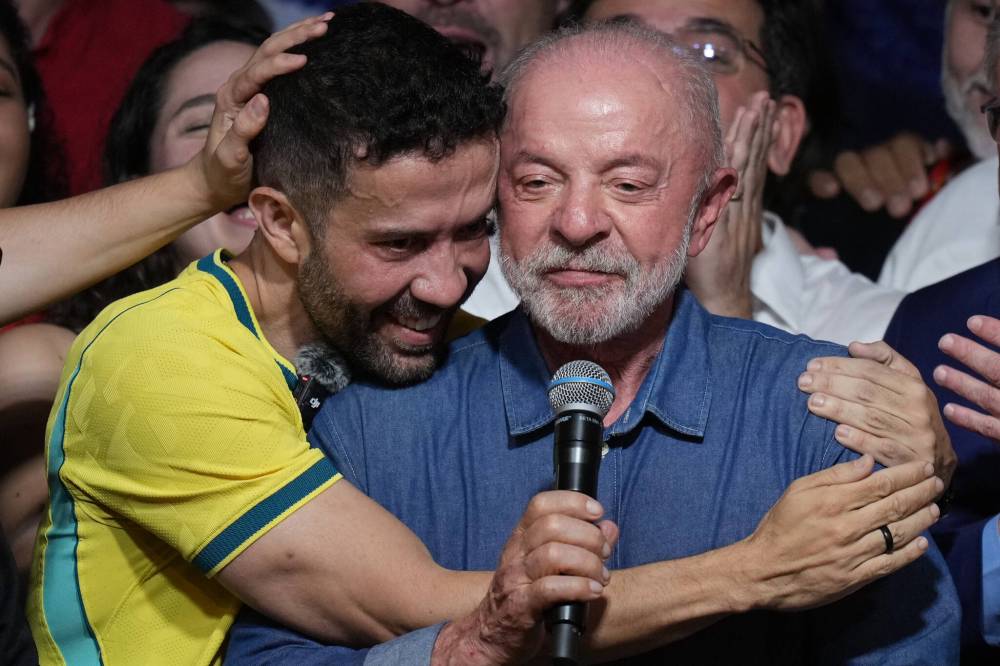
Brazilian lawmaker Andre Janones embraces President Luiz Inácio (Lula) da Silva as he delivers a victory speech after winning a fourth term in the presidential runoff in Brazil on Sunday, Oct. 25, 2026.
Flávio’s supporters, many galvanized around the “never Lula” camp, were desperate for change — even if it meant the kind of change that could turn Brazil on its head. So Lula resorted to one of the oldest political tricks in the campaign handbook — namely, using fear of an anti-democratic Bolsonaro to swing voters to his side (along with a host of last-minute announcements involving financial incentives to Brazilians). With a right-leaning Congress, voters were understandably worried that Flávio would go about systematically dismantling Brazil’s democratic ethos and institutions.
There were already deep concerns among Brazilian voters, encapsulated by the “Never Again Bolsonaro” crowd, who were rightly nervous about a repeat of the regime of Flávio’s father, Jair Bolsonaro — the former president now serving a lengthy criminal sentence under house arrest for instigating a coup d’état in January 2023. The last thing that they wanted was a return to the days when Brazil’s powerful military establishment, in cahoots with Flávio, called the shots.
There were reports that mainly older voters – 20 per cent, by some accounts – lackadaisically sat out the first round in early October. And there’s a pretty good chance that these Brazilians were well-acquainted with the violent and brutal military dictatorship that ruled the country for over 20 years (between 1964 and 1985). They most assuredly did not want to return to that repressive period.
Others were no doubt frightened by the prospect of Bolsonaro embracing and prescribing a medicine of free markets on steroids. They were turned off by him taking a chainsaw to administrative regulations and red tape (in sensitive sectors such as agriculture, forestry and mining), chopping public spending and cutting taxes, and rolling back any restrictions on direct foreign investment. Furthermore, those working in the public sector were scared to death that the pink slips would be flowing fast and furious.
Of course, there were those who thought that Lula’s best days were long behind him. He will need to refocus his government’s efforts on the critical issues of the campaign — higher prices and affordability, rising crime rates and endemic corruption. What will make governing more problematical for Lula, though, is the fact that the Brazilian congress is now controlled by the most conservative lawmakers in decades. That will make political life extraordinarily difficult for the left-leaning president and create roadblocks for passing his legislative agenda.
Interestingly, when he assumes office in early January, he will have succeeded in pushing back against the tide of recently elected hard-line conservative leaders in Argentina (Javier Milei), Colombia, (Abelardo de la Espriella), Chile (José Antonio Kast), Ecuador (Daniel Noboa) and Costa Rica (Laura Fernández). The wily Lula will likely find the hemispheric waters treacherous as he tries to navigate around the rough ideological waves engendered by his neighbouring country leaders.

But the one policy-making area in which Lula will still have some leeway is in international affairs. No one should expect him to shift away from his warm embrace of multilateralism, courting of the Chinese and fighting the climate emergency. Nor should we see him abandon struggling Cuba, Cuban medical professionals working in Brazil, or back away from his criticism of U.S. President Donald Trump’s “maximum pressure” campaign against Havana.
In fact, it is in Brazil’s relationship with the United States where things could take a more turbulent turn. It is very likely that Lula could adopt a more aggressive stance against the Trump administration — for its tariff madness and especially its penchant for openly interfering in the region.
At the same time, it is possible that a Lula government could spell good news for Canadian-Brazilian relations. It will certainly make it easier for Canada to secure membership in the long-coveted Mercosur trading bloc in South America.
Whatever else happens now, this will certainly be Lula’s final term in public office. He turns 81 on Oct. 27, and there will no more political comebacks to celebrate. The Brazilian people have given him one last unexpected victory, and the rest of the world can thank them for allowing democracy to live another day in Brazil.
Peter McKenna is professor of political science at the University of Prince Edward in Charlottetown.