

Winnipeg, police and downtown crime
Advertisement
Read this article for free:
or
Already have an account? Log in here »
To continue reading, please subscribe:

Digital Subscription
One year of digital access for only $205*
- Enjoy unlimited reading on winnipegfreepress.com
- Read the E-Edition, our digital replica newspaper
- Access News Break, our award-winning app
- Play interactive puzzles
*First annual payment billed as $205.00 + GST for one year. This annual subscription will automatically renew at $233.00 + GST every 52 weeks (10% off the regular annual price of $259.35). Offer available to new and qualified returning subscribers only. Cancel any time.
To continue reading, please subscribe:
Add Free Press access to your Brandon Sun subscription for only an additional
$1 for the first 4 weeks*
- Enjoy unlimited reading on winnipegfreepress.com
- Read the E-Edition, our digital replica newspaper
- Access News Break, our award-winning app
- Play interactive puzzles
*Your next Brandon Sun subscription payment will increase by $1.00 and you will be charged $17.95 plus GST for four weeks. After four weeks, your payment will increase to $24.95 plus GST every four weeks.
Read unlimited articles for free today:
or
Already have an account? Log in here »
A safer downtown is not much use if people are still afraid to walk there.
That is the uncomfortable message from Winnipeg’s latest police citizen survey, and one city council should take seriously.
Downtown crime has fallen this year, according to the most recent police statistics. Violent crime is down even more. But for most Winnipeggers, the downtown still feels like a place to avoid, particularly after dark.
MIKE DEAL / FREE PRESs fileS
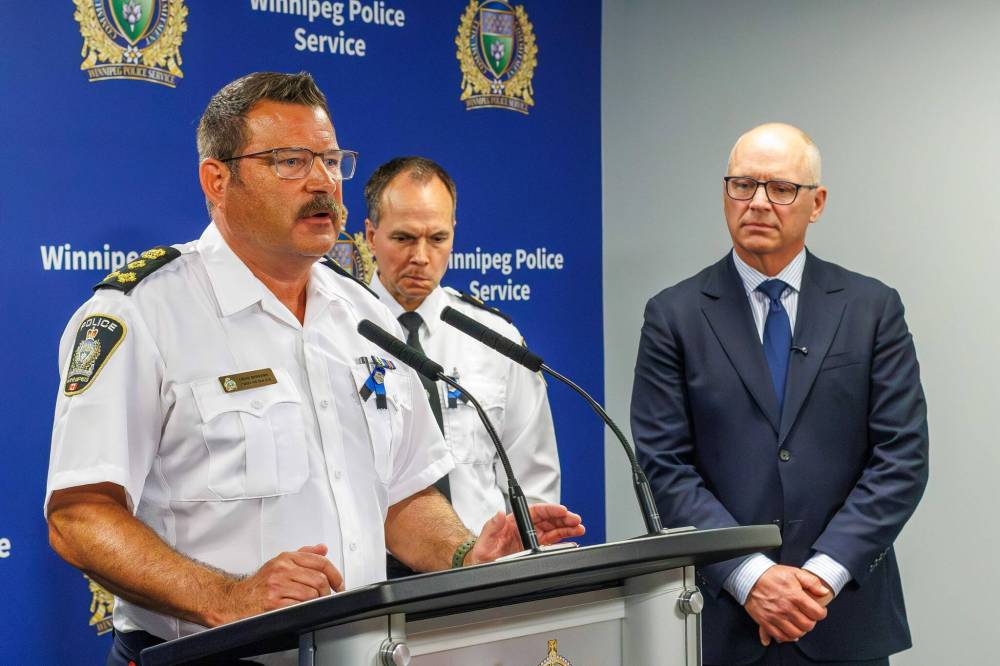
Winnipeg Police Chief Gene Bowers
Only 44 per cent of survey respondents said they feel very or reasonably safe walking alone downtown during the day. At night, that number plunges to just eight per cent. Among women, it is an appalling three per cent, compared with 14 per cent of men.
Police Chief Gene Bowers says overall downtown crime has decreased 10 per cent year-to-date and violent crime has fallen 19 per cent.
Those are real improvements. But they are improvements from a troubling baseline, not evidence that Winnipeg has solved its downtown safety problem.
The city’s violent crime severity index was 170.06 in 2025, according to Statistics Canada. It was lower than in 2024 and 2023, but still far above the 125.98 recorded a decade earlier.
Crime can be falling and still be far too high.
Meanwhile, the survey also showed most people — 57 per cent — said Winnipeg has too few police officers. Just four per cent said there are too many.
The police service’s own staffing numbers bear out that concern.
Winnipeg had 166.8 police officers per 100,000 residents in 2025. That was slightly higher than the 164.8 recorded in 2024, but was the second-lowest ratio in the past 20 years. The peak was 210.4 officers per 100,000 in 2013.
Bowers has asked the city for more officers, including 36 additional members to staff two more cruiser cars. But so far, council has not approved that new funding (pay attention, mayoral and council candidates!).
Public safety is one of the most basic responsibilities of municipal government. That does not mean more police will solve every problem downtown. Police cannot arrest their way out of homelessness, addiction, mental illness or poverty.
The province must do more on health care, housing and social services, and Winnipeg needs to continue supporting non-police responses to people in crisis.
But those realities are not an excuse for understaffing the police service.
In fact, the survey provides another reason to strengthen it. Ninety-three per cent of respondents said a quick response to calls for service is very or extremely important. Yet only 44 per cent rated WPS excellent or good on its response time.
When officers are stretched thin, they spend more time answering calls and less time doing proactive policing.
Response queues grow, foot patrols become harder to maintain and investigations compete with emergency calls. The public sees fewer officers and wonders where they are.
City hall continues to talk about revitalizing downtown. But there is little point in approving plans to attract more people to the core if those people don’t feel safe being there.

The Downtown Community Safety Partnership and Downtown Winnipeg BIZ are doing important work. The increase in police foot patrols are crucial.
But none of it changes the central message from the survey: Winnipeggers remain deeply uneasy about downtown safety.
The objective should not be merely to produce better crime statistics. It should be to create a downtown where people actually feel safe enough to live, work, shop, visit and walk around after dark.
A safer downtown cannot remain a promise, a strategy or a statistic.
It has to be something Winnipeggers can actually feel.