

Broadway Social: when public art gets it right
Advertisement
Read this article for free:
or
Already have an account? Log in here »
To continue reading, please subscribe:

Digital Subscription
One year of digital access for only $205*
- Enjoy unlimited reading on winnipegfreepress.com
- Read the E-Edition, our digital replica newspaper
- Access News Break, our award-winning app
- Play interactive puzzles
*First annual payment billed as $205.00 + GST for one year. This annual subscription will automatically renew at $233.00 + GST every 52 weeks (10% off the regular annual price of $259.35). Offer available to new and qualified returning subscribers only. Cancel any time.
To continue reading, please subscribe:
Add Free Press access to your Brandon Sun subscription for only an additional
$1 for the first 4 weeks*
- Enjoy unlimited reading on winnipegfreepress.com
- Read the E-Edition, our digital replica newspaper
- Access News Break, our award-winning app
- Play interactive puzzles
*Your next Brandon Sun subscription payment will increase by $1.00 and you will be charged $17.95 plus GST for four weeks. After four weeks, your payment will increase to $24.95 plus GST every four weeks.
Read unlimited articles for free today:
or
Already have an account? Log in here »
Great civic sculpture does something to us.
It might delight or irritate, intrigue or confuse. It can make us stop, look up, move closer. Sometimes we wonder who approved it, who paid for it, or what on Earth it is supposed to be. We photograph it, argue about it, give directions by it. Eventually, the best becomes part of a city’s mental map.
Indifference may be the one response it cannot afford.
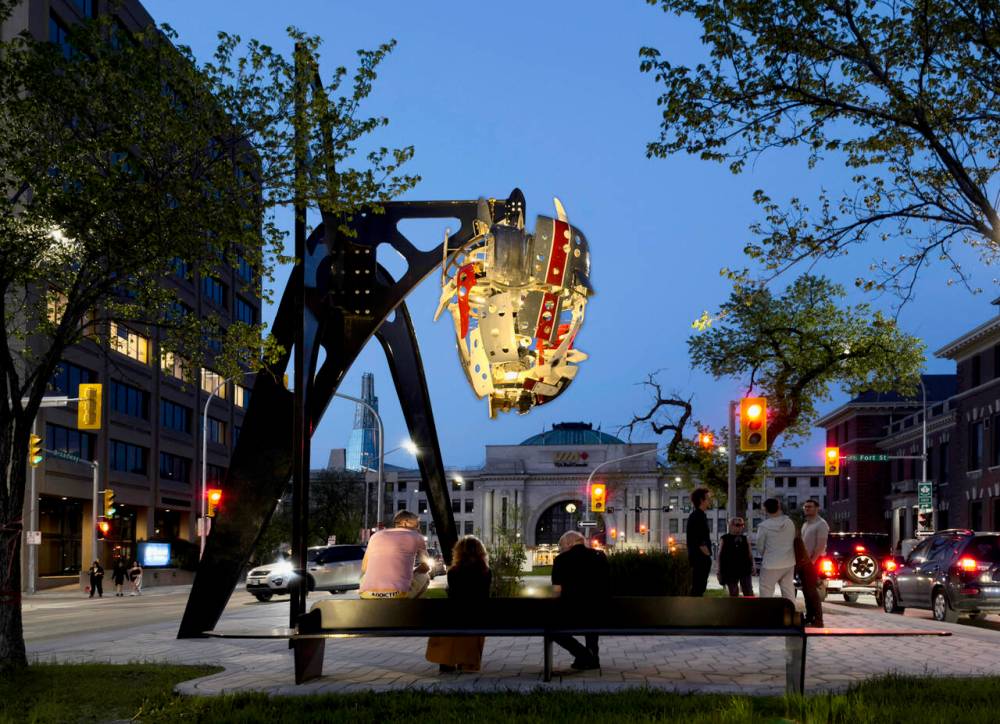
I have been thinking about this since spending time with Broadway Social, Eduardo Aquino’s remarkable public sculpture on Broadway, directly across from the Fort Garry Hotel.
I loved it almost immediately when I saw it going up a couple of years ago. And I’ll take a side here — I think it is one of Winnipeg’s most important public art commissions in recent years.
But I’m less interested in reviewing the sculpture than in understanding why it works — and what made it possible.
Successful public sculpture requires more than commissioning an artist and putting an object in a public place. It happens when a compelling idea, the right artist, the right site and civic ambition come together.
That happened with Eduardo Aquino.
From a distance, Broadway Social announces itself without overwhelming the streetscape. Three enormous black steel legs rise from a paved clearing, supporting a strange, intricate object suspended above the ground. It looks simultaneously mechanical and organic: part engine, chandelier, spacecraft, industrial relic and something for which I don’t quite have a name.
That uncertainty is part of its power.
This isn’t simply about esthetics. It is about good design: scale, material, construction and an intelligent understanding of place. Most importantly, there is a powerful concept holding it all together.
Aquino is a Winnipeg artist, architect and professor in the faculty of architecture at the University of Manitoba. Born and educated in Brazil before coming to Canada, his practice moves between art, architecture, urbanism and public space. He has produced art commissions in Winnipeg and elsewhere in Canada, while much of his work explores how people inhabit cities and how urban spaces become places of encounter.
That thinking is important to Broadway Social. This isn’t an artist simply placing a sculpture on Broadway. Aquino is thinking about what can happen around and beneath an artwork — and how an object can create a place.
Aquino collaborated on the project with Mitchell McIntosh and fabricator Brad Lagimodière of Prairie Pole, while Juca Aquino designed the Manitoba map tessellation beneath the sculpture. Its suspended form incorporates repurposed aluminum aircraft components, while 1,240 custom concrete pavers form a map of Manitoba below.
Then there is the site.
Located at 222 Broadway, the work sits between the Fort Garry Hotel and Union Station. The aircraft parts reference Winnipeg’s history as a transportation hub, while the railway hotel suggested another kind of movement: ballroom dancing. Aquino describes the space as an “open-air ballroom,” bringing together transportation and dance, work and play, movement and gathering.
That’s a lot to ask of one sculpture. Yet none of it feels forced.
The best public art can contain history, place and meaning without becoming an illustration of them. It can carry all that civic baggage and still remain, first and foremost, art.
That distinction matters.
Not everything presented as public art is the same. Community projects, fundraising initiatives and multiples — including cast concrete forms painted by artists — can animate a city and support worthwhile causes. But they are different from asking an artist to conceive an original work in response to a particular place. Once such objects become permanent fixtures, materials, weathering, maintenance and their long-term place in the streetscape matter.
Nor does public art always need another function to justify itself. It can become a bench, bicycle rack, gateway or shelter, and sometimes those combinations work. But public sculpture can also occupy space, provoke a response and alter our experience of a place.
Sometimes a sculpture should simply be allowed to be a sculpture.
Broadway Social doesn’t need an alibi.
It gets to be art.
And unlike art in a museum, it is difficult to avoid. Public sculpture, like architecture, inhabits the city with us.
That makes commissioning public art a serious civic undertaking. Engineering, accessibility, safety, durability and maintenance matter. A sculpture expected to survive decades of Winnipeg winters has obligations that an artwork inside a gallery does not.
But none of those things produces great art.
Consultation cannot manufacture imagination. Consensus cannot guarantee excellence.
At some point, somebody has to have a great idea.
And the process needs to be confident enough to let that idea survive. A committee can establish requirements. It cannot create art.
Whatever complicated journey brought Broadway Social from conception to completion — the project spanned more than a decade — the finished work doesn’t feel designed by a jury. It has conviction.
Its black steel armature triggers an art-historical memory for me: Alexander Calder’s monumental Trois disques, created for Expo 67 in Montreal. Aquino studied in Montreal, but I make no claim of influence. The association is mine. One encounter with art inevitably calls up another.
You can love Broadway Social. You can detest it. Call it beautiful, difficult, elegant or exhilarating. Photograph it. Debate it. Stand underneath it and wonder how it stays up.
Good.
Because the measure of successful public sculpture isn’t whether everybody likes it. It is whether it possesses the artistic, intellectual and physical presence to hold its place in the city — and perhaps change the way we understand that place.
Great public art doesn’t tell us what to think. It gives us something worth thinking about.
And sculpture on this scale doesn’t happen by accident. It requires vision, an understanding of the site, technical expertise, civic investment — and enough trust in the artist to allow something unexpected to emerge.
Every once in a while, all of those things come together.
They did here.

In the middle of one of Winnipeg’s great urban avenues, between a railway station and a grand old hotel, Aquino has given us an open-air ballroom, a mechanical chandelier, a beautifully designed and fabricated sculpture — and an object almost impossible to ignore.
Some people won’t like it.
I’m more than fine with that.
Winnipeg is considerably better for having it.
Stephen Borys is president and CEO of Civic Muse, an arts and cultural consulting practice based in Winnipeg. www.civicmuse.ca