

Quiet opening fitting for controversial site

Advertisement
Read this article for free:
or
Already have an account? Log in here »
To continue reading, please subscribe:

Digital Subscription
One year of digital access for only $205*
- Enjoy unlimited reading on winnipegfreepress.com
- Read the E-Edition, our digital replica newspaper
- Access News Break, our award-winning app
- Play interactive puzzles
*First annual payment billed as $205.00 + GST for one year. This annual subscription will automatically renew at $233.00 + GST every 52 weeks (10% off the regular annual price of $259.35). Offer available to new and qualified returning subscribers only. Cancel any time.
To continue reading, please subscribe:
Add Free Press access to your Brandon Sun subscription for only an additional
$1 for the first 4 weeks*
- Enjoy unlimited reading on winnipegfreepress.com
- Read the E-Edition, our digital replica newspaper
- Access News Break, our award-winning app
- Play interactive puzzles
*Your next Brandon Sun subscription payment will increase by $1.00 and you will be charged $17.95 plus GST for four weeks. After four weeks, your payment will increase to $24.95 plus GST every four weeks.
Read unlimited articles for free today:
or
Already have an account? Log in here »
One of this city’s most loudly debated facilities — after all the angst, all the opposition and all the vocal support — began operations in the most low-key way possible.
There was none of the usual fanfare that accompanies a new social or medical offering, no news conference, no speeches. Only a quiet Tuesday, around which was woven a lot of hope, and a great deal of worry.
Winnipeg’s first supervised drug consumption site has been a long time in the making. It’s been just over two years since the province first announced it would partner with the Aboriginal Health and Wellness Centre to design and open the site; advocates had been calling for a supervised consumption facility for years.
MIKAELA MACKENZIE / FREE PRESS
Winnipeg’s first supervised drug consumption site at 366 Henry Avenue, began operating Tuesday to little fanfare.
But the launch, originally eyed for 2025, was repeatedly delayed as the province and service providers sorted out approvals and negotiated community concerns. In the meantime, the drug crisis in Winnipeg kept growing, with paramedics burdened by a skyrocketing number of overdose calls.
Supporters hope the new facility can help ease that pressure. The site does not provide drugs; it offers clinical staff and supplies to ensure those who use them can do so safely. The site will also help those who are ready to connect with other forms of assistance.
Time will tell whether those hopes come to fruition — and in that way, it made sense that the site opened discreetly.
At first, when the temporary site operating out of the parking lot at 366 Henry St. opened at 11 a.m., a handful of observers — supporters, opponents and some media — milled about the sidewalk outside. After they trickled away, the scene outside the faded industrial building, which is now owned by the province, gave way to an unremarkable silence. The site will move inside the building once upgrades to it are complete.
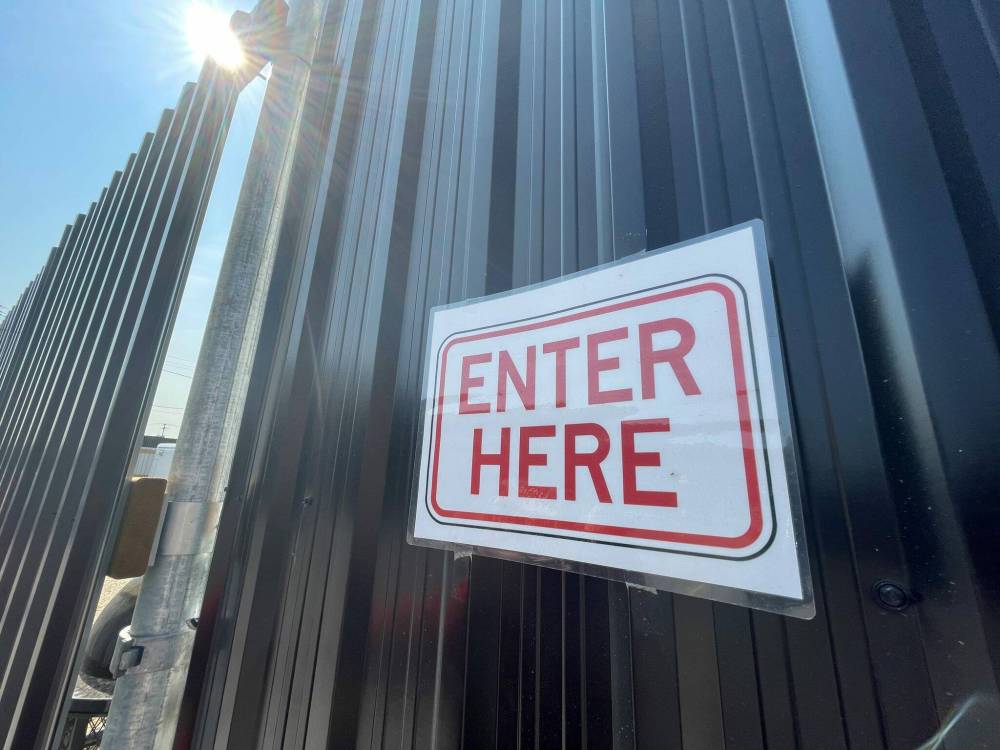
Over the course of one afternoon hour, a few people walked up to the metal fence around the property, alone or in pairs; a worker opened the gate and welcomed them inside. On the street nearby, a security guard discreetly kept watch from a vehicle, and a mobile support truck from community support agency Sunshine House sat parked outside.
Otherwise, the only immediate indication that anything was happening inside was a sign, handwritten on a whiteboard and punctuated with a friendly heart: “AHWC-SCS. We are open. Please come in.” If it weren’t for the sign, nobody passing by would ever guess that this spot was making a small piece of history in Manitoba.
Not that too many people will be passing by the site, or at least, not without intention. Tucked on a narrow thread of Henry between Logan Avenue and the rail yards, the location was chosen because it was set apart from schools and homes. Its neighbours are mostly autobody shops, a restaurant, and old warehouses.

Some of those business owners have spoken to media to express their concerns. Their fears have merit, and should also be considered; other cities where supervised consumption sites operate have seen mixed impacts on surrounding communities. The province has pledged to monitor the effect on neighbourhood safety closely.
What that means, above all, is that Tuesday’s opening isn’t the end of a long debate on how to respond to the drug crisis in Manitoba — it’s just the beginning of a new phase. Yet it’s one we must try. Every Winnipegger knows that the state of the drug crisis is now completely untenable; the cost to human life, safety and public health is beyond what we can bear.
To find our way out as a city, we will need to wield every possible tool to save lives, take the load off emergency responders and the health-care system, and strengthen lifelines for people to grasp and climb out of addiction. If one tool doesn’t prove to be effective, we don’t have to keep using it. But we do have to try.
Not only try — we have to give the site enough time and careful reflection to understand what its impact has been or will be. If even one life is saved at the unassuming site, that alone has a value beyond what can be neatly figured in annual reviews. But for those who must prioritize such things, it can often be counted beneficially in that way, too.
melissa.martin@freepress.mb.ca
Our newsroom depends on a growing audience of readers to power our journalism. If you are not a paid reader, please consider becoming a subscriber.
Our newsroom depends on its audience of readers to power our journalism. Thank you for your support.
Our newsroom depends on a growing audience of readers to power our journalism. If you are not a paid reader, please consider becoming a subscriber.
Our newsroom depends on its audience of readers to power our journalism. Thank you for your support.
Advertisement Advertise With Us
Advertisement Advertise With Us