

As the world watches, Haiti’s hopes continue to fade
Advertisement
Read this article for free:
or
Already have an account? Log in here »
To continue reading, please subscribe:

Digital Subscription
One year of digital access for only $205*
- Enjoy unlimited reading on winnipegfreepress.com
- Read the E-Edition, our digital replica newspaper
- Access News Break, our award-winning app
- Play interactive puzzles
*First annual payment billed as $205.00 + GST for one year. This annual subscription will automatically renew at $233.00 + GST every 52 weeks (10% off the regular annual price of $259.35). Offer available to new and qualified returning subscribers only. Cancel any time.
To continue reading, please subscribe:
Add Free Press access to your Brandon Sun subscription for only an additional
$1 for the first 4 weeks*
- Enjoy unlimited reading on winnipegfreepress.com
- Read the E-Edition, our digital replica newspaper
- Access News Break, our award-winning app
- Play interactive puzzles
*Your next Brandon Sun subscription payment will increase by $1.00 and you will be charged $17.95 plus GST for four weeks. After four weeks, your payment will increase to $24.95 plus GST every four weeks.
Read unlimited articles for free today:
or
Already have an account? Log in here »
I wish that I had something uplifting and positive to say about the circumstances in Haiti today.
Maybe things will turn out better for the Haitian people in the coming months.
Maybe the United Nations-authorized and 5,000-strong Gang Suppression Force will change the facts on the ground.
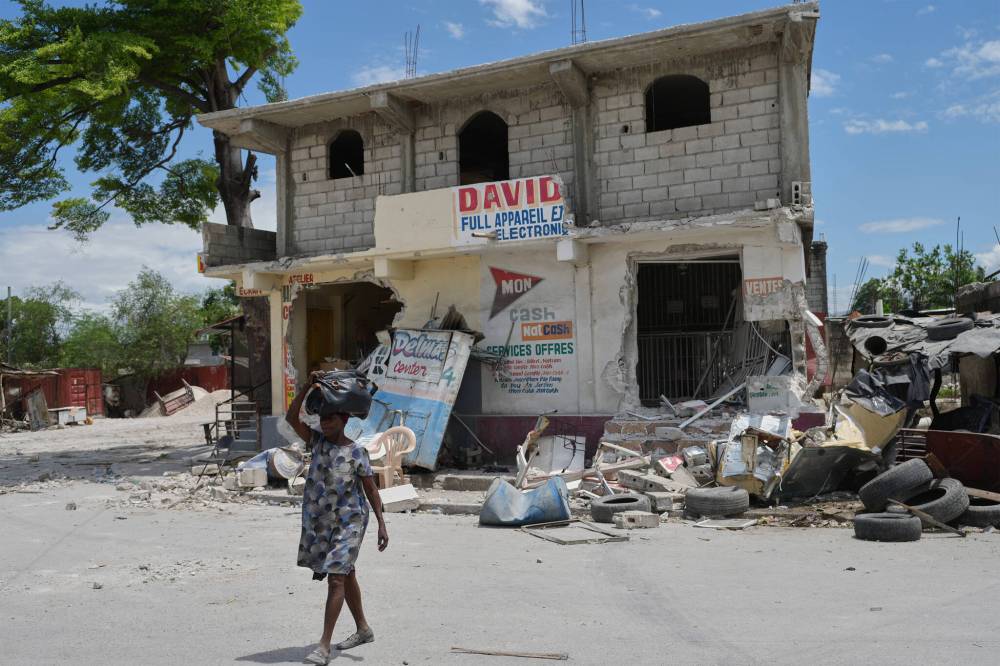
Odelyn Joseph / The Associated Press
A woman leaves her home to escape clashes between armed gangs in the Cite Soleil neighbourhood of Port-au-Prince, Haiti in May.
Maybe the parliamentary and presidential elections will finally be held in mid-December.
Maybe. But I’m having a hard time believing that Haiti has mercifully turned a corner. I say that because experience, past history, political calculations and structural constraints tell me otherwise.
Take the UN-backed Suppression Force. Where is it? The current 12-month mandate actually expires at the end of this coming September. Its slow rollout has been plagued by a series of critical impediments — namely, difficulties in transitioning from the Kenyan-led Multinational Security Support mission to the new entity, significant logistical hurdles and, most important, the lack of funding from member states.
As for talk about holding legitimate Haitian elections in a few months (after almost a decade of no elections), that’s hard to fathom.
How do you organize and administer free and fair elections in an environment where public safety and stability are missing? Who would risk voting let alone actually running for political office? More to the point: the gangs may have something to say about electoral democratization in Haiti.
To say that the current situation in Haiti is bleak is a massive understatement. There are some 1.5 million displaced Haitians living in ramshackle camps that don’t even have lavatories. Over six million are food insecure and going hungry each day. Humanitarian assistance, medical supplies, water and cash are scarcely to be found.
Moreover, marauding gangs in Haiti — especially in the capital Port-au-Prince and the Artibonite region — continue to wreak havoc on a daily basis. Heavily-armed gang members (some just teenagers) have been unrelenting in their use of violence: committing murders (over 2,300 since January), kidnappings (including three senior Haitian government officials recently) and untold acts of intimidation (closing down countless hospitals and schools).
A few weeks ago, the UN issued a stark warning about a sharp rise in the number of Haitian women and girls who reported being raped.
The UN Office for the Coordination of Humanitarian Affairs noted that over 3,000 cases of gender-based violence took place between the months of April and June — with the month of June alone accounting for over 1,000 incidents. The majority of these survivors were previously displaced from their homes and reported that their perpetrators were clearly members of armed groups.
Adding insult to injury, U.S. President Donald Trump has now secured the end of temporary protection status (which has been in place since 2010) for over 350,000 Haitians living and working in the United States.
They face the prospect of being rounded up by Immigration and Customs Enforcement (ICE) agents and deported back to Haiti — or to live in constant fear and anxiety if they choose to remain in the U.S.
It’s worth remembering that Haiti is obviously not a safe place to be deporting anyone. It is certainly not a stable, institutionally-strong country with a robust and proven social safety net.
In a word: it’s a mess.
Many Haitians being sent back have little connection to the country and wouldn’t even be able to recognize it today. What will they do when they arrive in Haiti? How will they be able to keep body and soul together? What about their personal safety?
As Jacqueline Charles, Caribbean correspondent for the Miami Herald newspaper, explains: “Some of these people haven’t been back to Haiti in 16 years — not since the earthquake in 2010, or even longer. People don’t have houses to go back to. There are no jobs in Haiti. Cap-Haïtien, Haiti’s second-largest city, is busting at the seams.”
No one is safe to walk down the streets in many parts of the country. In fact, the U.S. government has issued a travel advisory telling its citizens not to visit Haiti under any circumstances. (Commercial airlines won’t even risk flying into the Toussaint Louverture International Airport in Port-au-Prince.)
Recently, the State Department started asking American who do travel to Haiti to leave their DNA samples and dental records, just in case their dead bodies need to be identified.

After visiting the country in late July, one member of the U.S. Congress, Democrat Ami Bera of California, summed things up nicely:
“The conditions we saw on the ground were pretty horrific. This is not the right time to be sending people back to Haiti. You’re sending folks into a chaotic situation,” he said.
Sadly, the situation is only going to get worse in Haiti given recent developments. And countries such as France, the U.S. and Canada have seemingly turned their backs on the country.
It appears that a shortage of political will, an absence of commercial or trade incentives and multiple international crises and shrinking aid budgets have made it easy for governments — even when human suffering is staring right at them — to look the other way.
Peter McKenna is professor of political science at the University of Prince Edward Island in Charlottetown.