WEATHER ALERT

Trio of cruise-ship storylines converge in post-9/11 boat journey to Bermuda

Advertisement

Advertise with us

When it comes to cruise vacations, there are three types of people: those who love them, those who hate them, and those who love to hate them and remain fascinated by their cultural appeal.

Read this article for free:


By clicking the button above, an account will be created and you will begin to receive some of our recommended newsletters. You may opt out of any newsletter by visiting your Email and Communication Preferences page or by clicking "unsubscribe" at the bottom of any email.

or

Already have an account? Log in here »

To continue reading, please subscribe:

Digital Subscription

One year of digital access for only $1.44 a week*

  • Enjoy unlimited reading on winnipegfreepress.com
  • Read the E-Edition, our digital replica newspaper
  • Access News Break, our award-winning app
  • Play interactive puzzles

*Billed as $5.77 plus GST every four weeks. After 52 weeks, price increases to the regular rate of $19.95 plus GST every four weeks. Offer available to new and qualified returning subscribers only. Cancel any time.

To continue reading, please subscribe:

Add Free Press access to your Brandon Sun subscription for only an additional

$1 for the first 4 weeks*

  • Enjoy unlimited reading on winnipegfreepress.com
  • Read the E-Edition, our digital replica newspaper
  • Access News Break, our award-winning app
  • Play interactive puzzles
Start now

*Your next Brandon Sun subscription payment will increase by $1.00 and you will be charged $17.95 plus GST for four weeks. After four weeks, your payment will increase to $24.95 plus GST every four weeks.

Hey there, time traveller!
This article was published 25/04/2026 (191 days ago), so information in it may no longer be current.

When it comes to cruise vacations, there are three types of people: those who love them, those who hate them, and those who love to hate them and remain fascinated by their cultural appeal.

Jung Yun’s third novel, All the World Can Hold, scratches the itch of all these groups, criss-crossing the stories of three characters who embark on a five-day journey to Bermuda.

Cruises are inherently places of time-space warp, with their endless arrays of dining, leisure and entertainment options.
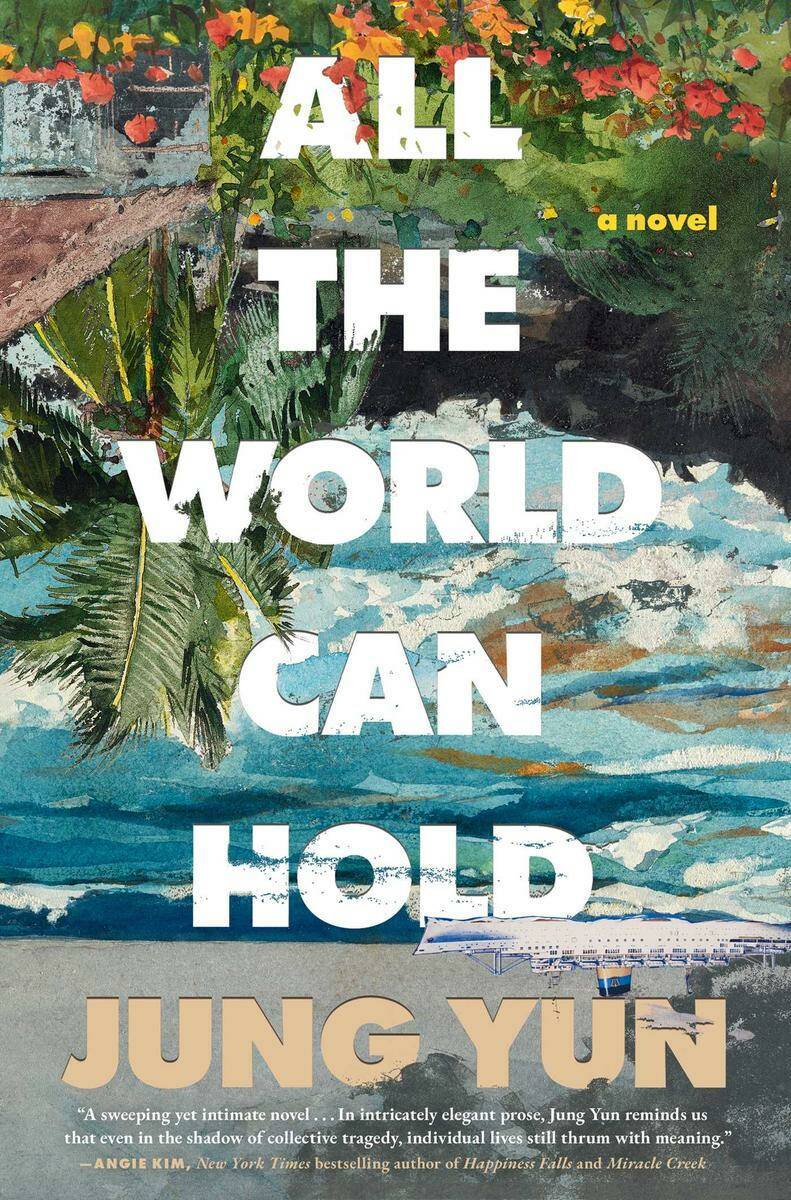
All the World Can Hold

All the World Can Hold

What distinguishes this voyage from others is that it takes to sea on Sept. 16, 2001. It’s been five days since 9/11. The characters have all been impacted by the attacks in ways they have yet to recognize.

Adding to the surreal timing of this cruise is its theme. The cruise ship, the Sonata, was the setting of a popular ’80s show called Starlight Voyages, and most of its passengers are older fans eager to embrace a nostalgia for a time that has long passed.

Yun’s cast of characters have differing attachments to the Love Boat-themed cruise and its intents. There’s Franny, a Korean-American woman accompanied by her extended family and obsessed with throwing her mother a lavish 70th birthday on board. There’s Doug, a white, washed-up actor from the original Starlight Voyages cast on board (again) for the paycheque. And there’s Lucy, a Black graduate student phenom at MIT trying to escape the stress of high-stake job interviews at start-ups with silly names like “Google,” unsure if the future she is hurtling toward is the one she wants.

The book’s allure comes as much from the three distinct storylines as it does from the ins and outs of cruise culture: the incessant small talk with strangers, cruise lingo and ship design details, the drama with and amongst what looks like an impeccably trained staff.

Yun’s decision to set her novel so shortly after 9/11 is partly autobiographical. Her own family took a similar cruise while the nation remained in shock. Her work stands on the cusp of a contemporary moment, when 9/11 is beginning to be remembered as a distant past, something unfathomable to those of us who bore witness to it 25 years ago.

Somewhere in the middle of these two spectacles — the packaged desire of an all-inclusive nostalgia cruise and the grief and confusion of a national security attack — lies the lives of everyday people who never knew they would make it as far as they have.

They embody different versions of survivor’s guilt that unfolds to reveal their deepest secrets and regrets. Alongside rigorously scheduled dance lessons and synchronized table-side dessert service, they come to reckon with the fact that they still have infinite futures ahead of them. Loss, desire and longing are often entangled.

Yun weaves between characters’ narratives, cruise culture and national tragedy with surprising ease, accentuating that the most superficial and staged places can contain moments of the truest clarity. Nothing may last, yet life is always brimming with possibility.

And sometimes, as Yun depicts, a towel folded perfectly into the shape of a swan is the thing that makes you realize it.

Serenity Joo is a professor of American literature at the University of Manitoba.
Report Error Submit a Tip

More Stories

Cottage communities constrained by COVID

Cassandra Szklarski, The Canadian Press 6 minute read Preview

Cottage communities constrained by COVID

Cassandra Szklarski, The Canadian Press 6 minute read Friday, May. 1, 2020

TORONTO - A springtime trickle of Manitobans entering Ontario to visit their lakeside cottages alarmed Kenora Mayor Daniel Reynard a month ago.

Now that Manitoba is poised to restart some non-essential services Monday, Reynard fears an even bigger influx — this time sun-seekers expecting amenities that are simply unavailable.

The message in Ontario is still one of restraint: Avoid non-essential travel, and do not visit your cottage. Provincial travel is not prohibited, but vacationers and day-trippers will find little to do.

Restaurants are closed, as are all beaches, golf courses, parks, trails and marinas.

Read
Friday, May. 1, 2020

Bob Saget, beloved TV dad of 'Full House,' dead at 65

Lynn Elber, The Associated Press 6 minute read Preview

Bob Saget, beloved TV dad of 'Full House,' dead at 65

Lynn Elber, The Associated Press 6 minute read Monday, Jan. 10, 2022

LOS ANGELES (AP) — Bob Saget, the actor-comedian known for his role as beloved single dad Danny Tanner on the sitcom “Full House” and as the wisecracking host of “America’s Funniest Home Videos,” died while on a stand-up tour. He was 65.

Deputies in Orange County, Florida, were called Sunday about an “unresponsive man” in a hotel room at the Ritz-Carlton in Orlando and found Saget dead, according to a sheriff’s statement on Twitter. Detectives found “no signs of foul play or drug use in this case.”

Saget was in Florida as part of his “I Don't Do Negative Comedy Tour.” After warm audience receptions to his gigs Friday in Orlando and Saturday in the Ponte Vedra Beach resort area, he celebrated online.

“I’m back in comedy like I was when I was 26. I guess I’m finding my new voice and loving every moment of it,” he posted Saturday on Instagram.

Read
Monday, Jan. 10, 2022

Third fire hits troubled Manitoba Housing apartment block

Malak Abas 4 minute read Preview

Third fire hits troubled Manitoba Housing apartment block

Malak Abas 4 minute read Yesterday at 3:19 PM EST

Residents of a North End Manitoba Housing apartment block with a long history of trouble say they’re shaken after the building was hit with its third fire in eight months Friday night.

An apartment complex at 145 Powers St. was evacuated by firefighters after a fire broke out at around 7:45 p.m.

When longtime resident Sharon Markwell heard the fire alarm go off, she chalked it up to a false alarm — kids will get into the building and pull the fire alarm around once or twice a month, she said — until smoke began billowing into the hallway of her fifth-floor apartment.

“Once I realized that I could smell smoke very, very strongly, and the smoke was seeping into my room, into my apartment, I said to myself, ‘This is no false alarm. This is the real thing,’” Markwell, 64, told the Free Press Sunday.

Read
Yesterday at 3:19 PM EST

Trio of cruise-ship storylines converge in post-9/11 boat journey to Bermuda

Reviewed by Serenity Joo 4 minute read Preview

Trio of cruise-ship storylines converge in post-9/11 boat journey to Bermuda

Reviewed by Serenity Joo 4 minute read Saturday, Apr. 25, 2026

When it comes to cruise vacations, there are three types of people: those who love them, those who hate them, and those who love to hate them and remain fascinated by their cultural appeal.

Jung Yun’s third novel, All the World Can Hold, scratches the itch of all these groups, criss-crossing the stories of three characters who embark on a five-day journey to Bermuda.

Cruises are inherently places of time-space warp, with their endless arrays of dining, leisure and entertainment options.

What distinguishes this voyage from others is that it takes to sea on Sept. 16, 2001. It’s been five days since 9/11. The characters have all been impacted by the attacks in ways they have yet to recognize.

Read
Saturday, Apr. 25, 2026

Second plant-based protein plant planned in Manitoba to meet vegan meat demand

Martin Cash 5 minute read Preview

Second plant-based protein plant planned in Manitoba to meet vegan meat demand

Martin Cash 5 minute read Tuesday, Jul. 16, 2019

Manitoba is about to become a key production centre for plant-based protein with a second pea-protein production plant about to break ground.

Merit Functional Foods Corporation is building a $65-million, 65,000-square-foot facility that will produce both pea and canola protein.

The French company, Roquette, is building a $400-million pea protein plant in Portage la Prairie.

Merit is a 60-40 partnership between an investor group made up of Shaun Crew, Barry Tomiski and Ryan Bracken -- all veteran senior management and founders of Hemp Oil Canada Inc./Manitoba Harvest -- and Burcon NutraScience Corp., a publicly traded Vancouver company with strong links to Winnipeg where it has had a research lab for 20 years.

Read
Tuesday, Jul. 16, 2019

Manitoba’s First Nations and the Indian Act

Hersh Seth 6 minute read 2:00 AM EST

On Monday in Ottawa, Manitoba Premier Wab Kinew called for the Indian Act to be abolished. Prime Minister Mark Carney said he was open to working with First Nations to reform or repeal this law, calling it racist.

The act was created in 1876 and still controls Indian status, reserve lands and band governance. It’s understandable why many people want a better relationship.

But repealing a law and building a new relationship are not the same. What would replace the act’s protections? Who decides? How do governments ensure removing federal authority gives First Nations power while the Crown keeps its promises?

Manitoba has faced these questions before. In 1971, First Nations created a document called Wahbung: Our Tomorrows, in response to then-prime minister Pierre Trudeau’s white paper on assimilation. More than 45 years later, elders and knowledge keepers met at Turtle Lodge, north of Winnipeg, to continue the conversation. Manitobans Dave Courchene Sr. and his son, Dave Courchene Jr., are generational links to the broader movement, and their story should be part of this discussion.