Free period products essential

Advertisement

Advertise with us

Let me break out all my red crayons and draw you a picture:

Read this article for free:

or

Already have an account? Log in here »

To continue reading, please subscribe:

Subscribe and receive a limited-edition Free Press branded hat or tote.

Digital Subscription

One year of digital access for only $205*

  • Enjoy unlimited reading on winnipegfreepress.com
  • Read the E-Edition, our digital replica newspaper
  • Access News Break, our award-winning app
  • Play interactive puzzles

*First annual payment billed as $205.00 + GST for one year. This annual subscription will automatically renew at $233.00 + GST every 52 weeks (10% off the regular annual price of $259.35). Offer available to new and qualified returning subscribers only. Cancel any time.

To continue reading, please subscribe:

Add Free Press access to your Brandon Sun subscription for only an additional

$1 for the first 4 weeks*

  • Enjoy unlimited reading on winnipegfreepress.com
  • Read the E-Edition, our digital replica newspaper
  • Access News Break, our award-winning app
  • Play interactive puzzles
Start now

*Your next Brandon Sun subscription payment will increase by $1.00 and you will be charged $17.95 plus GST for four weeks. After four weeks, your payment will increase to $24.95 plus GST every four weeks.

Opinion

Let me break out all my red crayons and draw you a picture:

You are sitting at your desk and realize it’s happened. The tampon has given up the ghost. Or maybe Aunt Horror has arrived for her visit ahead of schedule. You reach into your purse and — oh, snap — you remember you gave your last pad to another desperate member of the crimson covenant.

Wouldn’t it be so chill if your workplace had a basket of free menstrual products to get you through your day so you don’t have to jury-rig a pad out of toilet paper and wrap a Cotton Ginny sweatshirt around your waist and pray you don’t leak onto your chair? No? Just me in Grade 6?
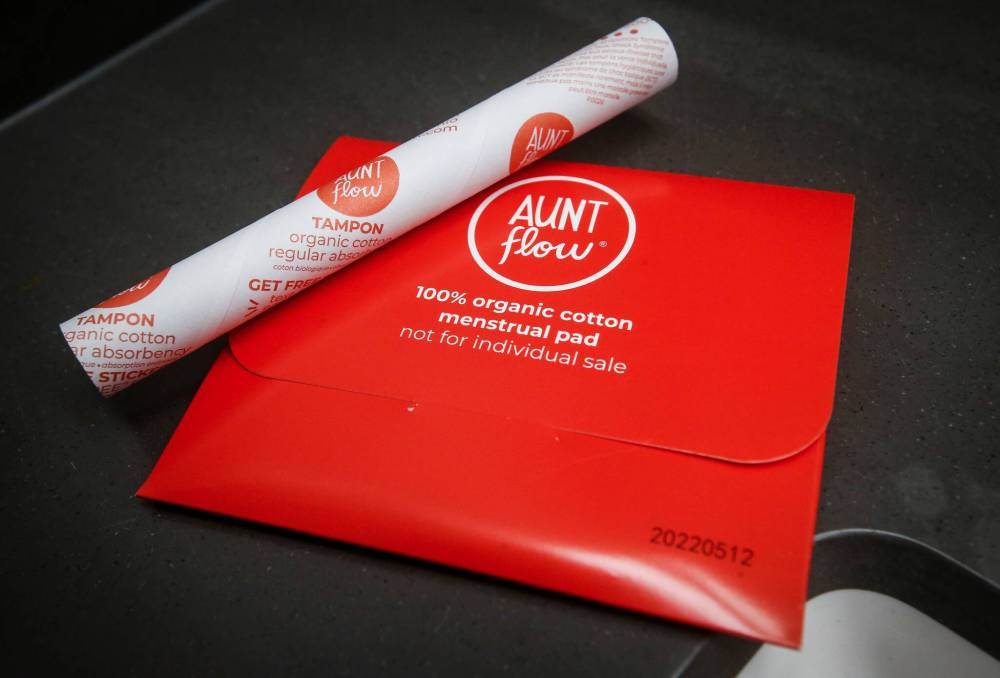
JOHN WOODS / FREE PRESS FILES
                                Menstrual products will soon be provided free in many workplaces.

JOHN WOODS / FREE PRESS FILES

Menstrual products will soon be provided free in many workplaces.

Very soon, this will be a reality in a lot of workplaces. Beginning in August, all provincially regulated companies must provide free menstrual products to their employees in washrooms or other accessible areas.

Many places already do this, and it goes beyond employees; I’m always happy to see baskets of products in restaurant bathrooms for customer use, as opposed to encountering a defunct metal box that hasn’t been stocked since 1994 vending “sanitary napkins” for 25 cents a pop.

Of course, some people are fretting about the cost, which estimates suggest will be about $10 to $25 per menstruating employee annually, and an initial cost of $20 to $300 for a dispenser and disposal container. (That last part seems unnecessary; a basket and garbage can would do.)

Employers provide all kinds of hygiene items. Toilet paper. Hand soap. Sanitizer. Maybe even facial tissue if you work somewhere fancy. This isn’t different from that. At all.

As with all initiatives like this, people worry about other people “abusing the system,” but this is very much an “in a pinch” situation.

We menstruators all have pretty specific preferences for what we look for in hygiene products, because everyone’s period and anatomy are different. And with the advent of reusables, such as period underwear and cups, disposables are not even a lot of people’s first choice these days.

Will the pads and tampons be stolen from time to time? I don’t know, maybe! But it’s still a net good that supports the dignity of your workforce.

Honestly, if men got periods, not only would free hygiene products be blasted out of confetti cannons on street corners, they would get free steaks and a paid week off every month because, top tip, having to work through pain sucks.

Actually, no, science probably would have figured out a way for them to simply unsubscribe.

If you suffer from any of the litany of understudied and underfunded chronic conditions that make your period especially heinous and unpredictable — I have endometriosis, which meant, pre-medication, my period was heavy and painful, but I also have PCOS, which meant I also never knew when it was coming — having a tiny bit of support in the form of accessible hygiene products when you find yourself up the crimson creek without a tampon is a welcome development.

But, as the Little Mermaid famously sang, I want mooooooore. I want research and funding and paid sick days that aren’t called “period days” so they can’t be weaponized against us later.

I want faster diagnoses and doctors to believe our pain and for no one to ever again be dismissed with an ibuprofen and a prayer.

The bar really is in the basement, isn’t it? Throw us a free pad.

winnipegfreepress.com/jenzoratti

Jen Zoratti

Jen Zoratti
Columnist

Jen Zoratti is a Winnipeg Free Press columnist and author of the newsletter, NEXT, a weekly look towards a post-pandemic future.

Our newsroom depends on a growing audience of readers to power our journalism. If you are not a paid reader, please consider becoming a subscriber.

Our newsroom depends on its audience of readers to power our journalism. Thank you for your support.

Report Error Submit a Tip

More Stories

Prepare to be … blutterbunged?

David McLaughlin 5 minute read Preview

Prepare to be … blutterbunged?

David McLaughlin 5 minute read 2:01 AM CDT

Are you not blutterbunged?

If Russell Crowe’s second-century gladiator character had uttered a 19th century equivalent of “Are you not entertained?” that fit the mood of today’s 21st century, that would be it.

Definitions first. Blutterbunged is an obscure regional dialect word from England that means everything from astonished to confounded to bemused or shocked into speechlessness. Its composition suggests something both more and less, namely blustering bloviation (that’s the more part) and empty words (that’s the empty part). These days we would more naturally punctuate our reaction to an event or statement with a profanity. But you get the drift.

Unearthed by lexicologist Susie Dent, it speaks volumes about our times that it fits now. That we need to reach back hundreds of years to find the right word to adequately capture a contemporary civic reaction to what the hell is going on in politics and the world today.

Read
2:01 AM CDT

Climate: what must be done now

Gwynne Dyer 5 minute read 2:01 AM CDT

I WAS reading an article about the current wildfires written in a reputable paper by a recognized ‘environmental journalist’, but I stumbled to a halt when I read the following sentence: “While the skies over North America and Europe will eventually clear, this climate change-driven era of wildfire will exact a lengthy toll.”

What? Does he expect the skies to “eventually clear” of their own accord? We already know with high confidence (85 to 92 per cent) that next year will be even hotter than this year. What natural event or human action is going to return us to the old ‘normal’? Here’s a market tip: invest in companies making water-bombers.

Some people seek solace in the belief that this is just another El Niño event, a nine-to-12-month weather phenomenon that starts in the tropical eastern Pacific but affects the entire global system. It repeats every two to seven years. This time it is coming back in three years so, technically, it could be just another El Niño — but there are strong reasons to doubt that.

A normal El Niño temporarily adds only about 0.2 C to average global temperature, whereas the 2023-24 El Niño added more than 0.3 C. Much more importantly, that extra heat never went away again. It acted like a ratchet, taking us up past some invisible of no return, and we seem to be stuck there.

How to fill potholes

By Brent Bellamy 6 minute read Preview

How to fill potholes

By Brent Bellamy 6 minute read Monday, Apr. 21, 2014

The people of Winnipeg have become a tired and irritable bunch. They have endured the worst winter since the invention of the automobile and now are living through what might be the worst spring for potholes since they started making roads for those vehicles.

It's understandable then, that as city council was presented with the details of a $590-million plan to complete the city's first leg of rapid transit, the public, politicians and media all wondered aloud if the money would be better spent filling that proliferation of potholes.

As we yet again get dragged into the quagmire of a 60-year-old rapid-transit debate, every Canadian city Winnipeg competes with for investment, immigration and tourism has been lining up to announce their long-term commitment to rapid-transit development. Vancouver is currently constructing a $1.4-billion expansion to its Skytrain system, Calgary and Edmonton have announced billion-dollar additions to their existing networks, Ottawa will be investing $3 billion over the next 10 years and Hamilton and Kitchener are both building new light-rail systems.

Most of these cities face the same infrastructure challenges as Winnipeg, but their leadership believes the solution is not a choice between conflicting priorities of transit spending and road repair. Rapid transit is seen as a complementary strategy that addresses the root causes of infrastructure deficits, helping to make road-maintenance budgets more sustainable, in part by reducing private vehicle use and in turn road wear and capacity demands.

Read
Monday, Apr. 21, 2014

0 minute read

Hospital transfers hastened mother’s death, family says

Katie May 5 minute read Preview

Hospital transfers hastened mother’s death, family says

Katie May 5 minute read Tuesday, Apr. 5, 2022

The family of a senior with dementia who died after being transferred between two Manitoba hospitals is calling on the province to end patient transfers, especially for the elderly.

Of the 331 hospital patients sent far from home since last October under Manitoba’s inter-regional patient-transfer protocol, it’s unknown how many are elderly, how many have dementia or how many died soon after being transferred.

Shared Health is not disclosing any of that information publicly, and there is no demographic data to show which groups of Manitobans are hit hardest by the transfer policy.

Joyce Rivard, 84, fell and dislocated her hip on Feb. 1 and died at Concordia Hospital on Feb. 25. Before she died, and despite her dementia and frail state, Rivard was transferred to a health centre in Treherne, 126 kilometres away, to free up a bed in Winnipeg. Within 24 hours after the ambulance ride, she dislocated her hip again and was sent back to Concordia.

Read
Tuesday, Apr. 5, 2022

Ontario ramps up COVID vaccinations in LTC

Paola Loriggio, The Canadian Press 5 minute read Preview

Ontario ramps up COVID vaccinations in LTC

Paola Loriggio, The Canadian Press 5 minute read Wednesday, Jan. 13, 2021

Canada's largest province laid out its plan Wednesday to administer the first dose of the COVID-19 vaccine in all nursing and high-risk retirement homes by the middle of next month as it works to boost its immunization capacity.

The Ontario government said it is stepping up immunizations in long-term care homes now that it has protocols in place to safely transport the Pfizer-BioNTech vaccine, which has strict storage requirements.

The plan builds on an earlier promise to give the COVID-19 vaccine to long-term care facilities in hot spots by Jan. 21.

"We're moving at a rapid speed right now," Ontario Premier Doug Ford said in an afternoon news conference. "We're building the capacity. We're emptying our freezers."

Read
Wednesday, Jan. 13, 2021