Modern-day parallels abound in Winter War historical novel

Advertisement

Advertise with us

It isn’t hard to see how recent events have brought a new currency to the 1939-40 Winter War between Finland and the Soviet Union, the setting of this first historical novel by a leading French crime writer.

Read this article for free:


or

Already have an account? Log in here »

To continue reading, please subscribe:

Subscribe and receive a limited-edition Free Press branded hat or tote.

Digital Subscription

One year of digital access for only $205*

  • Enjoy unlimited reading on winnipegfreepress.com
  • Read the E-Edition, our digital replica newspaper
  • Access News Break, our award-winning app
  • Play interactive puzzles

*First annual payment billed as $205.00 + GST for one year. This annual subscription will automatically renew at $233.00 + GST every 52 weeks (10% off the regular annual price of $259.35). Offer available to new and qualified returning subscribers only. Cancel any time.

To continue reading, please subscribe:

Add Free Press access to your Brandon Sun subscription for only an additional

$1 for the first 4 weeks*

  • Enjoy unlimited reading on winnipegfreepress.com
  • Read the E-Edition, our digital replica newspaper
  • Access News Break, our award-winning app
  • Play interactive puzzles
Start now

*Your next Brandon Sun subscription payment will increase by $1.00 and you will be charged $17.95 plus GST for four weeks. After four weeks, your payment will increase to $24.95 plus GST every four weeks.

Hey there, time traveller!
This article was published 14/02/2026 (216 days ago), so information in it may no longer be current.

It isn’t hard to see how recent events have brought a new currency to the 1939-40 Winter War between Finland and the Soviet Union, the setting of this first historical novel by a leading French crime writer.

Author Olivier Norek is a former police officer who has written a string of bestselling novels, including a series set in the crime-ridden immigrant suburbs (banlieus) surrounding Paris. Several, including The Lost and the Damned and Between Two Worlds, have been translated into English.

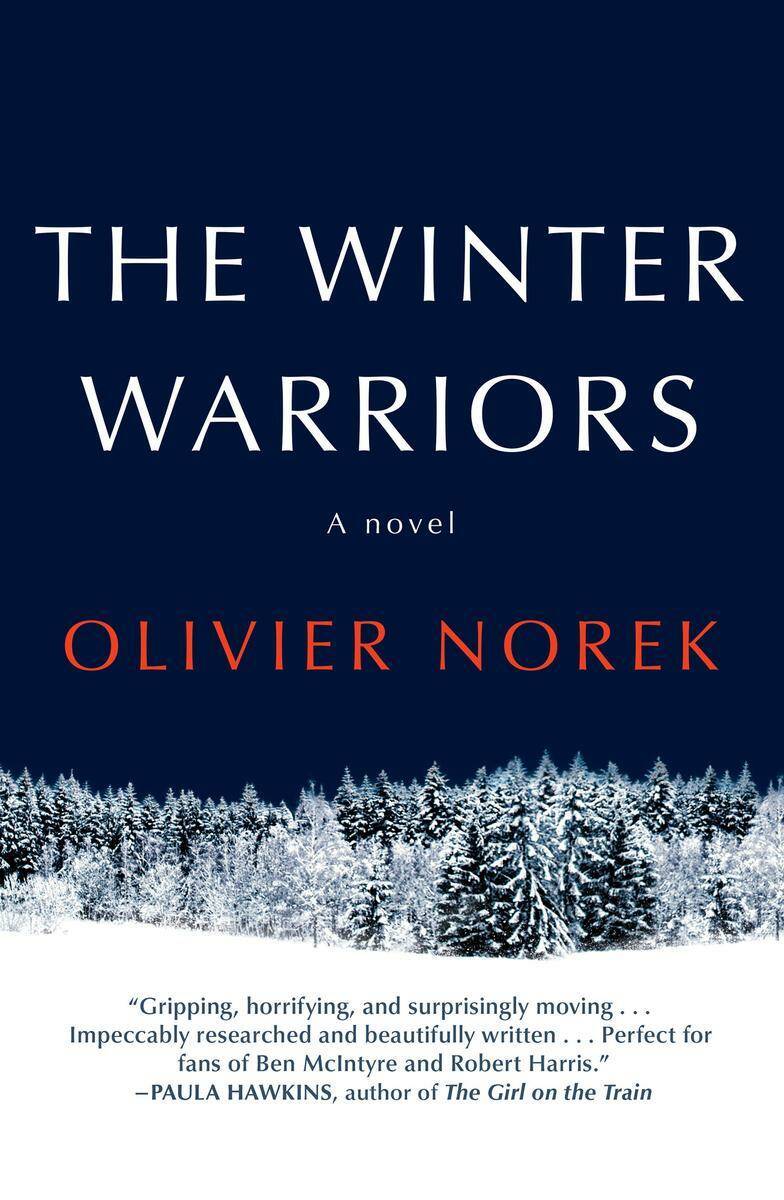
In The Winter Warriors, translated by Nick Caistor and based on the 105-day Winter War (and especially on the exploits of Finnish sniper Simo Hayha, who earns the nickname White Death), parallels abound with Russia’s war against Ukraine.
The novel begins with young Finns being called up for military exercises in response to Soviet territorial demands, and follows one group of village youths through the nightmare of battle with a numerically superior foe.

Scenes from the young soldiers’ perspectives are interspersed with sections focusing on the high command in Finland and Moscow, civilians in Helsinki and even diplomatic activity in Paris.

In these scenes beyond the frontline, Norek underlines the historical connections between past and present. The head of Finland’s military, Carl Gustaf Mannerheim, notes to a colleague: “Ukraine, too, wanted its independence. And he starved it. Four million dead can testify to that… I don’t know how he’ll do it, but if Stalin wants to move against Finland, he’ll find an excuse.”

Just as today’s Ukraine was part of the Soviet Union until 1991, Finland had only declared independence from Russia after the October Revolution of 1917. In the Winter War, like the Soviet invasion of eastern Poland a few months earlier, Stalin sought to re-establish the Czar’s empire under the hammer and sickle.

The parallels continue with Vladimir Putin’s “special operation” against Ukraine, which the Kremlin thought would be over in a few days. Norek has Soviet foreign minister Vyacheslav Molotov demonstrate the arrogance of the invaders: “Stalin wants to celebrate his birthday on the steps of the Finnish parliament. In other words, in precisely 20 days. We will be facing an army hastily thrown together, badly equipped, few in numbers and unevenly trained … After all, it’s only Finland.”

As it turned out, the Red Army (whose officer class had recently been purged by Stalin) was the one that was poorly equipped and unevenly trained, and its soldiers paid for that in blood.

And in one additional parallel to today, Finland gets moral support and vague promises of military aid from France — but with Hitler threatening to turn his attentions to the West, that aid never arrives.

While the novel succeeds in showing the continuity of Russian Empire/Soviet Union/Russian Republic ambitions and ruthlessness, as a work of fiction it’s a bit flat. Some of the shortcomings may be a result of translation, such as this mathematical howler: “Each of the twelve aircraft in the first Russian wave dropped 100 kilos of bombs — that is, more than seven tonnes of incendiaries.”

More often, though, the novel suffers from Norek’s determination to pack information into every conversation, leading to unnatural sounding dialogue.

In one scene, a political commissar tells an army commander that an incoming Moscow official is a powerful figure because “He helped to plan the Holodomor.” Surely a proper Stalinist would not have used that Ukrainian word, and would have referred to the manmade starvation as the “liquidation of the kulaks.”

Ultimately, The Winter Warriors is a novel for history buffs, rather than for lovers of fiction.

Bob Armstrong is a history buff, a frequent traveller and a writer who works in every genre but poetry and ransom notes.
Report Error Submit a Tip

More Stories

We used to love a good thunderstorm

Jessica Scott-Reid 5 minute read Preview

We used to love a good thunderstorm

Jessica Scott-Reid 5 minute read 2:00 AM CDT

Growing up on the prairies, even as a city girl, summertime thunderstorms were always cause for excitement. That first rumble signalled it was time to go search for the sleeping bags.

We’d cuddle under them on the front step, under the awning, as we watched the rain pour. And we’d stay out there until we were soaked.

If the lightning wasn’t bad enough for our parents to call us in, we neighbourhood kids would then throw on our bathing suits and go play in the warm puddles. It was some of the best stuff of summer.

As a mom now, with a little girl of my own, I was excited to watch her growing up loving Winnipeg thunderstorms, too.

Read
2:00 AM CDT

Remove barriers, coalition says

Dan Lett 6 minute read Preview

Remove barriers, coalition says

Dan Lett 6 minute read Monday, Jul. 30, 2018

Game on.

Just two weeks after city council approved a referendum on whether to open Winnipeg’s landmark intersection, an official ‘Yes’ campaign in support of tearing down the barriers has formed.

A coalition of downtown business and land owners, planners, architects and advertising and marketing firms — with the support of organizations such as the Exchange District and Downtown BIZ organizations — has taken up the challenge to defend Mayor Brian Bowman’s vision of a barrier-free Portage and Main.

Organizers said the campaign in favour of re-opening the intersection will be funded by an online crowd-sourcing campaign and will open a storefront headquarters in the shadow of the historic intersection. Lawn signs, promotional videos and mass mail will all be part of the drive to remove pedestrian barriers once and for all.

Read
Monday, Jul. 30, 2018

Letters, Sept. 18

7 minute read 2:00 AM CDT

Efficiency matters

Re: A development infused with personal memory, Think Tank, Sept. 15

Columnist Brent Bellamy mentions “a focus on high energy efficiency and near-zero carbon emissions over the life of the building.”

I hope this means geothermal heating, which is not specifically mentioned. This environmentally friendly feature is highly touted and is supposedly being employed in the new Southwood Circle development. This project at The Forks would also seem to be a prime candidate for the same.

Space war and other distractions

Gwynne Dyer 5 minute read 2:00 AM CDT

When Troy Meink, the chief of the U.S. Space Force, announces for no obvious reason that the United States “now has on-orbit space-control weapons,” people naturally assume that something is up. Why is Meink admitting the truth now? He’s even boasting about it!

It can’t be to frighten the Chinese or the Russians, because they have long been watching U.S. military activities in space. They regularly monitor the flights of the semi-secret X-37B Orbital Test Vehicle, the re-usable uncrewed spaceplane that the U.S. Space Force launches from Florida but sometimes lands at Vandenberg in California (eight missions so far).

The Chinese can’t complain, because they have their own ‘secret’ spaceplane, and sometimes they even play ‘silly buggers’ in orbit with their American and British counterparts. (‘Silly buggers’ is the old naval game of high-speed manoeuvres of warships in formation, a frequent cause of collisions.)

Reuters reported a year ago on a joint U.S.-British operation in which the U.S. Space Force, working from a base in Colorado, directed an American military satellite to swoop in close to a British satellite just as China’s Shiyan 12-01 satellite passed beneath it. What for? Who knows? They may have done it just because they could.

Free as can be

AV Kitching 5 minute read Preview

Free as can be

AV Kitching 5 minute read Tuesday, Sep. 15, 2026

Katelyn Sawatzky founded Childfree Winnipeg Women in 2021 to bring together women who don’t have kids — be it by choice or circumstance — and do not plan on raising children.

The group is designed to help them share experiences and build meaningful friendships.

The community welcomes cisgender, straight, transgender, bisexual and lesbian women. Parents, including empty nesters and men, are turned away.

“Our group is a safe space where women can hang out with other women without being asked when you’re going to have kids or why you don’t have kids … where you don’t feel like you have to validate or defend your choices in any way, because everyone gets it,” Sawatzky says.

Read
Tuesday, Sep. 15, 2026

Fiddling and a jig mark ceremony to rename Wolseley-area school

Maggie Macintosh 4 minute read Preview

Fiddling and a jig mark ceremony to rename Wolseley-area school

Maggie Macintosh 4 minute read 2:00 AM CDT

Beckoned by a fiddle, students broke out into a jig behind Little Bluestem School on Thursday evening to mark the end of a multi-year renaming process.

“I couldn’t help myself. I just had to dance,” eight-year-old Stevie Morrison said at a ribbon-cutting event to celebrate the new signage at 511 Clifton St., formerly known as Wolseley School.

Stevie and Fallon Lovelace Sharkey, 7, were out of breath after bouncing up and down to the beat, attempting to execute the Red River Métis dance moves they were taught at school.

There were cheers and tears as adults watched jigging on school grounds once named after a man who did not believe in Métis peoples’ right to self-determination.

Read
2:00 AM CDT