Feuding factions seek clues from mysterious manuscript
Advertisement
Read this article for free:
or
Already have an account? Log in here »
To continue reading, please subscribe:
Digital Subscription
One year of digital access for only $1.44 a week*
- Enjoy unlimited reading on winnipegfreepress.com
- Read the E-Edition, our digital replica newspaper
- Access News Break, our award-winning app
- Play interactive puzzles
*Billed as $5.77 plus GST every four weeks. After 52 weeks, price increases to the regular rate of $19.95 plus GST every four weeks. Offer available to new and qualified returning subscribers only. Cancel any time.
To continue reading, please subscribe:
Add Free Press access to your Brandon Sun subscription for only an additional
$1 for the first 4 weeks*
- Enjoy unlimited reading on winnipegfreepress.com
- Read the E-Edition, our digital replica newspaper
- Access News Break, our award-winning app
- Play interactive puzzles
*Your next Brandon Sun subscription payment will increase by $1.00 and you will be charged $17.95 plus GST for four weeks. After four weeks, your payment will increase to $24.95 plus GST every four weeks.
Read unlimited articles for free today:
or
Already have an account? Log in here »
Hey there, time traveller!
This article was published 10/01/2026 (295 days ago), so information in it may no longer be current.
From Josephine Tey’s classic 1951 novel The Daughter of Time through to Peter Watson’s 1989 book Landscape of Lies to Dan Brown’s 2003 mega-hit The Da Vinci Code, mysteries featuring books and works of art hold an enduring appeal for many readers. With The Burning Library, Gilly Macmillan — a former art historian and U.K.-based author of eight previous thrillers — has added a new entry to this genre.
Her protagonist Anya Brown (surely a nod to the Da Vinci Code author) is a paleographer who, having made her reputation deciphering a mysterious manuscript, is hired by a group of women to study a collection of priceless volumes held in the Institute of Manuscript Studies in St. Andrews, Scotland. Anya is not only an expert in ancient handwriting, she also possesses an eidetic memory which (she claims) allows her to remember everything she sees in detail.
(In an odd turn, Anya is a first-person narrator surrounded by a large cast of characters whose actions are described in the third person — an authorial choice that doesn’t seem to have any justification).
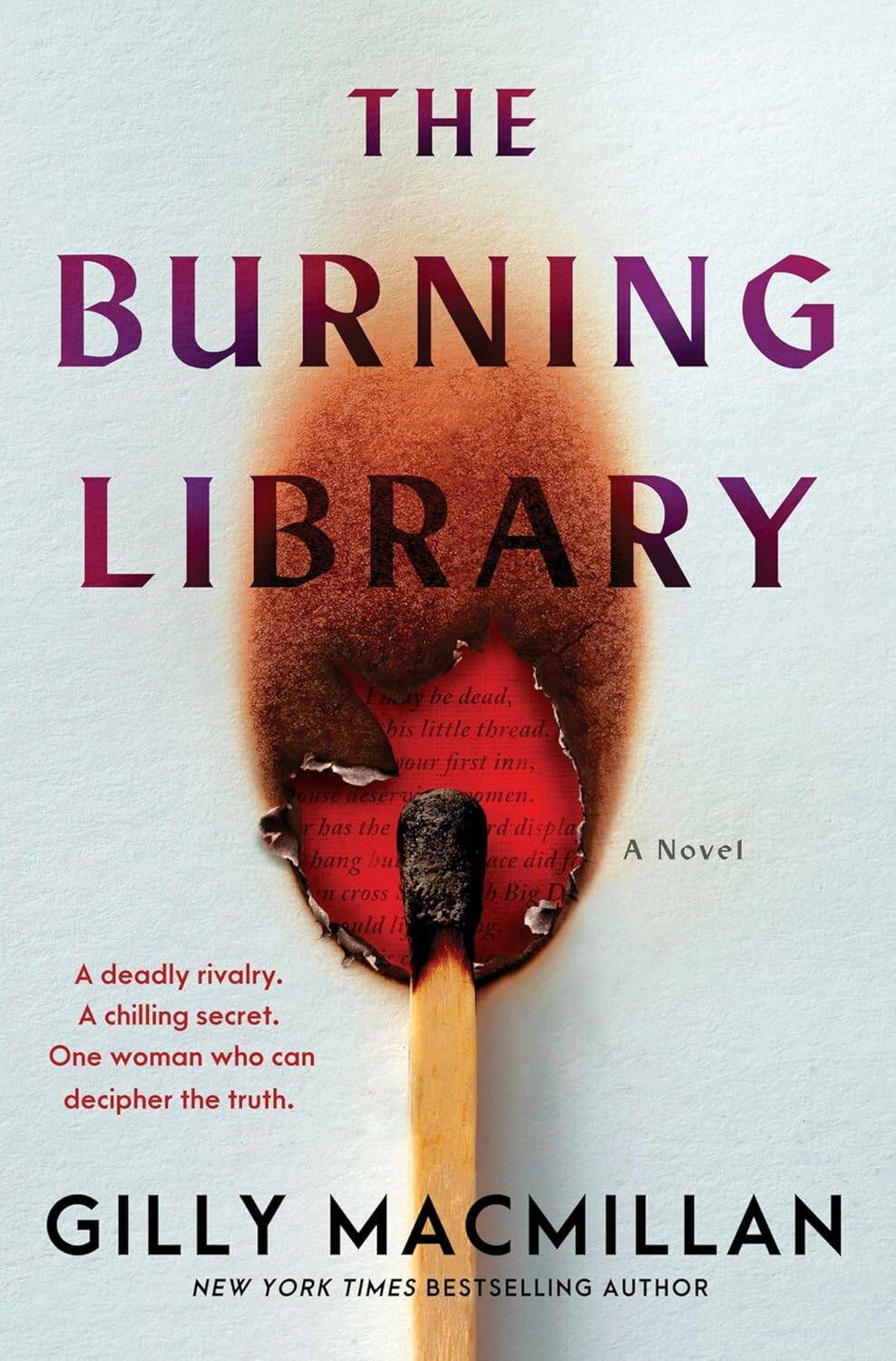
The Burning Library
Anya soon learns that her employers are part of a secret society of women calling themselves the Fellowship of the Lark, which has for centuries been engaged in a shadowy and often lethal conflict with another female-led cabal known as the Order of St. Katherine. While the “Larks” are glass-ceiling-shattering career women seeking power in corporations and governments, the “Kats” foreswear careers to care for their families and husbands — the latter of whom they secretly manipulate to their own ends.
Both factions are in pursuit of a fragment of medieval embroidery which they believe holds the secret to discovering a long-lost manuscript entitled The Book of Wonder, alleged to contain information that will grant each the power to achieve their goals.
Normally, one would think that a quest by warring secret societies to discover a long-lost and potentially world-changing manuscript would make for an intellectually stimulating thriller. Sadly, The Burning Library lacks the charms usually associated with literary and art mysteries.
To start with, the book’s title is not just misleading but more than a little sensationalistic. Yes, a library once owned by Anya’s father burned down decades ago, but this is mere backstory and hardly merits titular treatment. (The Book of Wonder might have been a far more apt title.)

There’s also something both absurd and distasteful about the novel’s ideological conflict between murderous career women and conniving homemakers; it seems a crude caricature of the debate over women’s rights, one that would probably have been viewed as clunky and passé even in the 1970s.
Macmillan’s use of the real-world Voynich Manuscript as a plot point is also somewhat disappointing, as she doesn’t really convey to readers just how genuinely bizarre this book is, having been written in a unique and undeciphered language and filled with botanical drawings of plants unknown to science.
Mysteries featuring amateur sleuths from specialized professions are typically solved thanks to those characters’ disciplined knowledge. Yet when Anya is not being handed important clues outright by other characters, or recalling in perfect detail artwork she saw years before (and no, eidetic memory doesn’t work that way), what little sleuthing she does is confined to viewing scans of the Voynich on her laptop, searching the internet and locating landmarks on Google Maps. In other words, her professional expertise plays almost no role in resolving the plot.
Nor, unfortunately, do books themselves: aside from the fact that we never learn what power The Book of Wonder is supposed to hold, it is that the rare books at the heart of the novel are only talked about and admired but never actually read, making this a disappointing literary mystery.
Michael Dudley is a librarian at the University of Winnipeg.