New CancerCare facility could cost $1B to treat, study disease

Construction set to begin next summer on expansion

Advertisement

Advertise with us

Manitoba’s premier is prepared to spend $1 billion to open a new CancerCare site that his government says will attract “world-class” physicians and researchers to Winnipeg.

Read this article for free:


By clicking the button above, an account will be created and you will begin to receive some of our recommended newsletters. You may opt out of any newsletter by visiting your Email and Communication Preferences page or by clicking "unsubscribe" at the bottom of any email.

or

Already have an account? Log in here »

To continue reading, please subscribe:

Digital Subscription

One year of digital access for only $1.44 a week*

  • Enjoy unlimited reading on winnipegfreepress.com
  • Read the E-Edition, our digital replica newspaper
  • Access News Break, our award-winning app
  • Play interactive puzzles

*Billed as $5.77 plus GST every four weeks. After 52 weeks, price increases to the regular rate of $19.95 plus GST every four weeks. Offer available to new and qualified returning subscribers only. Cancel any time.

To continue reading, please subscribe:

Add Free Press access to your Brandon Sun subscription for only an additional

$1 for the first 4 weeks*

  • Enjoy unlimited reading on winnipegfreepress.com
  • Read the E-Edition, our digital replica newspaper
  • Access News Break, our award-winning app
  • Play interactive puzzles
Start now

*Your next Brandon Sun subscription payment will increase by $1.00 and you will be charged $17.95 plus GST for four weeks. After four weeks, your payment will increase to $24.95 plus GST every four weeks.

Hey there, time traveller!
This article was published 09/06/2025 (510 days ago), so information in it may no longer be current.

Manitoba’s premier is prepared to spend $1 billion to open a new CancerCare site that his government says will attract “world-class” physicians and researchers to Winnipeg.

Premier Wab Kinew was joined by Health Minister Uzoma Asagwara and physicians to announce the next steps to expand cancer research and patient care in the province on Monday.

Kinew confirmed that a site that is kitty-corner to CancerCare headquarters at 675 McDermot Ave. — where he made the announcement — will host the second facility.

Few specifics were provided, although the premier said $815 million is the preliminary estimate to complete the construction project.

Combined with equipment and scoping expenses, that figure could be closer to $1 billion, he said.

“In many respects, our province is doing its absolute best to deliver yesterday’s care because we don’t have the space to welcome the future,” Asagwara said at an afternoon news conference. “This facility will change that.”

It will help the province “flex our research muscles” and host clinical trails, the health minister said.

Construction is scheduled to begin in August 2026. It is anticipated to take about four years.

Doctors Manitoba called the extension to the Health Sciences Centre campus, first announced in 2011 under then-NDP premier Greg Selinger, “a long-delayed, much-needed addition.”

Selinger pledged an initial $70 million for the CancerCare expansion. In 2017, the Progressive Conservatives pegged the 300,000-square-feet project at $300 million and scrapped it.

“While it’s frustrating to think of the cancer facilities we could have today if the project hadn’t been stalled for a decade, it’s encouraging to see it moving forward,” a spokesperson for the advocacy organization said in a statement.

“The development process can’t move swiftly enough to deliver the improved access to life-saving, state of the art technology and care for patients across the province.”
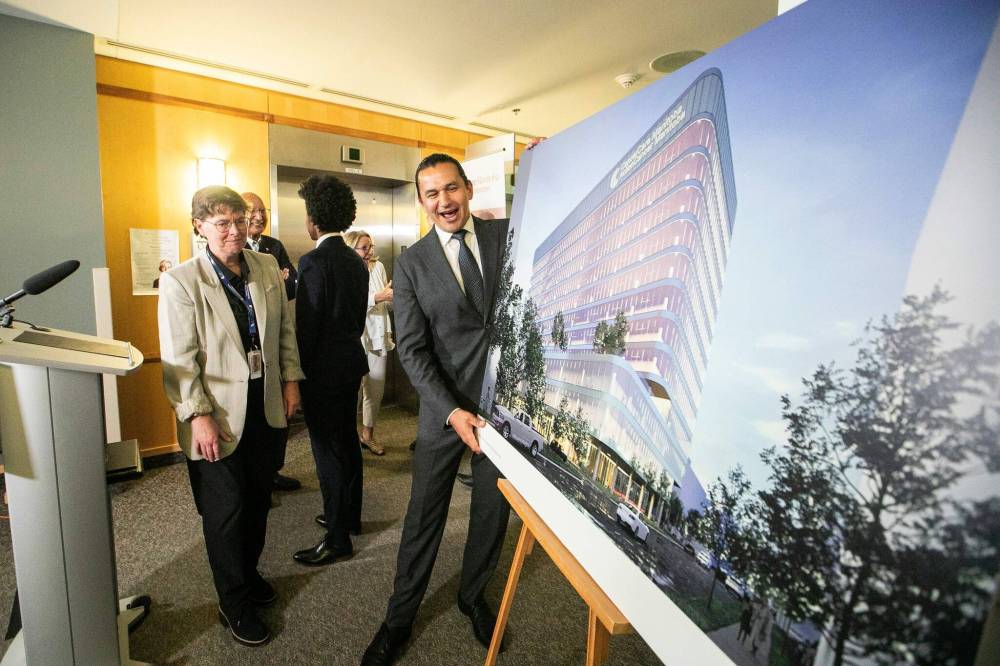
MIKAELA MACKENZIE / WINNIPEG FREE PRESS
                                Premier Wab Kinew, at an announcement at CancerCare on Monday, said the province will use tobacco company settlement funds to support the project

MIKAELA MACKENZIE / WINNIPEG FREE PRESS

Premier Wab Kinew, at an announcement at CancerCare on Monday, said the province will use tobacco company settlement funds to support the project

Dr. Dhali Dhaliwal, past president and the former chief executive officer of CancerCare Manitoba, echoed those comments.

Dhaliwal oversaw CancerCare between 2003 and 2013 — a period during which he said he was often troubled by a shortage of space. He recalled being asked to approve the conversion of two toilets into offices shortly after he first accepted the job.

A “relentless increase” in patient demand and the associated workload was met by “every creative means possible,” he said, noting that services were fragmented because they had to rent external space.

The NDP pledged to revive the CancerCare expansion during the 2023 election campaign; Dhaliwal endorsed that pledge on the campaign trail.

Kinew said the province will use tobacco company settlement funds to support the project. Earlier this year, he said Manitoba was anticipating $1 billion from a class-action lawsuit.

“We’re going to invest every single dollar in curing cancer, in fighting cancer and supporting cancer patients every step of the way,” Kinew said.

He did not provide an update on that lump sum payment on Monday.

Budget 2025 included a $11.5 million commitment to complete the design work for the second CancerCare site. A request for proposal recently closed.

“This project is too important to become another empty promise,” PC health critic Kathleen Cook said in a statement Monday.
MIKAELA MACKENZIE / WINNIPEG FREE PRESS
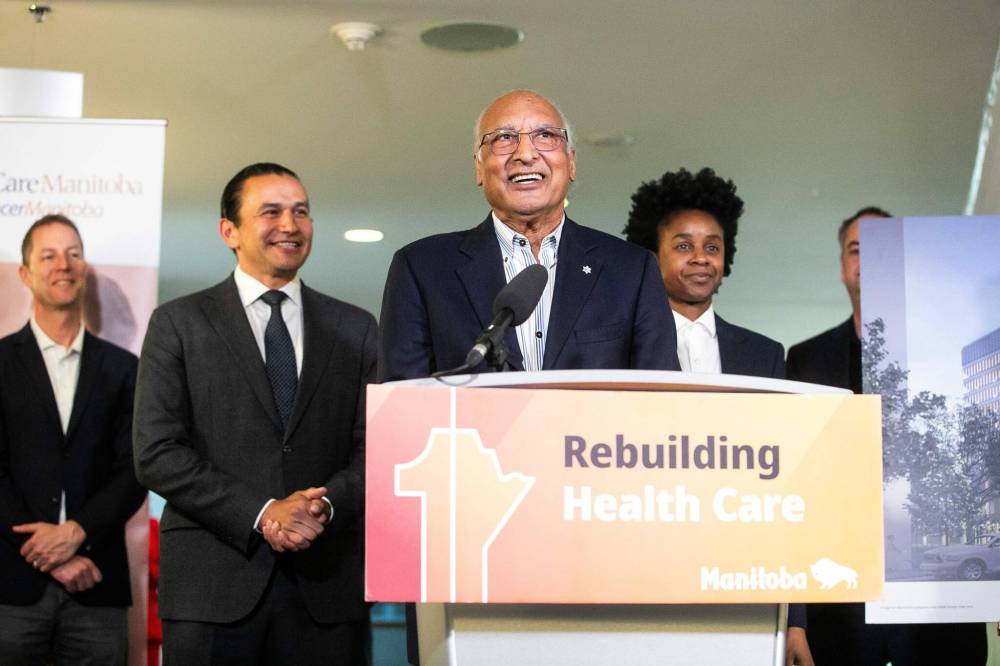
                                Dr. Dhali Dhaliwal, past president and CEO of CancerCare Manitoba, oversaw CancerCare between 2003 and 2013 — a period during which he said he was often troubled by a shortage of space.

MIKAELA MACKENZIE / WINNIPEG FREE PRESS

Dr. Dhali Dhaliwal, past president and CEO of CancerCare Manitoba, oversaw CancerCare between 2003 and 2013 — a period during which he said he was often troubled by a shortage of space.

The MLA for Roblin accused the premier and health minister of a pattern of overpromising and underdelivering.

Cook cited the NDP’s plan to perform 800 hip and knee replacement surgeries annually at the Selkirk Hospital as an example.

A total of 79 procedures were completed between March 12 and May 4.

The 2025 launch of the Selkirk program, which involved adding staff and expanding operating space, was delayed; it was supposed to start in January.

— with files from Massimo De Luca-Taronno

maggie.macintosh@freepress.mb.ca

Maggie Macintosh

Maggie Macintosh
Reporter

Maggie Macintosh reports on education for the Winnipeg Free Press. Funding for the Free Press education reporter comes from the Government of Canada through the Local Journalism Initiative.

Our newsroom depends on a growing audience of readers to power our journalism. If you are not a paid reader, please consider becoming a subscriber.

Our newsroom depends on its audience of readers to power our journalism. Thank you for your support.

History

Updated on Monday, June 9, 2025 6:32 PM CDT: Updates throughout with details, comments, new headline, adds deck and fresh photos.


Report Error Submit a Tip

More Stories

New CancerCare facility could cost $1B to treat, study disease

Maggie Macintosh 4 minute read Preview

New CancerCare facility could cost $1B to treat, study disease

Maggie Macintosh 4 minute read Monday, Jun. 9, 2025

Manitoba’s premier is prepared to spend $1 billion to open a new CancerCare site that his government says will attract “world-class” physicians and researchers to Winnipeg.

Premier Wab Kinew was joined by Health Minister Uzoma Asagwara and physicians to announce the next steps to expand cancer research and patient care in the province on Monday.

Kinew confirmed that a site that is kitty-corner to CancerCare headquarters at 675 McDermot Ave. — where he made the announcement — will host the second facility.

Few specifics were provided, although the premier said $815 million is the preliminary estimate to complete the construction project.

Read
Monday, Jun. 9, 2025

Bob Saget, beloved TV dad of 'Full House,' dead at 65

Lynn Elber, The Associated Press 6 minute read Preview

Bob Saget, beloved TV dad of 'Full House,' dead at 65

Lynn Elber, The Associated Press 6 minute read Monday, Jan. 10, 2022

LOS ANGELES (AP) — Bob Saget, the actor-comedian known for his role as beloved single dad Danny Tanner on the sitcom “Full House” and as the wisecracking host of “America’s Funniest Home Videos,” died while on a stand-up tour. He was 65.

Deputies in Orange County, Florida, were called Sunday about an “unresponsive man” in a hotel room at the Ritz-Carlton in Orlando and found Saget dead, according to a sheriff’s statement on Twitter. Detectives found “no signs of foul play or drug use in this case.”

Saget was in Florida as part of his “I Don't Do Negative Comedy Tour.” After warm audience receptions to his gigs Friday in Orlando and Saturday in the Ponte Vedra Beach resort area, he celebrated online.

“I’m back in comedy like I was when I was 26. I guess I’m finding my new voice and loving every moment of it,” he posted Saturday on Instagram.

Read
Monday, Jan. 10, 2022

Canada tops Dominican Republic in pre-qualifier

Jason Hills, The Canadian Press 4 minute read Preview

Canada tops Dominican Republic in pre-qualifier

Jason Hills, The Canadian Press 4 minute read Sunday, Nov. 17, 2019

EDMONTON - Canada's women's basketball team put its depth on display Sunday in a dominant 110-60 victory over the Dominican Republic in the final game of the FIBA Olympic pre-qualifying tournament.

All 12 players hit the scoresheet, including six in double digits, to help the Canadians finish 3-0 at the tournament and advance to the next Olympic qualifier in February.

Sami Hill led the way with 16 points, three rebounds, two assists and three steals, while 20-year-old Shaina Pellington recorded 14 points. Bridget Carleton and Jamie Scott had 13 points each and Ruth Hamblin had 11 points and five rebounds.

"We got to roll our whole lineups through, and it was fun when we got going," said Canada's coach Lisa Thomaidis. "It was nice to see different lineup contributing and building chemistry.

Read
Sunday, Nov. 17, 2019

RRC Polytech program cuts take bite out of hospitality, tourism sector

Maggie Macintosh 4 minute read Preview

RRC Polytech program cuts take bite out of hospitality, tourism sector

Maggie Macintosh 4 minute read Saturday, May. 2, 2026

Manitoba’s tourism industry is bracing for the disappearance of hospitality training programs — once-popular courses among international students.

Citing budgetary challenges related to a shift in federal immigration policy, Red River College Polytechnic is scrapping 11 programs and scaling back three others in 2026-27. Its hospitality business management diploma is one of seven permanent casualties.

The announcement, while unsurprising, is but the latest blow to a sector trying to “build back the workforce” in the wake of the COVID-19 pandemic, said Michael Juce, president of the Manitoba Hotel Association.

“Are people going to go outside of Manitoba for training? And if they leave, are they going to come back?” Juce said, adding that rural hotels in particular are already grappling with staffing shortages.

Read
Saturday, May. 2, 2026

Has the political wind changed?

Gwynne Dyer 5 minute read Yesterday at 2:01 AM CDT

It has been quite a week. First we had “Lula” – Luiz Inácio da Silva (as nobody but his mother ever called him) – defying everybody’s expectations. After winding up two million votes behind his challenger, Flávio Bolsonaro, in the first round of the Brazilian presidential election, he made a “miraculous” comeback in the second.

It was like a man going into a revolving door behind you and coming out in front. At the end of the first round, Lula was two million votes behind; at the end of the second round on Oct. 25 he was four million votes ahead. So how did he win a fourth term without cheating?

That’s what Bolsonaro claims he did, having fled to the United States; Trump, Flávio’s mentor, hints at the same. But Lula’s victory was not miraculous. He only learned to read when he was 10, and at 80 he still refused to have a mobile phone. His team finally made him get one and use it.

He wouldn’t do social media videos, so they created a WhatsApp channel called Lula’s Army, and made him appear on it at least daily. The channel went from zero to 10.8 million viewers in two weeks, and Lula won.

Imperialist crusades: 21st-century style

John R. Wiens 5 minute read Preview

Imperialist crusades: 21st-century style

John R. Wiens 5 minute read Wednesday, Jul. 8, 2026

In the 11th century and lasting into the 13th, the papacy launched a series of at least eight military campaigns we now refer to as the Crusades, or Holy Wars. They were an imperialistic call to arms for Christians to retake Jerusalem, which was at the time under Muslim rule.

Spiritual rewards for participation were implied, and other incentives offered, to dull the extra taxation demanded to fund the campaigns. Over time, the “crusades” morphed to become massacres of not only Muslims but also Jews and Christian dissidents — in other words, any enemies of the papacy. If today’s news sounds like déjà vu all over again, it probably should.

The stories keep repeating themselves in many forms. We now know that two 20th century world wars, global in scope, were caused by imperialistic ambitions, changes in the balance of international powers and corresponding arms races. The first was attributed to the assassination of the heir to the Austro-Hungarian throne by a Bosnian Serb, a kind of “regime change” initiative. The second resulted from rising tensions between Allied and Axis powers, triggered by the rise of European fascism and Japanese militarism. The human toll of both was unimaginable.

In the First World War, 15 to 22 million people, including soldiers and civilians, were killed and another 23 million were wounded. These numbers do not account for those otherwise affected — victims of chemical warfare whose compromised health shortened their lives; of the subsequent Spanish flu epidemic amplified by the displacement of peoples; others who died from other diseases caused by war conditions; and those who were malnourished or starved. Nor do they account for the ongoing trauma and resentments passed on intergenerationally to this day.

Read
Wednesday, Jul. 8, 2026