Canada commits $800 million to support Indigenous-led conservation projects

Advertisement

Advertise with us

MONTREAL - Ottawa will spend up to $800 million to support four major Indigenous-led conservation projects across the country covering nearly one million square kilometres of land and water, Prime Minister Justin Trudeau announced Wednesday.

Read this article for free:


By clicking the button above, an account will be created and you will begin to receive some of our recommended newsletters. You may opt out of any newsletter by visiting your Email and Communication Preferences page or by clicking "unsubscribe" at the bottom of any email.

or

Already have an account? Log in here »

To continue reading, please subscribe:

Digital Subscription

One year of digital access for only $1.44 a week*

  • Enjoy unlimited reading on winnipegfreepress.com
  • Read the E-Edition, our digital replica newspaper
  • Access News Break, our award-winning app
  • Play interactive puzzles

*Billed as $5.77 plus GST every four weeks. After 52 weeks, price increases to the regular rate of $19.95 plus GST every four weeks. Offer available to new and qualified returning subscribers only. Cancel any time.

To continue reading, please subscribe:

Add Free Press access to your Brandon Sun subscription for only an additional

$1 for the first 4 weeks*

  • Enjoy unlimited reading on winnipegfreepress.com
  • Read the E-Edition, our digital replica newspaper
  • Access News Break, our award-winning app
  • Play interactive puzzles
Start now

*Your next Brandon Sun subscription payment will increase by $1.00 and you will be charged $17.95 plus GST for four weeks. After four weeks, your payment will increase to $24.95 plus GST every four weeks.

Hey there, time traveller!
This article was published 07/12/2022 (1429 days ago), so information in it may no longer be current.

MONTREAL – Ottawa will spend up to $800 million to support four major Indigenous-led conservation projects across the country covering nearly one million square kilometres of land and water, Prime Minister Justin Trudeau announced Wednesday.

Trudeau made the announcement at the Biosphere environment museum in Montreal accompanied by Indigenous leaders and federal Environment Minister Steven Guilbeault as a UN meeting on global biodiversity, known as COP15, takes place in the city.

Trudeau said the four projects — which will be located in British Columbia, the Northwest Territories, northern Ontario and Nunavut — will be developed in partnership with the communities in question.
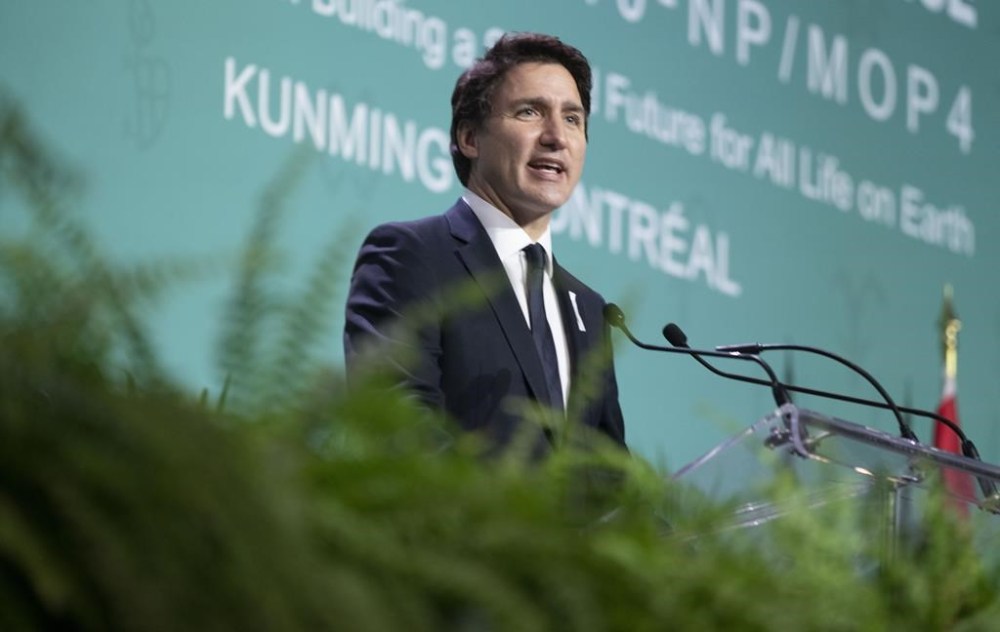
Prime Minister Justin Trudeau delivers remarks during the opening ceremony of the COP15 UN conference on biodiversity in Montreal on Tuesday, December 6, 2022. THE CANADIAN PRESS/Paul Chiasson

“Each of these projects is different, because each of these projects is being designed by communities, for communities,” he said.

Chief Jackson Lafferty, of the Tlicho government in the Northwest Territories, said Indigenous groups have long been working to protect their lands and water but have lacked resources and tools to fully do so.

Lafferty, who attended the announcement, called the funding “a significant step forward on a path to reconciliation across Canada.”

Among the projects to be funded is a marine conservation and sustainability initiative in the Great Bear Sea along British Columbia’s north coast, championed by 17 First Nations in the area.

Another project includes protection for boreal forests, rivers and lands across the Northwest Territories, spearheaded by 30 Indigenous governments.

Funds will also go to an Inuit-led project involving waters and land in Nunavut’s Qikiqtani region and to a project in western James Bay to protect the world’s third largest wetland, led by the Omushkego Cree in Ontario.

Trudeau told reporters that the exact details of the agreements have yet to be worked out — including which portions of the lands will be shielded from resource extraction.

The Indigenous partners, he said, will be able to decide which lands need to be completely protected and where there can be “responsible, targeted development.”

“We know we need jobs, we know we need protected areas, we know we need economic development,” he said. “And nobody knows that, and the importance of that balance, better than Indigenous communities themselves that have been left out of this equation, not just in Canada but around the world, for too long.”

Dallas Smith, president of Nanwakolas Council, said the B.C. funding to help protect the Great Bear Sea would allow Indigenous groups to build on previous agreements to protect the terrestrial lands of Great Bear Rainforest, which were announced about 15 years ago.
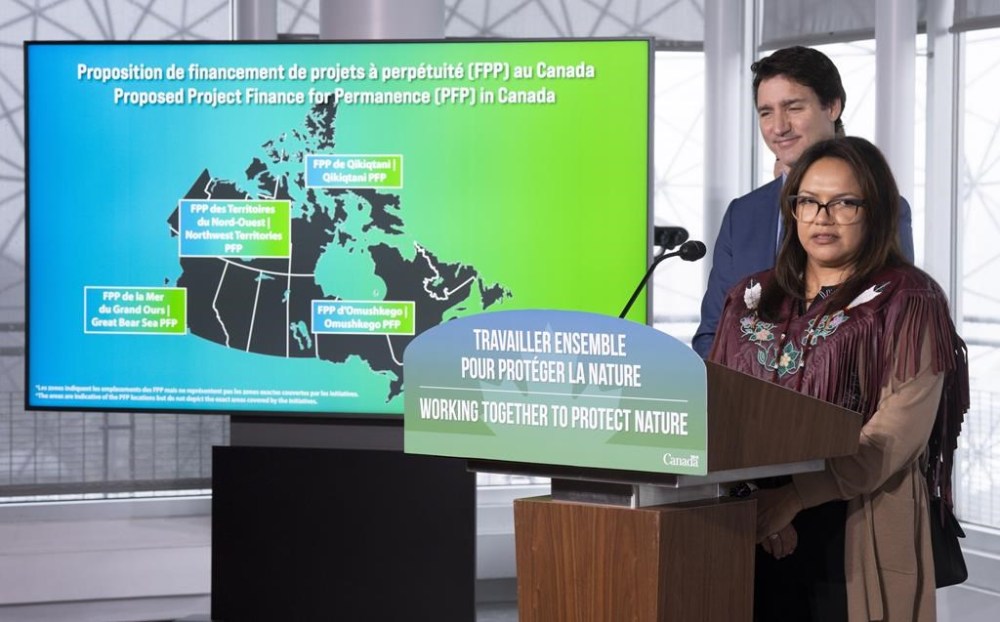
Grand Chief Alison Linklater delivers remarks as Prime Minister Justin Trudeau looks on during a news conference in Montreal on Wednesday, December 7, 2022. THE CANADIAN PRESS/Paul Chiasson

“I did media all over the world, and I got home and my elder said, ‘Don’t sprain your arm patting yourself on the back, because until you do the marine component, it doesn’t mean anything,'” he said.

Grand Chief Alison Linklater of the Mushkegowuk Council, which represents seven Cree communities in northern Ontario, said their traditional territory includes ancient peatlands that store “billions of tons” of carbon, as well as wetlands that are home to many migratory birds and fish, and 1,200 kilometres of coastline.

She said caring for the lands is one of her sacred duties as grand chief and one of the main concerns of the people she represents.

“Without our lands and waters we do not exist,” she told the news conference.

In a statement, the federal government said the program would employ a “unique funding model” bringing together government, Indigenous Peoples, philanthropic partners and other investors to secure long-term financing for community-led conservation projects.

The government did not specify how much of the funding would be allocated for each project.

This report by The Canadian Press was first published Dec. 7, 2022.
Report Error Submit a Tip

More Stories

Trump has a tough 2 years ahead of him

Peter McKenna 5 minute read 2:00 AM EST

Tuesday was definitely not a good night for the Republican Party.

But it was an especially painful night for U.S. President Donald Trump, who has now lost control of both chambers of Congress. Without sufficient numbers of Republicans in the U.S. House of Representatives and the Senate, he can no longer dictate the terms for his legislative agenda.

More significantly, the Trump administration will effectively lose congressional control over the “power of the purse.” In a divided U.S. government, it is much harder for the executive branch to secure funding for its various programs, departments and agencies — along with discretionary policy initiatives, tax measures and supplemental wartime requests.

On the positive side, divided government can lead to greater oversight or scrutiny by the legislative branch over the executive — or vice versa. These checks and balances are integral to the U.S. democratic process and can incentivize both branches of government to find compromises.

Fact Check

1 minute read Thursday, Nov. 30, 2023

Fact Check

Having problems with the form?Contact Us Directly |

Ready to launch: Inside the massive undertaking to revitalize the beloved Nonsuch replica

Jill Wilson  35 minute read Preview

Ready to launch: Inside the massive undertaking to revitalize the beloved Nonsuch replica

Jill Wilson  35 minute read Monday, Jun. 4, 2018

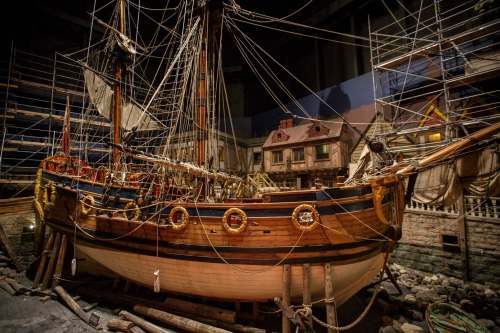
For 44 years, the Nonsuch has been enchanting visitors to the Manitoba Museum, bringing a whiff of adventure and the romance of the sea to our landlocked city.The jewel in the crown of the Hudson’s Bay Company Museum Collection, the replica of the 17th-century fur-trading ship takes those who board her back in time.

Decades’ worth of schoolchildren have clutched the rails at the side of the rickety gangway that leads you onboard and descended the narrow stairs — backwards, please, for safety! — into the fo’c’sle, where they could marvel at the tiny bunks — how short men were back then — and peer out the round portholes, imagining them being lashed by salt spray as you crossed the Atlantic Ocean on a grand adventure to find a new trade route for England.

Few of us on long-ago field trips ever stopped to think about why this Prairie city was honouring a British ship that never actually visited Manitoba — let alone why we had built an entire museum wing around a replica that, while it sailed more than 14,000 kilometres in European, Canadian and American waters, was hauled into Winnipeg in pieces.

As the first phase of its $17.5-million Bringing Our Stories Forward capital campaign, the museum has spent about three years planning its refurbishment of the Nonsuch exhibit, which has remained largely untouched since it was installed in 1974, in part to better tell that story.

Read
Monday, Jun. 4, 2018

Shifting line on COVID-19 statistics

Larry Kusch 5 minute read Preview

Shifting line on COVID-19 statistics

Larry Kusch 5 minute read Friday, Aug. 7, 2020

Last week, Saskatchewan Premier Scott Moe provided residents of his province with the kind of detailed coronavirus pandemic information rarely seen in neighbouring Manitoba.

Concerned by the rapid spread of COVID-19 in Saskatchewan Hutterite colonies, Moe served up some cold facts July 29: of the 322 active cases in the province that day, 244 were from colonies. In an update the following day, Saskatchewan officials backed away from specifically mentioning Hutterite colonies, instead citing infection totals for "multiple communal living settings."

Manitoba has also seen a recent spike in Hutterite case counts, but its residents have received scant information from their provincial government.

For a time, the province did refer to certain cases as being linked to Hutterite colonies, but quickly stopped when it received blowback from the communities for being singled out. The public can now only guess the actual numbers based on regional health authority counts.

Read
Friday, Aug. 7, 2020

Concert hall under fire: Indigenous teacher alleges racial profiling

Maggie Macintosh 5 minute read Preview

Concert hall under fire: Indigenous teacher alleges racial profiling

Maggie Macintosh 5 minute read 3:11 PM EST

An Anishinaabe teacher is calling for a formal apology saying she was singled out by security officers and repeatedly demanded to show ID at a school event hosted at the Centennial Concert Hall.

Seven Oaks School Division administration has requested a meeting with management of the downtown venue to discuss allegations of racial profiling reported by the teacher and a colleague who witnessed security guards confront her.

“I didn’t blend in, in their eyes. I didn’t fit their vision of what a professional teacher looks like,” Pamela Morrison told the Free Press about the moments that left her feeling “dumbfounded” and “othered” upon arriving at the concert hall Tuesday.

Hundreds of Seven Oaks teachers gathered in downtown Winnipeg that morning for the division’s annual professional development conference.

Read
3:11 PM EST

4/20 party organizers lose their mellow

Solomon Israel 4 minute read Preview

4/20 party organizers lose their mellow

Solomon Israel 4 minute read Thursday, Apr. 18, 2019

The organizing committee behind the subdued 4/20 cannabis celebration expected at the Manitoba Legislative Building this Saturday has been torn apart by internal political rifts over the past year, as former participants accuse head organizer Steven Stairs of embezzling money meant to fund the event — allegations Stairs vigorously denies.

Tracey Cecchini, who identified herself to the Free Press as a member of the Winnipeg 420 Organizing Committee, said other committee members and event sponsors "all pitched in money" to help fund the event last year.

"Unfortunately the money was never put into the treasury, the money was mishandled," said Cecchini.

"He was using it to throw parties at his house, he was paying his rent, he wasn't putting it back into the 420 (Organizing Committee) for our permits, and (for) what we were going to do for this year."

Read
Thursday, Apr. 18, 2019