Alberta not proceeding with Premier Smith’s bill to protect COVID-19 unvaccinated

Advertisement

Advertise with us

EDMONTON - Alberta Premier Danielle Smith is reversing a promise to enshrine human rights protections for the COVID-19 unvaccinated in law this fall.

Read this article for free:


By clicking the button above, an account will be created and you will begin to receive some of our recommended newsletters. You may opt out of any newsletter by visiting your Email and Communication Preferences page or by clicking "unsubscribe" at the bottom of any email.

or

Already have an account? Log in here »

To continue reading, please subscribe:

Digital Subscription

One year of digital access for only $1.44 a week*

  • Enjoy unlimited reading on winnipegfreepress.com
  • Read the E-Edition, our digital replica newspaper
  • Access News Break, our award-winning app
  • Play interactive puzzles

*Billed as $5.77 plus GST every four weeks. After 52 weeks, price increases to the regular rate of $19.95 plus GST every four weeks. Offer available to new and qualified returning subscribers only. Cancel any time.

To continue reading, please subscribe:

Add Free Press access to your Brandon Sun subscription for only an additional

$1 for the first 4 weeks*

  • Enjoy unlimited reading on winnipegfreepress.com
  • Read the E-Edition, our digital replica newspaper
  • Access News Break, our award-winning app
  • Play interactive puzzles
Start now

*Your next Brandon Sun subscription payment will increase by $1.00 and you will be charged $17.95 plus GST for four weeks. After four weeks, your payment will increase to $24.95 plus GST every four weeks.

Hey there, time traveller!
This article was published 28/11/2022 (1433 days ago), so information in it may no longer be current.

EDMONTON – Alberta Premier Danielle Smith is reversing a promise to enshrine human rights protections for the COVID-19 unvaccinated in law this fall.

Instead, Smith said she is phoning up organizations with vaccine mandates to urge them to change their minds, tying it to government funding if need be.

Smith is also asking Albertans to call her government to report on those imposing vaccine mandates.
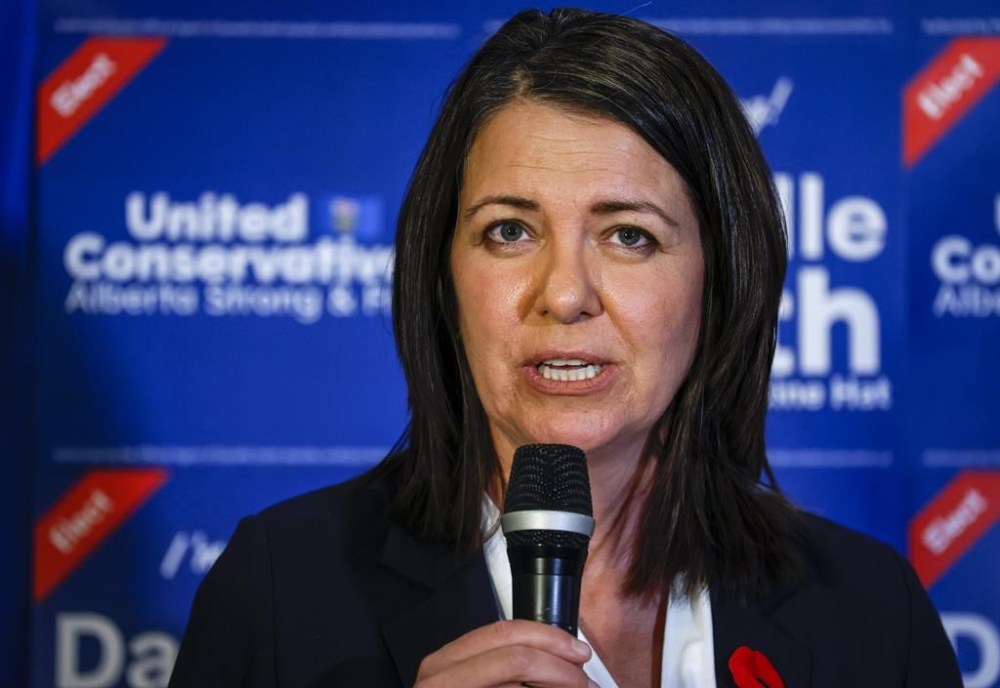
United Conservative Party Leader and Premier Danielle Smith celebrates her win in a byelection in Medicine Hat, Alta., Tuesday, Nov. 8, 2022.THE CANADIAN PRESS/Jeff McIntosh

“I’m calling people,” Smith told reporters Monday.

“The Arctic Winter Games wanted $1.2 million from us to support their effort and they were discriminating against the athletes, telling them they had to be vaccinated.

“So we asked them if they would reconsider their vaccination policy in the light of new evidence and they did. And I was pleased to see that.”

Smith said she heard an Alberta film production has a similar policy for its hairdressers, so she has directed a cabinet minister to call the company to urge it to reconsider.

“I’m quite prepared to make those phone calls and have my (cabinet) ministers make those phone calls if there are other examples,” Smith said.

“If there is still discrimination, I’d like to know about it … people should contact their MLAs.”

Opposition NDP justice critic Irfan Sabir denounced the phone calls as intimidation tactics in the service of an anti-science United Conservative government.

“If you believe in science, if you believe in public health measures, your funding will be cut, you will be discriminated against,” said Sabir.

“That is clear cut intimidation and harassment.”

The legislature is scheduled to resume Tuesday for the fall sitting, but Smith said the agenda will not include her promised bill to amend the provincial Human Rights Act to forbid restrictions based on someone’s COVID-19 vaccination status.

Smith won the leadership of the United Conservatives mainly by leveraging anger within a faction of the party over COVID-19 vaccine mandates and health restrictions that they deemed unnecessary and a profound breach of personal freedoms.

On her first day as premier last month, Smith called the COVID-19 unvaccinated the most discriminated group she had seen in her lifetime.

On Monday, she said she has revisited the human rights issue and believes the problem has become somewhat moot with most employers not having vaccine rules.

And she said rather than be hasty, she wants a more detailed analysis in order to find more durable, broader, long-term solutions and protections later.

“Just making this one change to this one piece of legislation isn’t going to be adequate,” she said.

“(I) didn’t want to do this as a bit of slapdash measure. I want to make sure we’re solving this problem for the future.

“I think my supporters will understand.”

As recently as five weeks ago, Smith said the human rights change needed to be passed immediately, characterizing it as a stand-alone symbolic line in the sand tantamount to an Alberta declaration of freedom.

In an Oct. 20 speech to the Edmonton Chamber of Commerce, Smith told the audience the bill was coming this fall whether they liked it or not.

“I want to give you fair warning: we are going to be making a serious pivot,” Smith told the chamber luncheon.

“We want to send a message to the community, and to the world community, and to the investment markets that this is a place that is open for business, that this is a place that believes in freedom, this is a place that believes in free enterprise and this is a place where we’re not going to be making arbitrary decisions that are going to disproportionately impact small and medium businesses.”

The first bill in the sitting is to be Smith’s long-promised, controversial Alberta sovereignty act, since renamed the “Alberta sovereignty within a united Canada act.”

Smith has promised the legislation would allow the province to reject federal laws deemed as encroaching on provincial jurisdiction but in a constitutionally respectful manner. Smith has not explained how this would be done.

Legal experts have said such an act as described would be unconstitutional.

This report by The Canadian Press was first published Nov. 28, 2022.

Report Error Submit a Tip

More Stories

Court ruling concludes Canadian Wheat Board saga

Laura Rance-Unger 4 minute read Preview

Court ruling concludes Canadian Wheat Board saga

Laura Rance-Unger 4 minute read 2:01 AM CDT

It remains to be seen whether the recent court ruling in a lawsuit filed after Canadian Wheat Board’s dissolution in 2012 puts the whole debate to rest, as some no doubt hope.

But either way, the dust has settled on the post-CWB world. The sun still rises and a new generation of farmers on the land only knows by name an institution that for generations influenced every aspect of Prairie grain farming.

The first Rural Revival column I wrote for this newspaper more than 30 years ago was about a thousand farmers from Western Canada demonstrating in support of the Wheat Board. It was in the aftermath of the Western Grain Marketing Panel report, one of several efforts that eventually included a plebiscite to help the federal government decide what to do about a vocal minority of farmers who wanted marketing “freedom.”

The polls at the time suggested about two-thirds of farmers were comfortable enough with the single-desk system for food wheat and barley to keep it around. It served as a counterbalance to canola, which they sold on the open market. They essentially had a dual market.

Read
2:01 AM CDT

SNC planned U.S. move if no deal: documents

Jordan Press and Christopher Reynolds, The Canadian Press 5 minute read Preview

SNC planned U.S. move if no deal: documents

Jordan Press and Christopher Reynolds, The Canadian Press 5 minute read Thursday, Mar. 28, 2019

OTTAWA - SNC-Lavalin warned federal prosecutors last fall about a possible plan to split the company in two, move its offices to the United States and eliminate its Canadian workforce if it didn't get a deal to avoid criminal prosecution, newly obtained documents show.

The documents, part of a PowerPoint presentation obtained by The Canadian Press, describe something called "Plan B" — what Montreal-based SNC might have to do if it can't convince the government to grant a so-called remediation agreement to avoid criminal proceedings in a fraud and corruption case related to projects in Libya.

Under that plan, SNC would move its Montreal headquarters and corporate offices in Ontario and Quebec to the U.S. within a year, cutting its workforce to just 3,500 from 8,717, before eventually winding up its Canadian operations.

“The government of Canada needs to weigh the public interest impact of the prosecution of SNC-Lavalin," the presentation reads.

Read
Thursday, Mar. 28, 2019

Olympics Overnight: Speedskater Blondin wins silver in the mass start, Bowman narrowly misses podium in halfpipe skiing, Jamaica returns to bobsled track

Richie Assaly - Toronto Star, Toronto Star 6 minute read Preview

Olympics Overnight: Speedskater Blondin wins silver in the mass start, Bowman narrowly misses podium in halfpipe skiing, Jamaica returns to bobsled track

Richie Assaly - Toronto Star, Toronto Star 6 minute read Saturday, Feb. 19, 2022

Here’s what you missed overnight at Day 15 of the 2022 Beijing Olympics.

Read
Saturday, Feb. 19, 2022

Letters, Oct. 31

6 minute read 2:01 AM CDT

Civic election a missed opportunity

The outcome of the latest municipal election in Winnipeg is nothing short of baffling. The decline of what was once a proud, beautiful prairie hub is impossible to ignore.

Winnipeg is rapidly sliding into a state of structural and social dilapidation, yet voters have inexplicably chosen to hand incumbent Mayor Scott Gillingham a second term. The decision smells of complacency, and sadly, it represents a massive missed opportunity for real urban renewal.

Walking through downtown Winnipeg today is an exercise in heartbreak. A city centre that should be a bustling economic and cultural core has instead transformed into an absolute eyesore. Encampments and tents are permitted to dot the heart of the city. Streets that used to thrive are now dominated by the tragic, visible reality of severe addiction, with individuals wandering and staggering through public spaces without adequate intervention or care.

Submit a news tip

1 minute read Monday, Mar. 16, 2026

Submit a news tip

The new normal in Canadian politics

David McLaughlin 5 minute read Preview

The new normal in Canadian politics

David McLaughlin 5 minute read 2:01 AM CDT

“Nothing happening, all at once.”

Welcome to the new normal of Canadian politics, where normality is the new normal. Routine and stable are in; disruptive and excessive are out. Exhibits A and B are the Alberta referendum and the British Columbia election. Voters opted for stability over volatility.

The opposite of being normal is being different from the norm. In politics that means different from where we’ve been and what we’ve come to expect. Two competing trends have dominated our politics for the past decade and a half — progressivism and populism. Think Justin Trudeau and liberal, progressive identity politics in Canada, and Donald Trump and conservative, populist MAGA politics in America. We are now experiencing a swing away from both those trends.

Representing this “new normal” are Prime Minister Mark Carney, for one, and newly elected British Columbia premier, Lorne Doerksen, for another. Both are considered normal because they talk and act like adults in a childish political world. Their political flair is to not have any political flair. They stand out for not standing out.

Read
2:01 AM CDT