WEATHER ALERT

Rainbow struggle playing out on sidelines of World Cup

Advertisement

Advertise with us

DOHA, Qatar (AP) — Aside from the competition for the World Cup title, one of the most hotly contested issues in the tournament in Qatar is over rainbow colors.

Read this article for free:


By clicking the button above, an account will be created and you will begin to receive some of our recommended newsletters. You may opt out of any newsletter by visiting your Email and Communication Preferences page or by clicking "unsubscribe" at the bottom of any email.

or

Already have an account? Log in here »

To continue reading, please subscribe:

Digital Subscription

One year of digital access for only $1.44 a week*

  • Enjoy unlimited reading on winnipegfreepress.com
  • Read the E-Edition, our digital replica newspaper
  • Access News Break, our award-winning app
  • Play interactive puzzles

*Billed as $5.77 plus GST every four weeks. After 52 weeks, price increases to the regular rate of $19.95 plus GST every four weeks. Offer available to new and qualified returning subscribers only. Cancel any time.

To continue reading, please subscribe:

Add Free Press access to your Brandon Sun subscription for only an additional

$1 for the first 4 weeks*

  • Enjoy unlimited reading on winnipegfreepress.com
  • Read the E-Edition, our digital replica newspaper
  • Access News Break, our award-winning app
  • Play interactive puzzles
Start now

*Your next Brandon Sun subscription payment will increase by $1.00 and you will be charged $17.95 plus GST for four weeks. After four weeks, your payment will increase to $24.95 plus GST every four weeks.

Hey there, time traveller!
This article was published 25/11/2022 (1438 days ago), so information in it may no longer be current.

DOHA, Qatar (AP) — Aside from the competition for the World Cup title, one of the most hotly contested issues in the tournament in Qatar is over rainbow colors.

In the first week of the tournament, seven European teams lost the battle to wear multi-colored “One Love” armbands during World Cup matches and some fans complained they weren’t allowed to bring items with rainbow colors, a symbol of LGBTQ rights, into the stadiums of the conservative Islamic emirate.

Qatar, where gay sex is illegal, faced intense international scrutiny and criticism in the run-up to the tournament over rights issues, including questions on whether LGBTQ visitors would feel safe and welcome. The Gulf nation has said all are welcome, including LGBTQ fans, and that it would ensure safety for everyone, regardless of background, but that visitors should respect the nation’s culture.

Piara Powar, executive director of Fare, the anti-discrimination group that is reporting incidents in and around stadiums to world soccer body FIFA, said he believes the Qatari hosts felt that the debate about LGBTQ rights has been given too much space and that they need to clamp down internally.

“We have talked to them about rainbow flags and the symbolism that it has across the world, not just in western Europe. There are Latin Americans who recognize that, there are Asians who recognize the Pride flag,” Powar said.

Just before the tournament started, FIFA stopped plans by seven European teams including England and Germany to have their captains play with “One Love” anti-discrimination armbands, saying they would receive yellow cards if they did. The decision sparked outrage by some in the countries involved.

One of the teams, Belgium, tweeted a team photo Friday showing captain Eden Hazard wearing the “One Love” armband. The country’s foreign minister, Hadja Lahbib, wore it as she watched Belgium’s World Cup opener against Canada on Wednesday.

Former Danish Prime Minister Helle Thorning-Schmidt turned up at Denmark’s match against Tunisia wearing an outfit with rainbow-colored sleeves. In an Instagram post a day later, she appeared conflicted about the choice of clothing.

“I’ve been reflecting on whether showing up in rainbow colors is actually helping gay and queer folks in Qatar,” Thorning-Schmidt wrote in the post. She wondered whether it could “make things worse by hardening the Qatar government against them? I don’t know the answer but doesn’t it show us that nothing is binary, only good or only bad?”

Some fans have said that they were asked to remove and discard their rainbow hats at a World Cup stadium earlier this week despite assurances by FIFA before the tournament that such items would be allowed in stadiums.

Justin Martin, a U.S. citizen living in Qatar, said he was holding a small rainbow flag on the metro on his way to the U.S. opener against Wales when two people wearing shirts that identified them as volunteers asked him to put the flag away. He didn’t want to.

“One of them became agitated and … referred to me as ‘disgusting,’” said Martin, an associate professor of journalism at the Doha Institute for Graduate Studies.

At the stadium, however, a woman in Qatari police uniform who was searching his bag found the rainbow flag, looked at it and put it back, he said. “I actually wasn’t prohibited from bringing that into the stadium.”

Martin said he had previously worn a pride T-shirt in Qatar to the grocery store or to exercise without any issues.

Some Wales fans said they were prevented from taking rainbow bucket hats to the game against the U.S., prompting the Wales soccer federation to raise the issue with FIFA, which assured them that rainbow symbols would be allowed for Friday’s game against Iran.

Laura McAllister, a former Wales captain who acts as ambassador to the World Cup, said she and other fans wore rainbow hats to Friday’s game without problems. She said she was among those asked to remove their hats before the earlier game with the U.S.

The Qatari World Cup organizing committee did not provide answers to questions by The Associated Press on the instructions to stadium security and volunteers about rainbow symbols.

In April, a Qatari official suggested that fans carrying rainbow flags could have them removed to protect them from possible attacks.

The issue has been debated frequently in Qatar and the wider Middle East, where many believe it’s only fair for visitors to respect the country’s laws, customs and religious beliefs, just like people from the region are expected to honor other nations’ rules when they travel. Others counter that rights’ issues are universal and that sports must be inclusive.

Ahead of the tournament, some LGBTQ rights activists sought to raise concerns about how LGBTQ people in Qatar may be treated after the World Cup ends. Some of them have also argued that international attention was disproportionately focused on the visitors and not enough on LGBTQ people in the country.

___

Associated Press writers Karl Ritter and Graham Dunbar contributed.

___

Associated Press religion coverage receives support through the AP’s collaboration with The Conversation US, with funding from Lilly Endowment Inc. The AP is solely responsible for this content.

Report Error Submit a Tip

The Free Press acknowledges the financial support it receives from members of the city’s faith community, which makes our coverage of religion possible.
More Stories

Canada tops Dominican Republic in pre-qualifier

Jason Hills, The Canadian Press 3 minute read Preview

Canada tops Dominican Republic in pre-qualifier

Jason Hills, The Canadian Press 3 minute read Sunday, Nov. 17, 2019

EDMONTON - Canada's women's basketball team put its depth on display Sunday in a dominant 110-60 victory over the Dominican Republic in the final game of the FIBA Olympic pre-qualifying tournament.

All 12 players hit the scoresheet, including six in double digits, to help the Canadians finish 3-0 at the tournament and advance to the next Olympic qualifier in February.

Sami Hill led the way with 16 points, three rebounds, two assists and three steals, while 20-year-old Shaina Pellington recorded 14 points. Bridget Carleton and Jamie Scott had 13 points each and Ruth Hamblin had 11 points and five rebounds.

"We got to roll our whole lineups through, and it was fun when we got going," said Canada's coach Lisa Thomaidis. "It was nice to see different lineup contributing and building chemistry.

Read
Sunday, Nov. 17, 2019

SNC planned U.S. move if no deal: documents

Jordan Press and Christopher Reynolds, The Canadian Press 5 minute read Preview

SNC planned U.S. move if no deal: documents

Jordan Press and Christopher Reynolds, The Canadian Press 5 minute read Thursday, Mar. 28, 2019

OTTAWA - SNC-Lavalin warned federal prosecutors last fall about a possible plan to split the company in two, move its offices to the United States and eliminate its Canadian workforce if it didn't get a deal to avoid criminal prosecution, newly obtained documents show.

The documents, part of a PowerPoint presentation obtained by The Canadian Press, describe something called "Plan B" — what Montreal-based SNC might have to do if it can't convince the government to grant a so-called remediation agreement to avoid criminal proceedings in a fraud and corruption case related to projects in Libya.

Under that plan, SNC would move its Montreal headquarters and corporate offices in Ontario and Quebec to the U.S. within a year, cutting its workforce to just 3,500 from 8,717, before eventually winding up its Canadian operations.

“The government of Canada needs to weigh the public interest impact of the prosecution of SNC-Lavalin," the presentation reads.

Read
Thursday, Mar. 28, 2019

Imperialist crusades: 21st-century style

John R. Wiens 5 minute read Preview

Imperialist crusades: 21st-century style

John R. Wiens 5 minute read Wednesday, Jul. 8, 2026

In the 11th century and lasting into the 13th, the papacy launched a series of at least eight military campaigns we now refer to as the Crusades, or Holy Wars. They were an imperialistic call to arms for Christians to retake Jerusalem, which was at the time under Muslim rule.

Spiritual rewards for participation were implied, and other incentives offered, to dull the extra taxation demanded to fund the campaigns. Over time, the “crusades” morphed to become massacres of not only Muslims but also Jews and Christian dissidents — in other words, any enemies of the papacy. If today’s news sounds like déjà vu all over again, it probably should.

The stories keep repeating themselves in many forms. We now know that two 20th century world wars, global in scope, were caused by imperialistic ambitions, changes in the balance of international powers and corresponding arms races. The first was attributed to the assassination of the heir to the Austro-Hungarian throne by a Bosnian Serb, a kind of “regime change” initiative. The second resulted from rising tensions between Allied and Axis powers, triggered by the rise of European fascism and Japanese militarism. The human toll of both was unimaginable.

In the First World War, 15 to 22 million people, including soldiers and civilians, were killed and another 23 million were wounded. These numbers do not account for those otherwise affected — victims of chemical warfare whose compromised health shortened their lives; of the subsequent Spanish flu epidemic amplified by the displacement of peoples; others who died from other diseases caused by war conditions; and those who were malnourished or starved. Nor do they account for the ongoing trauma and resentments passed on intergenerationally to this day.

Read
Wednesday, Jul. 8, 2026

Go with the snow

Eva Wasney 6 minute read Preview

Go with the snow

Eva Wasney 6 minute read Tuesday, Feb. 8, 2022

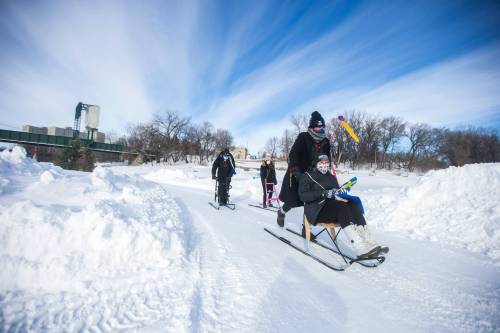
Wearing a dusty pink snowsuit and a face mask emblazoned with colourful Dala horses, Sonja Lundstrom is excited.

“This is going to be my 80th birthday present to myself,” she says, pointing to a nearby wooden kicksled poised for takeoff. “My grandma had one of these and my dad made me one out of hockey sticks for all my children… but these are the new modern ones and I haven’t had one of those.”

But today’s frosty jaunt is less of a test drive and more of a diplomatic adventure. Lundstrom is the president of the Swedish Cultural Association of Manitoba and is at The Forks to give Urban Ahlin, the Swedish Ambassador to Canada, a little taste of home.

“In my part of Sweden we use the (kicksleds) when we go out on the ice for ice fishing,” says Ahlin, who was in town recently with several other Nordic ambassadors to meet with the premier. “This is a very climate-friendly means of transportation and you can use it for lots of different reasons… it’s actually pretty fun to ride as well.”

Read
Tuesday, Feb. 8, 2022

Haunted houses aren’t the only places to find jump scares

Jen Zoratti 3 minute read Preview

Haunted houses aren’t the only places to find jump scares

Jen Zoratti 3 minute read Yesterday at 2:01 AM CDT

C’est l’Halloween, to quote the 1981 elementary school French class banger by Matt Maxwell, but you know what’s already plenty scary? Life.

We all have our personal haunted houses, so to speak, hence the popularity of the “a haunted house but it’s just…” meme that pops up every October. Sample: “a haunted house but it’s just a bunch of men telling you you’d be prettier if you smiled.”

In the spirit of the season, I thought I’d offer up a few jump scares of my own.

A haunted house but it’s just Gate E25

Read
Yesterday at 2:01 AM CDT

Say What?! Sports guys travel to new destination

Steve Lyons and Paul Wiecek 16 minute read Preview

Say What?! Sports guys travel to new destination

Steve Lyons and Paul Wiecek 16 minute read Thursday, Jan. 30, 2020

Say What?! is an email conversation between sports editor Steve Lyons and sports columnist Paul Wiecek. Look for us regularly but intermittently on the Free Press website.


Steve Lyons: Heya. How you doing? How’s 2020 treating you so far?

Few things to get us started:

Read
Thursday, Jan. 30, 2020