Prime Minister Justin Trudeau describes his choice to invoke the Emergencies Act

Advertisement

Advertise with us

OTTAWA - Prime Minister Justin Trudeau was the last witness to testify at the public inquiry into his Liberal government's decision to invoke the Emergencies Act to quell protests in Ottawa and at several Canada-U.S. border crossings last winter.

Read this article for free:


or

Already have an account? Log in here »

To continue reading, please subscribe:

Subscribe and receive a limited-edition Free Press branded hat or tote.

Digital Subscription

One year of digital access for only $205*

  • Enjoy unlimited reading on winnipegfreepress.com
  • Read the E-Edition, our digital replica newspaper
  • Access News Break, our award-winning app
  • Play interactive puzzles

*First annual payment billed as $205.00 + GST for one year. This annual subscription will automatically renew at $233.00 + GST every 52 weeks (10% off the regular annual price of $259.35). Offer available to new and qualified returning subscribers only. Cancel any time.

To continue reading, please subscribe:

Add Free Press access to your Brandon Sun subscription for only an additional

$1 for the first 4 weeks*

  • Enjoy unlimited reading on winnipegfreepress.com
  • Read the E-Edition, our digital replica newspaper
  • Access News Break, our award-winning app
  • Play interactive puzzles
Start now

*Your next Brandon Sun subscription payment will increase by $1.00 and you will be charged $17.95 plus GST for four weeks. After four weeks, your payment will increase to $24.95 plus GST every four weeks.

Hey there, time traveller!
This article was published 25/11/2022 (1398 days ago), so information in it may no longer be current.

OTTAWA – Prime Minister Justin Trudeau was the last witness to testify at the public inquiry into his Liberal government’s decision to invoke the Emergencies Act to quell protests in Ottawa and at several Canada-U.S. border crossings last winter.

There had already been a consensus around the table, Trudeau said Friday, that the government should bring in the emergency powers, but then at 3:41 p.m. on Feb. 14, he received another memo that he testified played a strong role in his making that final decision.

That was when he received the “decision note” from Janice Charette, clerk of the Privy Council, who is Canada’s top civil servant, that formally recommended the invocation of the Emergencies Act for the first time since it had replaced the War Measures Act in 1988.
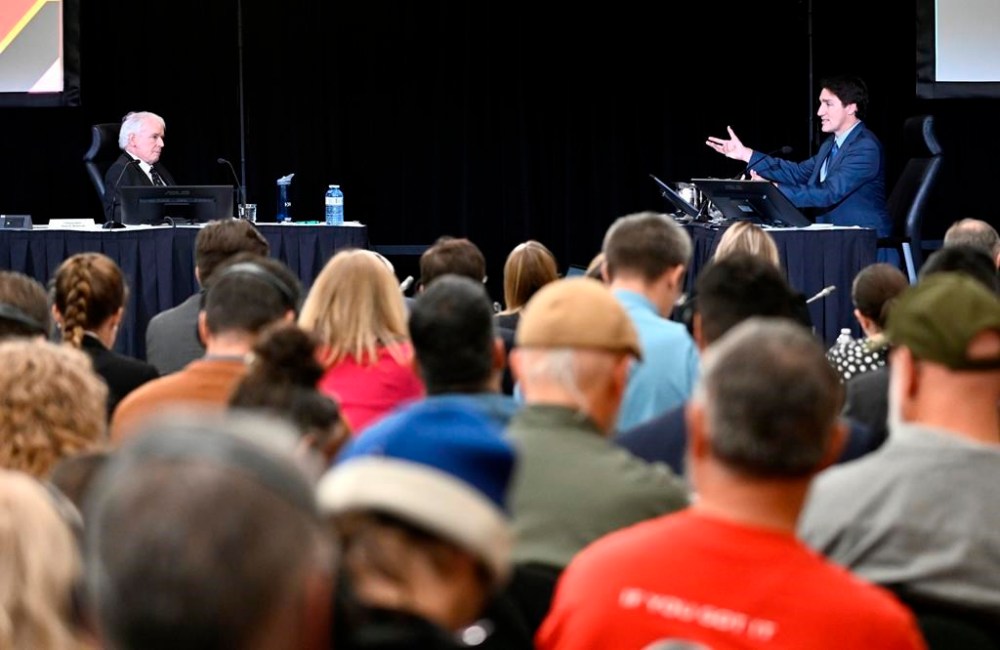
Justice Paul Rouleau listens as Prime Minister Justin Trudeau testifies at the Public Order Emergency Commission, in Ottawa, on Friday, Nov. 25, 2022. Trudeau was the last witness to testify at the public inquiry into his Liberal government's decision to invoke the Emergencies Act to quell protests in Ottawa and at several Canada-U.S. border crossings last winter. THE CANADIAN PRESS/Justin Tang

In his own words, here is what Trudeau told the Public Order Emergency Commission about his thinking in that moment.

“It was a big thing, not a small thing, to have the head of the public service formally recommend the invocation of the Emergencies Act and the declaration of a public order emergency. It’s not something that had ever been done in Canada before. It was certainly not something that we undertook to do lightly. And as a prime minister, I get to sign off and agree with these notes, or in some cases, disagree with them. And that was a moment that I took with the weight of the decision I was about to take.

“And I reflected briefly on first of all, the reassurance that it gave me that the entire system, all the inputs in the system had come up to the clerk of the Privy Council — the top public servant in Canada; impartial, professional public service — making the recommendation to move forward on this was essential to me.

“But I also reflected on OK, what if I don’t sign it? What if I say, ‘OK, we now have advice from the professional public service to invoke a public order or emergency.’ And I decide, you know what? Let’s give it a few days where the professional public service had made a determination that the thresholds were met, that the use of it was appropriate and responsible and the measures were the right ones that we were going to put in it. And I said, ‘No, you know what? Let’s wait and see another few days, another week, to see if we really need to do it.’

“First of all, what if the worst had happened in those following days? What if someone had gotten hurt? What if a police officer had been put in a hospital? What if, when I had an opportunity to do something, I had waited and we had the unthinkable happen over the coming days, even though there was all this warning that it was possibly coming? I would have worn that in a way that we would certainly be talking about in a forum such as this.

“But more than that, the responsibility of a prime minister is to make the tough calls and keep people safe. And this was a moment where the collective advice of cabinet, of the public service and my own inclination was that this was a moment to do something that we needed to do to keep Canadians safe. And knowing full well that this was an inevitable consequence of me signing ‘I agree’ on this note, I was very comfortable that we were at a moment where this was the right thing to do. And we did it.

“And it is a certain amount of comfort that first of all, the system is working as it should, that people who are defending civil liberties are able to say, ‘You really should be careful about doing this. Maybe you shouldn’t have done it,’ that we have a system pushing back on this, because it’s a big thing, not a small thing, to do this.

“But that also we were able to solve the situation with it, that there was no loss of life. There was no serious violence, that we were able to get neighbourhoods back under control, border services opened and there haven’t been a recurrence of these kinds of illegal occupations since that.

“I’m not going to pretend that it’s the only thing that could have done it. But it did do it. And that colours the conversations we’re having now with the fact that these could be very different conversations.

“And I am absolutely, absolutely serene and confident that I made the right choice in agreeing with the invocation.”

This report by The Canadian Press was first published Nov. 25, 2022.

Report Error Submit a Tip

More Stories

0 minute read

Severe weather preparedness not one-time exercise for businesses

Abiola Odutola 3 minute read Monday, Sep. 21, 2026

BRANDON — Local business owners should prepare for the possibility that severe weather could disrupt their operations — even when their facilities escape major damage, a climate resilience expert told the Brandon Chamber of Commerce last week.

Emilia Cameron of the Institute for Catastrophic Loss Reduction told attendees at a September luncheon the recent flooding and heavy rainfall across southern Manitoba affected several businesses.

“Businesses need to prepare not just for direct damages to buildings, but for wide disruptions that can prevent them from operating,” she said. “Road closures, power outages, damaged infrastructure, internet failures and employees being unable to reach work can all bring operations to a standstill.”

Supply chains can also be affected when suppliers cannot reach their customers, she said.

Province announces free daycare for low-income families

Nicole Buffie 3 minute read Preview

Province announces free daycare for low-income families

Nicole Buffie 3 minute read Wednesday, Sep. 2, 2026

Eligible parents will have their child-care fees waived come Sept. 13.

The province announced Wednesday child care would be free for about 4,100 children from 3,000 families as part of a budget commitment to eliminate the $2-per-day fee for low-income families.

“This announcement that we’re making here today is going to be hugely, hugely impactful for the families that rely on this important, important service of child care,” Education and Early Childhood Learning Minister Tracy Schmidt said at a news conference at Panda Bear Day Care.

She said the program would save families between $520 and $2,600 per child per year.

Read
Wednesday, Sep. 2, 2026

From footnote to martyr: execution altered Scott’s place in history

Tom Brodbeck 5 minute read Preview

From footnote to martyr: execution altered Scott’s place in history

Tom Brodbeck 5 minute read Friday, Feb. 14, 2020

When Thomas Scott was marched outside the walls of Upper Fort Garry and executed by firing squad, it forever changed how history would treat Louis Riel and the Red River Resistance. The killing of Scott, whether a misguided error by Riel or an unavoidable step to prevent further bloodshed, would turn out to be one of the most pivotal events of the resistance.

Only a month after the Irish-born Canadian was condemned to death in March 1870, Riel opponents in Ontario used Scott’s execution to whip up anti-Métis sentiment in an effort to sabotage negotiations between Ottawa and the Red River Settlement. It nearly worked. Two of three Red River delegates sent to Ottawa to negotiate the terms of Manitoba’s entry into confederation were arrested on arrival (but later released) for Scott’s death. At the same time, Prime Minister John A. Macdonald was under increasing political pressure to send military troops to quell the resistance in Red River, rather than engage in peaceful negotiations.

Scott’s death didn’t just complicate matters for the Red River delegates. It undermined their efforts to bargain with Ottawa.

Scott was tried and convicted by a “military council” on March 3 for rebelling against the provisional government and attacking a Métis guard at Upper Fort Garry, where he and other political prisoners were held. The trial wasn’t conducted under normal court rules, even by 1870 Red River standards. Scott had no defence counsel and wasn’t present for much of the proceedings, which were conducted in French (a language he didn’t understand). Riel, one of the chief witnesses in the case, had to act as translator. The military council was not unanimous in its decision to sentence Scott to death. Some felt the penalty was too harsh.

Read
Friday, Feb. 14, 2020

Finding new markets — across an ocean

Editorial 4 minute read Preview

Finding new markets — across an ocean

Editorial 4 minute read Monday, Sep. 21, 2026

Prime Minister Mark Carney’s barnstorming trade mission to the European Union has created a ton of discussion and debate about cultivating new trade opportunities for Canadian exporters. What is hasn’t created, however, is very much certainty.

At first blush, opening up new trade relationships with the EU seems like a no-brainer as Canada is confronted with an increasing number of tariffs and restrictions from an increasingly unhinged Trump White House. And the possibilities are tantalizing; the EU and United Kingdom represent a market of more than 519 million people, which is larger than North America.

Canada is one of few nations to push back against Trump’s irrational trade demands. The result is an almost daily escalation of punitive measures and threatening rhetoric. Our trade relationship with the U.S. has been deeply wounded; in short order, it may become fatally so.

However, it is our courage in the face of American trade threats that has made us a coveted trading partner for many European nations. So much so that the EU created an entirely new category of “associate member” to give Canada an incentive to strengthen trading relationships.

Read
Monday, Sep. 21, 2026

Changing Transit Plus drivers’ status a ‘ridiculous anti-worker provision,’ councillor says

Joyanne Pursaga 5 minute read Preview

Changing Transit Plus drivers’ status a ‘ridiculous anti-worker provision,’ councillor says

Joyanne Pursaga 5 minute read Yesterday at 5:32 PM CDT

Some fear a change of status for Winnipeg Transit Plus drivers could allow them to be paid less and receive fewer benefits.

However, council’s public works chairwoman said pay protections are now embedded in contracts and the change is needed to attract enough workers.

Three years ago, city council passed a motion that required Winnipeg Transit Plus drivers to be employees of companies the city hires to provide accessible transit service.

Coun. Brian Mayes said that clause prevents “sub-minimum wages” from being permitted for subcontracted drivers and ensures drivers can access multiple benefits.

Read
Yesterday at 5:32 PM CDT