

Finding new markets — across an ocean
Advertisement
Read this article for free:
or
Already have an account? Log in here »
To continue reading, please subscribe:

Digital Subscription
One year of digital access for only $205*
- Enjoy unlimited reading on winnipegfreepress.com
- Read the E-Edition, our digital replica newspaper
- Access News Break, our award-winning app
- Play interactive puzzles
*First annual payment billed as $205.00 + GST for one year. This annual subscription will automatically renew at $233.00 + GST every 52 weeks (10% off the regular annual price of $259.35). Offer available to new and qualified returning subscribers only. Cancel any time.
To continue reading, please subscribe:
Add Free Press access to your Brandon Sun subscription for only an additional
$1 for the first 4 weeks*
- Enjoy unlimited reading on winnipegfreepress.com
- Read the E-Edition, our digital replica newspaper
- Access News Break, our award-winning app
- Play interactive puzzles
*Your next Brandon Sun subscription payment will increase by $1.00 and you will be charged $17.95 plus GST for four weeks. After four weeks, your payment will increase to $24.95 plus GST every four weeks.
Read unlimited articles for free today:
or
Already have an account? Log in here »
Prime Minister Mark Carney’s barnstorming trade mission to the European Union has created a ton of discussion and debate about cultivating new trade opportunities for Canadian exporters. What is hasn’t created, however, is very much certainty.
At first blush, opening up new trade relationships with the EU seems like a no-brainer as Canada is confronted with an increasing number of tariffs and restrictions from an increasingly unhinged Trump White House. And the possibilities are tantalizing; the EU and United Kingdom represent a market of more than 519 million people, which is larger than North America.
Canada is one of few nations to push back against Trump’s irrational trade demands. The result is an almost daily escalation of punitive measures and threatening rhetoric. Our trade relationship with the U.S. has been deeply wounded; in short order, it may become fatally so.
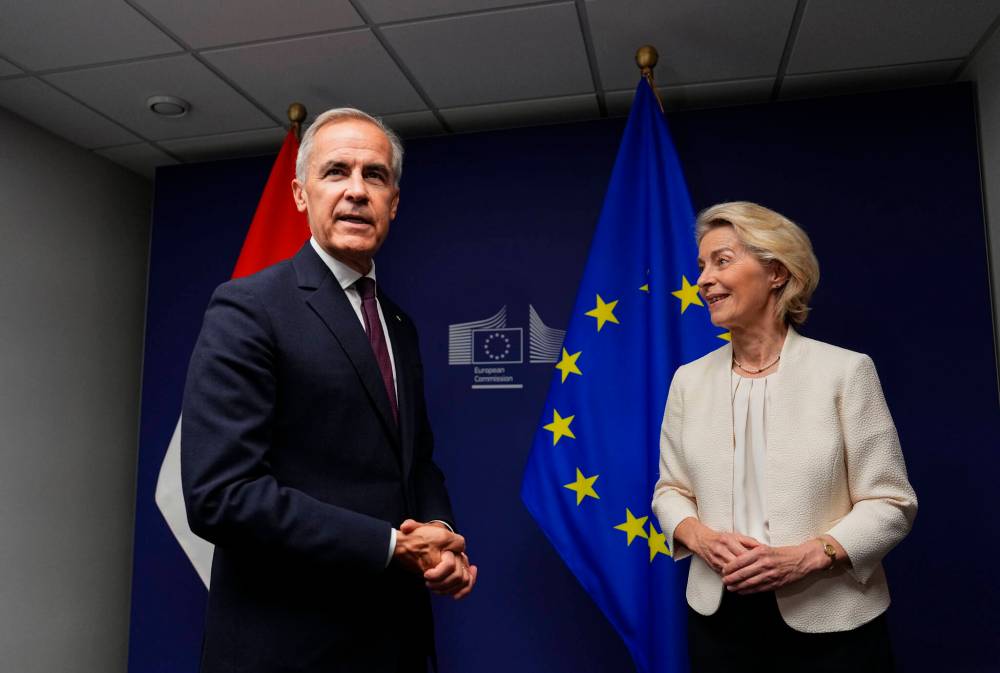
The Canadian Press
Prime Minister Mark Carney
However, it is our courage in the face of American trade threats that has made us a coveted trading partner for many European nations. So much so that the EU created an entirely new category of “associate member” to give Canada an incentive to strengthen trading relationships.
The terms and benefits of an associate membership are not entirely known, although it reportedly will not require Canada to adopt legal frameworks or currency, as is the case for member nations in Continental Europe. Still, it is a beckoning call to export more goods and services.
This new category of EU membership is the byproduct of Carney’s exhaustive diplomatic efforts. For much of the summer, the prime minister has taken meetings with state leaders across Europe and delivered a speech this week to the EU in which he promoted a new trading alliance that would help Canada increase trade to Europe, which in turn would help us secure our sovereignty amid the “ferocious storm” sparked by the U.S. threats.
However, a number of hurdles lay between Canadian exporters and increased EU trade.
The Comprehensive Economic and Trade Agreement (CETA) between Canada and the EU remains, a decade after its creation, ratified by only 17 of the 27 European member nations. The gap in ratification means that Canadian companies selling into the 10 non-ratified nations do not have the overarching protections offered in CETA, which includes things like a dispute mechanism in the event of tariffs.
Perhaps because not all EU nations have ratified the deal, Canadian exporters seem unaware that they can take advantage of favorable trade conditions with the ones that have ratified. Finance Canada has reported that one-third of all eligible Canadian exports entered the EU without claiming the opportunity to do so tariff-free.
Replacing American customers with European customers also means more complex logistics and much heavier transportation costs. Language and culture, which is more diverse in the EU, is also a consideration.

Still, diversifying Canada’s trading partners is essential if we are to weather the next two years of Trump tariffs and other non-trade threats. Canada currently has a nearly $50 billion annual trade deficit with the EU and the consensus is that even if the EU market alone cannot make up lost business with the U.S. amid the trade war, there is tremendous room for growth.
How big a deal is this, really? If U.S. President Donald Trump’s displeasure is a metric by which we can measure the effectiveness of Carney’s efforts, then the associate EU membership is producing the desired results.
When asked this week about Canada’s blossoming relationship with the EU, Trump said he might consider it a “hostile act” and respond with even higher tariffs on European goods and services.
Given our historical relationship with the U.S., and close geographic proximity, the EU can never completely restore the losses experienced by Canadian exporters.
However, there is just enough room to grow to make us a little less likely to give up the fight with Trump.