Manitoba’s top doctor to field questions as respiratory virus numbers climb

Advertisement

Advertise with us

WINNIPEG - Manitoba's chief public health officer is scheduled to take part in a telephone town hall Tuesday night as the number of children with respiratory viruses climbs.

Read this article for free:


By clicking the button above, an account will be created and you will begin to receive some of our recommended newsletters. You may opt out of any newsletter by visiting your Email and Communication Preferences page or by clicking "unsubscribe" at the bottom of any email.

or

Already have an account? Log in here »

To continue reading, please subscribe:

Digital Subscription

One year of digital access for only $1.44 a week*

  • Enjoy unlimited reading on winnipegfreepress.com
  • Read the E-Edition, our digital replica newspaper
  • Access News Break, our award-winning app
  • Play interactive puzzles

*Billed as $5.77 plus GST every four weeks. After 52 weeks, price increases to the regular rate of $19.95 plus GST every four weeks. Offer available to new and qualified returning subscribers only. Cancel any time.

To continue reading, please subscribe:

Add Free Press access to your Brandon Sun subscription for only an additional

$1 for the first 4 weeks*

  • Enjoy unlimited reading on winnipegfreepress.com
  • Read the E-Edition, our digital replica newspaper
  • Access News Break, our award-winning app
  • Play interactive puzzles
Start now

*Your next Brandon Sun subscription payment will increase by $1.00 and you will be charged $17.95 plus GST for four weeks. After four weeks, your payment will increase to $24.95 plus GST every four weeks.

Hey there, time traveller!
This article was published 21/11/2022 (1440 days ago), so information in it may no longer be current.

WINNIPEG – Manitoba’s chief public health officer is scheduled to take part in a telephone town hall Tuesday night as the number of children with respiratory viruses climbs.

With hospital resources being strained and school absences rising, Dr. Brent Roussin said he hopes to answer parents’ questions and deliver a plea to take preventive measures.

“We normally see these viruses throughout the respiratory virus season, but we sort of got hit with them all at once,” Roussin said Monday.
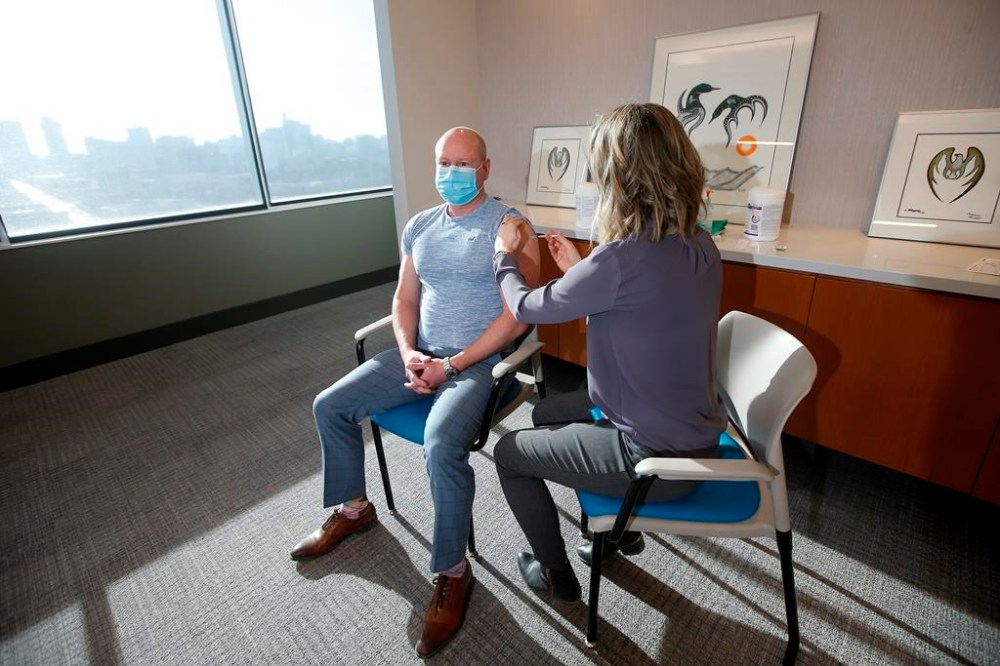
Dr. Brent Roussin, Manitoba's chief public health officer, receives the AstraZeneca COVID-19 vaccine from Dr. Joss Reimer, medical lead on the Manitoba Vaccine Implementation Task Force, at a clinic in Winnipeg, Friday, March 19, 2021. THE CANADIAN PRESS/John Woods

The province is dealing with COVID-19, the seasonal flu and respiratory syncytial virus, or RSV. The latter two occur every year, but have hit hard, early and simultaneously this autumn.

Doctors Manitoba, which represents some 4,000 physicians and medical students, has warned that hospitals are at risk of being overwhelmed in the near future.

The problem is especially noticeable among children. The children’s hospital in Winnipeg is already struggling to keep up with a surge in demand.

The Louis Riel School Division, one of several in the city, has seen total student absences, which include any reason for missing school, roughly triple since the start of the school year. Almost one in five students was absent Monday.

Roussin will be joined in the town hall by Dr. Elisabete Doyle, medical director and section head of pediatric emergency medicine at the children’s hospital.

They will tell parents about where kids can be taken if they fall ill, Roussin said, including medical clinics, emergency departments and urgent care centres — an option for any incident that is not life-threatening.

The town hall will also deal with preventive measures such as handwashing, getting flu and COVID-19 vaccines, and wearing a mask in indoor places, especially those that are crowded or poorly ventilated.

Roussin said there are no current plans to make mask use mandatory in indoor public places, as was done earlier in the COVID-19 pandemic.

“We don’t have any limits on, say, private gatherings so masks in public could only have so much effect when we’re not going to be able to mandate it in private settings and all the interaction that goes on,” Roussin said.

“We’re just not wanting to mandate it at this point. We don’t think that that’s going to be a necessary approach.”

Parents who want to take part in the town hall are being asked to provide their contact information on the government’s public engagement website (https://engagemb.ca/caregiver-town-hall/survey_tools/registration )

This report by The Canadian Press was first published Nov. 21, 2022.
Report Error Submit a Tip

More Stories

The long and winding road

Editorial 4 minute read Preview

The long and winding road

Editorial 4 minute read 2:01 AM CDT

As theatre goes, it sent a strong message.

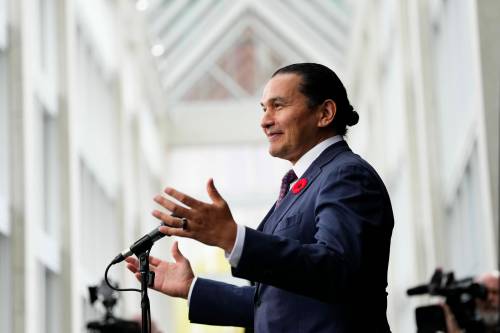
Manitoba Premier Wab Kinew, standing in front of microphones and television cameras, holding up his Indigenous status card and saying that he didn’t feel Canada should have “a race-based form of identification in this country, but that is a reality,” adding that it was time to abolish the Indian Act.

“I think it’s time to abolish the Indian Act, get rid of the Indian Act, move past the Indian Act, and it needs to be done with First Nations people and First Nations governments, of course. I think it’s long overdue that we have a relationship with Indigenous Peoples in Canada that reflects who we are as Canadians today,” he said.

The Indian Act — the name alone suggests how out-dated and out of place the law has become. Originally dating from 1876, the law was put in place to “amend and consolidate the laws respecting Indians” and gave the Minister of the Interior the responsibility to “control and management of the reserves, lands, moneys and property of Indians in Canada.”

Read
2:01 AM CDT

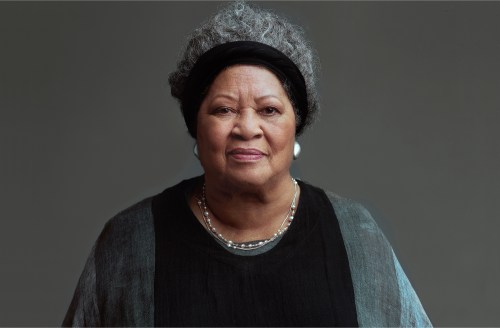
Nobel laureate Toni Morrison dead at 88

Hillel Italie, The Associated Press 18 minute read Preview

Nobel laureate Toni Morrison dead at 88

Hillel Italie, The Associated Press 18 minute read Tuesday, Aug. 6, 2019

NEW YORK - Nobel laureate Toni Morrison, a pioneer and reigning giant of modern literature whose imaginative power in "Beloved," ''Song of Solomon" and other works transformed American letters by dramatizing the pursuit of freedom within the boundaries of race, has died at age 88.

Publisher Alfred A. Knopf announced that Morrison died Monday night at Montefiore Medical Center in New York. Morrison's family issued a statement through Knopf saying she died after a brief illness.

"Toni Morrison passed away peacefully last night surrounded by family and friends," the family announced. "The consummate writer who treasured the written word, whether her own, her students or others, she read voraciously and was most at home when writing."

Few authors rose in such rapid, spectacular style. She was nearly 40 when her first novel, "The Bluest Eye," was published. By her early 60s, after just six novels, she had become the first black woman to receive the Nobel literature prize, praised in 1993 by the Swedish academy for her "visionary force" and for her delving into "language itself, a language she wants to liberate" from categories of black and white. In 2012, Barack Obama awarded her a Presidential Medal of Freedom.

Read
Tuesday, Aug. 6, 2019

A little toponder, a lot to celebrate

Erna Buffie 5 minute read 2:01 AM CDT

Well, another civic election season has come and gone, and I have to say it was a doozy. The most surprising event was the steady climb in support for young mayoral candidate Noah Redden, who started out with just four per cent public support in September but had reached a solid 14 per cent support in October.

On election day, Redden nearly came in second, less than one percentage point behind Kevin Klein, an experienced politician.

Indeed, the 27-year-old’s accomplishment was nothing short of astonishing. Particularly given that his shoestring campaign was given very little coverage — largely, according to one pundit, because he didn’t send out any press releases.

This when Redden’s unwritten press releases were there for everyone to see on Instagram, as he popped up in locations across the city, posting videos about what he hoped to achieve as mayor.

Newspaper websites display fewer stories, more curation

5 minute read Tuesday, Feb. 10, 2026

A city subcommittee was provided with a routine update on the status of an ongoing administrative process Thursday, in accordance with standard reporting procedures.

Human rights museum responds to reopening backlash

Julia-Simone Rutgers 4 minute read Preview

Human rights museum responds to reopening backlash

Julia-Simone Rutgers 4 minute read Thursday, Jul. 29, 2021

The Canadian Museum for Human Rights reopened to fully vaccinated members of the public this week, drawing cries of discrimination from those who have chosen not to get vaccinated against COVID-19.

While the some of the backlash has been “disturbing,” museum CEO Isha Khan said the conflict has opened room for a conversation about human rights during the pandemic.

“We made the decision to open in compliance with that law, really because we’re a public institution and we saw it as our responsibility to open as soon as we could to the public — within the restrictions as they currently are,” Khan said Thursday.

“But it’s really important to us, as the Canadian Museum for Human Rights we have a mandate for human rights education, that we’re trying to ground the conversation in human rights principles.”

Read
Thursday, Jul. 29, 2021

Court ruling concludes Canadian Wheat Board saga

Laura Rance-Unger 4 minute read Preview

Court ruling concludes Canadian Wheat Board saga

Laura Rance-Unger 4 minute read 2:01 AM CDT

It remains to be seen whether the recent court ruling in a lawsuit filed after Canadian Wheat Board’s dissolution in 2012 puts the whole debate to rest, as some no doubt hope.

But either way, the dust has settled on the post-CWB world. The sun still rises and a new generation of farmers on the land only knows by name an institution that for generations influenced every aspect of Prairie grain farming.

The first Rural Revival column I wrote for this newspaper more than 30 years ago was about a thousand farmers from Western Canada demonstrating in support of the Wheat Board. It was in the aftermath of the Western Grain Marketing Panel report, one of several efforts that eventually included a plebiscite to help the federal government decide what to do about a vocal minority of farmers who wanted marketing “freedom.”

The polls at the time suggested about two-thirds of farmers were comfortable enough with the single-desk system for food wheat and barley to keep it around. It served as a counterbalance to canola, which they sold on the open market. They essentially had a dual market.

Read
2:01 AM CDT