Parliamentary budget officer says climate change already costing economy billions

Advertisement

Advertise with us

OTTAWA - The effects of climate change bit a $20-billion hole out of Canada's economy last year, parliamentary budget officer Yves Giroux said Tuesday.

Read this article for free:


By clicking the button above, an account will be created and you will begin to receive some of our recommended newsletters. You may opt out of any newsletter by visiting your Email and Communication Preferences page or by clicking "unsubscribe" at the bottom of any email.

or

Already have an account? Log in here »

To continue reading, please subscribe:

Digital Subscription

One year of digital access for only $1.44 a week*

  • Enjoy unlimited reading on winnipegfreepress.com
  • Read the E-Edition, our digital replica newspaper
  • Access News Break, our award-winning app
  • Play interactive puzzles

*Billed as $5.77 plus GST every four weeks. After 52 weeks, price increases to the regular rate of $19.95 plus GST every four weeks. Offer available to new and qualified returning subscribers only. Cancel any time.

To continue reading, please subscribe:

Add Free Press access to your Brandon Sun subscription for only an additional

$1 for the first 4 weeks*

  • Enjoy unlimited reading on winnipegfreepress.com
  • Read the E-Edition, our digital replica newspaper
  • Access News Break, our award-winning app
  • Play interactive puzzles
Start now

*Your next Brandon Sun subscription payment will increase by $1.00 and you will be charged $17.95 plus GST for four weeks. After four weeks, your payment will increase to $24.95 plus GST every four weeks.

Hey there, time traveller!
This article was published 08/11/2022 (1454 days ago), so information in it may no longer be current.

OTTAWA – The effects of climate change bit a $20-billion hole out of Canada’s economy last year, parliamentary budget officer Yves Giroux said Tuesday.

His office issued a new analysis looking at the economic impacts of climate change over the next 80 years, which comes as the annual United Nations climate conference, also known as COP27, is kicking into high gear in Egypt.

Environment Minister Steven Guilbeault, who is in Sharm El-Sheikh for the two-week gathering, said this meeting is supposed to be the “implementation COP,” where promises made around the world to cut greenhouse-gas emissions become more than just talking points.
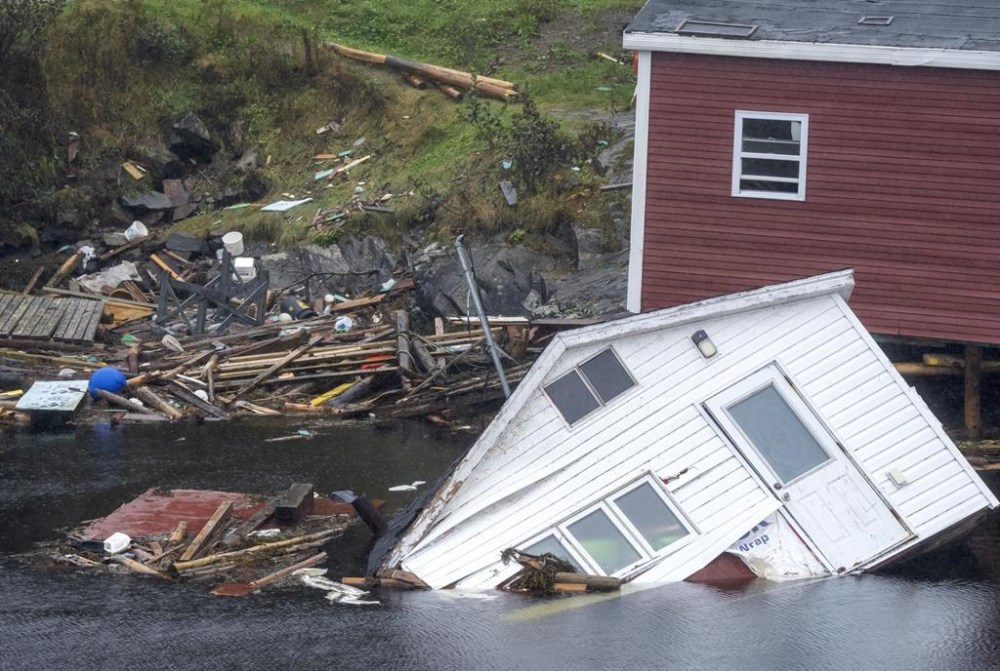
Buildings sit in the water along the shore following hurricane Fiona in Rose Blanche-Harbour Le Cou, N.L. on Tuesday September 27, 2022. The parliamentary budget watchdog says climate change has already begun to hurt the Canadian economy. THE CANADIAN PRESS/Frank Gunn

“We are in the make-or-break decade in our effort to stay below 1.5 degrees Celsius, to keep the planet livable,” Guilbeault said in an interview with reporters by phone on Tuesday.

The 2015 Paris climate accord saw every country agree to reduce emissions enough to limit global warming to as close as possible to 1.5 C above pre-industrial times. Over 1.5 C, the effects of climate change begin to mount exponentially. Above 2 C, many are considered irreversible.

Currently, the average global temperature is 1.2 C above pre-industrial levels. A UN report last month said the climate policies in place now would see that grow to 2.8 C by 2100.

If the policies that have been promised but not yet implemented are added, that will come down to 2.4 C to 2.6 C, the UN report said. In Canada those promises would include a cap on emissions from oil and gas production, which is in development now.

Giroux’s report concludes that even if all those promises are fully implemented, Canada’s GDP is going to grow more slowly than if climate change didn’t exist.

And in fact it already did, Giroux said. In 2021, the PBO estimates that the effects of extreme weather caused Canada’s GDP to fall to 0.8 per cent lower than what it would have been without climate change.

Tim Scholz, a PBO analyst who co-authored the report, said that works out to roughly between $20 billion and $25 billion less on the reported GDP of $2.5 trillion in 2021.

The economic hits from climate change can include reduced farm outputs from drought or extreme precipitation, lowered productivity for outdoor workers and higher energy bills due to hotter summers.

It can also mean lost work hours when hurricanes, tornadoes and other major storms damage power grids or destroy buildings, and impacts on tourism, such as shorter ski seasons.

In a scenario where all promised climate policies are fully enacted, Canada’s GDP is expected to be 0.08 percentage points lower every year than in a world without climate change.

By 2050, that amounts to a GDP reduced by 2.4 per cent compared to no climate change, and by 2100, by 5.8 per cent.

In a scenario where only policies already implemented are in place, the effects of climate change could grow to 2.5 per cent by 2050, and 6.6 per cent by 2100.

Without clear estimates of what Canada’s GDP will be in those years, Giroux said quantifying the amount is difficult. But 5.8 per cent of Canada’s current economy is about $145 billion and 6.6 per cent is $165 billion.

Giroux is clear that this analysis is the first attempt to quantify the economic impact of climate change and that a variety of factors could influence the final outcome.

That includes how much and how well Canada does to adapt to extreme weather. Investments to strengthen power grids against high winds, make homes and businesses more resilient to floods and fires, irrigate or improve drainage of farm land, and reinforce coastal properties against the growing risk of hurricanes and storm surge could all help keep Canada’s economy going even as the weather changes.

Climate change could also bring some positive economic growth, the report notes, such as the possibility of longer growing seasons for farms.

The report doesn’t account for the economic impacts of trade disruptions that may be caused as the changing climate affects the economies of some of Canada’s big trading partners.

The COP27 meeting in Egypt is wrestling with a lot of that this week, amid dire warnings from UN Secretary-General António Guterres.

“We are in the fight of our lives and we are losing,” he said in his opening speech Monday.

Guterres said countries need to make a pact to do everything they can to lower greenhouse gas emissions before 2030, and that rich countries, including Canada, need to step up to help poorer countries transition to renewable energy.

Guilbeault said he hadn’t seen the PBO report but he thinks Canadians understand the costs because almost everyone has been directly impacted by climate change themselves, including increasingly strong post-tropical storms like Fiona.

“I don’t think we need to convince Canadians that climate is already having an impact in Canada, and that it’s costing Canadians billions of dollars,” he said. “Go and talk to people in Atlantic Canada right now and it’s a very, it’s a very quick conversation. They get it.”

This report by The Canadian Press was first published Nov. 8, 2022.

Report Error Submit a Tip

More Stories

SNC planned U.S. move if no deal: documents

Jordan Press and Christopher Reynolds, The Canadian Press 5 minute read Preview

SNC planned U.S. move if no deal: documents

Jordan Press and Christopher Reynolds, The Canadian Press 5 minute read Thursday, Mar. 28, 2019

OTTAWA - SNC-Lavalin warned federal prosecutors last fall about a possible plan to split the company in two, move its offices to the United States and eliminate its Canadian workforce if it didn't get a deal to avoid criminal prosecution, newly obtained documents show.

The documents, part of a PowerPoint presentation obtained by The Canadian Press, describe something called "Plan B" — what Montreal-based SNC might have to do if it can't convince the government to grant a so-called remediation agreement to avoid criminal proceedings in a fraud and corruption case related to projects in Libya.

Under that plan, SNC would move its Montreal headquarters and corporate offices in Ontario and Quebec to the U.S. within a year, cutting its workforce to just 3,500 from 8,717, before eventually winding up its Canadian operations.

“The government of Canada needs to weigh the public interest impact of the prosecution of SNC-Lavalin," the presentation reads.

Read
Thursday, Mar. 28, 2019

Has the political wind changed?

Gwynne Dyer 5 minute read 2:01 AM CDT

It has been quite a week. First we had “Lula” – Luiz Inácio da Silva (as nobody but his mother ever called him) – defying everybody’s expectations. After winding up two million votes behind his challenger, Flávio Bolsonaro, in the first round of the Brazilian presidential election, he made a “miraculous” comeback in the second.

It was like a man going into a revolving door behind you and coming out in front. At the end of the first round, Lula was two million votes behind; at the end of the second round on Oct. 25 he was four million votes ahead. So how did he win a fourth term without cheating?

That’s what Bolsonaro claims he did, having fled to the United States; Trump, Flávio’s mentor, hints at the same. But Lula’s victory was not miraculous. He only learned to read when he was 10, and at 80 he still refused to have a mobile phone. His team finally made him get one and use it.

He wouldn’t do social media videos, so they created a WhatsApp channel called Lula’s Army, and made him appear on it at least daily. The channel went from zero to 10.8 million viewers in two weeks, and Lula won.

Defunding police ‘illogical step’: Pallister

Carol Sanders 6 minute read Preview

Defunding police ‘illogical step’: Pallister

Carol Sanders 6 minute read Tuesday, Jun. 9, 2020

Manitoba Premier Brian Pallister says he’s open to channelling justice funding to preventive programs, but questions whether defunding police is the best approach — warning there will always be criminals taking advantage of vulnerable people.

“I think the motivation that lies in frustrations of the actions of some police services — not necessarily here in Winnipeg exclusively, but elsewhere — is justifiable and understandable, and I get it,” Pallister said Tuesday, when asked to comment on the 30,000 signatures collected for a Justice 4 Black Lives Winnipeg petition calling for the abolition of the city police.

“But then moving to defunding police is, to me, an illogical step from that one. Don’t let your frustration lose your common sense... There’s a lot of people out there in vulnerable communities who depend on the police to protect them and make sure they’re safe from the action of criminals.”

There has been a widespread call to restructure police funding in the wake of George Floyd’s death May 25 in Minneapolis.

Read
Tuesday, Jun. 9, 2020

Provincial budget fails to chart new course

Editorial 4 minute read Preview

Provincial budget fails to chart new course

Editorial 4 minute read Wednesday, Apr. 13, 2022

If the 2022 Manitoba budget was intended to provide a lifeline for the Progressive Conservative government, it must surely be considered a failure.

Prior to the budget’s release, Premier Heather Stefanson and her government were teetering on the edge of the political abyss. Manitobans are profoundly unhappy with the government’s performance on most issues, including pandemic management. National polls show Ms. Stefanson is Canada’s least popular premier.

That political context made this budget a high-priority project for the Tories. It was, simply put, their best chance to shed the lingering burden left by former premier Brian Pallister, and rebuild the party brand under a new leader.

Unfortunately, Ms. Stefanson’s first budget remains shackled to the deeply flawed fiscal and political logic that defined the Pallister years. And no single budgetary measure embodies that failure more than the premier’s decision to continue cutting education property taxes.

Read
Wednesday, Apr. 13, 2022

The long and winding road

Editorial 4 minute read Preview

The long and winding road

Editorial 4 minute read 2:01 AM CDT

As theatre goes, it sent a strong message.

Manitoba Premier Wab Kinew, standing in front of microphones and television cameras, holding up his Indigenous status card and saying that he didn’t feel Canada should have “a race-based form of identification in this country, but that is a reality,” adding that it was time to abolish the Indian Act.

“I think it’s time to abolish the Indian Act, get rid of the Indian Act, move past the Indian Act, and it needs to be done with First Nations people and First Nations governments, of course. I think it’s long overdue that we have a relationship with Indigenous Peoples in Canada that reflects who we are as Canadians today,” he said.

The Indian Act — the name alone suggests how out-dated and out of place the law has become. Originally dating from 1876, the law was put in place to “amend and consolidate the laws respecting Indians” and gave the Minister of the Interior the responsibility to “control and management of the reserves, lands, moneys and property of Indians in Canada.”

Read
2:01 AM CDT

Teemu Selanne living the good life in southern California

Mike McIntyre 19 minute read Preview

Teemu Selanne living the good life in southern California

Mike McIntyre 19 minute read Friday, Oct. 15, 2021

LAGUNA BEACH — He likes his coffee black. His steak “medium rare plus.” And he’s an extremely generous pour, especially when it comes to a Moscow mule.

His left knee is giving him all sorts of trouble these days, he’s admittedly almost always running behind schedule and his biggest pride and joy are his four children, who keep him and his wife Sirpa hopping with their numerous athletic pursuits.

He is Teemu Selanne, the beloved Winnipeg Jets legend who, you’ll be happy to know, is still living the good life just a stone’s throw from the Pacific Ocean in this little piece of southern California paradise.

Despite being nearly eight years removed from the end of a Hall of Fame hockey career, the Finnish Flash remains a big deal around here. That was clear as we sat down earlier this week for an exclusive chat inside “Selanne’s Steak Tavern” — a high-end eatery he owns that sits along the stunning Pacific Coast Highway.

Read
Friday, Oct. 15, 2021